The story of what happened at First Church in Edgewater, N. J. — also known as “The Church on the Edge” — is not one of them. Last spring, following Easter worship, the small congregation, of which Wanda Lundy was then pastor, turned its property over to the Presbytery of the Palisades. This church did not survive.
But it’s also a story of a congregation that became intentionally multicultural; that tried new and sometimes uncomfortable things; and that never gave up hope, even after the doors closed. Some of its members still gather for Bible study, prayer, and fellowship.
“We all had this sense that, even though we’re closing, there’s something more,” Lundy said. “What we talked about every Sunday was transformation. That’s what we were called to do. The image we used was the picture of the butterfly. As transformation takes place, death occurs and life follows. … It wasn’t easy,” to close the doors. “It was very difficult especially for people whose lives had been centered in this congregation — marriages, baptisms, funerals, everything. This was their home.”
But in its final decade the small congregation continued to take risks, feeling certain that God was calling it to new forms of ministry. And Lundy thinks other Presbyterians can learn from that example of following faith into new territory whether or not the century-old congregation continued to exist.
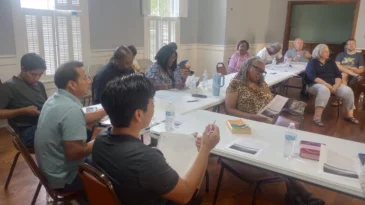
Before Lundy came to Edgewater, the congregation provided its own leadership – gathering for Bible study in members’ homes. After she arrived, the parishioners continued the practice, working slowly and deliberately through the book of Acts.
“The Bible study … was a turning point for us … praying together and studying together and arguing. It was the fuel, and we believe it was the power of the Holy Spirit that gave us the courage to do things other people didn’t believe we could do,” says Lundy.
When Lundy came to Edgewater in 1996, the community was in transition. Located not far from Manhattan, Edgewater was one of the fastest-growing towns in all of New Jersey.
What had been a predominantly Catholic and Jewish community was seeing an influx of young commuters, including African-Americans, Asians, and Spanish-speaking immigrants.
With such a transitory neighborhood, “we were constantly starting all over again,” Lundy said. “It’s very difficult to try to build a financial base when you don’t have that stability.”
The Edgewater church, hampered by a shortage of parking, worked hard to reach out — offering after-school programs in music and art, and, following the lead of nearby restaurants, valet parking for worship.
The presbytery helped the church purchase a yellow school bus used to bring children to after-school programs. On Sundays, the bus ferried patients from drug rehabilitation programs in New York City for worship – an intentional act of hospitality.
Shortly after the Sept. 11 attacks, three men walked into the church one night during Bible study and said, “We want to learn what it means to be a Christian.” They were Muslims curious about Christianity, and for two years they came to read the Bible with the Presbyterians.
Now, the church is closed – although Lundy, who teaches at New York Theological Seminary, prefers to say the congregation was “dissolved” or “transformed.” She is sure “there’s more to come” for Christian witness in that community — and thinks Presbyterians in struggling congregations in other places could learn from her congregation’s example of taking risks and following where God might lead.
“We trust God enough to say, ‘I surrender. I will allow you to transform me, no matter what the outcome.’ Would God give us a stone or something that would hurt us? Absolutely not. For us to be willing to let go and see what God is going to do would really be a testament to the faith of the Presbyterian Church (U.S.A.).”