The decades-long membership decline in the Presbyterian Church (U.S.A.) continued in 2025, with losses in both members and congregations. But the drop in membership was significantly smaller than in any year in the past decade.

Quoting a report prepared for GA227 commissioners and advisory delegates by Manuel D. Silva-Esterrich, manager for Call Process Support and Statistics, and Sean Payne, manager of Research Service, Stated Clerk/Executive Director Jihyun Oh reported during the denomination’s 227th General Assembly in Milwaukee that the total reported membership for 2025 was 1,019,003.
“In 2025, there were 8,304 congregations, 128 fewer than in 2024, a difference of -1.5%,” she said. “This rate of decrease is close to decreases in recent years.”
“The net decrease came almost entirely from dissolutions, which rose to 127,” she said. “There were 11 newly organized congregations and 12 dismissed to other denominations.”
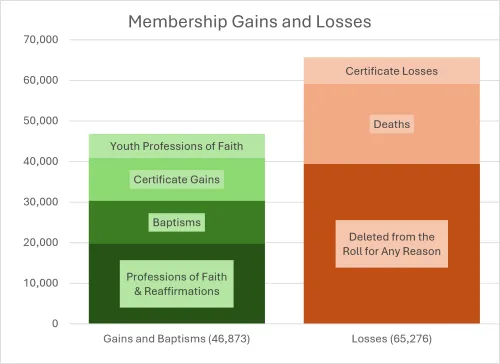
Total membership dropped by 26,845, a 2.6% decline compared with declines of 4% or more in recent years.
Like other mainline denominations, the PC(USA) has experienced decades of decline, resulting in a roughly 39% decrease from the 3.1 million members recorded when the northern and southern Presbyterian denominations reunited in 1983. Although a Pew Research Center report last year suggested those declines may be slowing. Denominational leaders had expected the PC(USA) to drop below 1 million members in this statistical report.
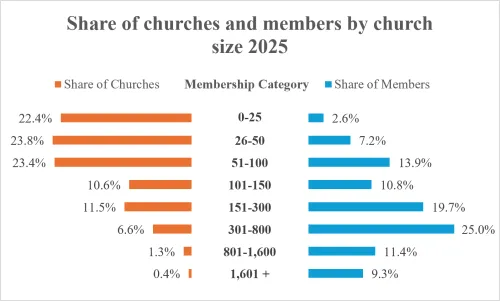
The distribution of members among the denomination’s congregations continues to show that small congregations make up the bulk of churches, but most Presbyterians belong to larger congregations. The median congregational size is 53 members, meaning half of churches are larger, and half are smaller.
Only 8% of congregations – accounting for 46% of membership – have more than 300 members, while 70% have fewer than 100 members, accounting for 24% of membership.
Other statistics include:
- Total reported receipts fell 4.2% to $3.4 billion.
- The average total receipts per member were $3,313, essentially level with the giving per member in 2024.
- Church expenditures fell 22.6% to $2.73 billion.
- 59.1% of members identify as women and 40.7% as men.
- Non-binary/genderqueer people make up 0.2% of the denomination.
- The racial and ethnic breakdown was 3.5% Asian/Pacific Islander/South Asian; 4.8% Black/African American/African; 1.8% Hispanic/Latinx; 0.3% Middle Eastern/North African; Native/Indigenous are each 0.3%; 1.6% are reported as multiracial; and 87.7% are White.
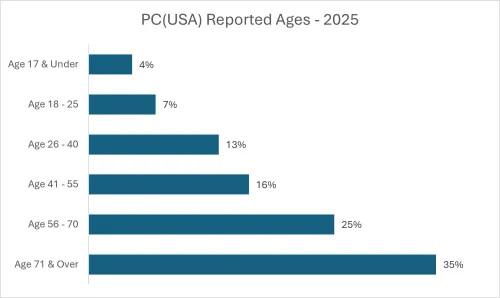
- The age breakdown was: over 70, 35%; 56-70, 25%; 41-55, 16%; 26-40, 13%; 18-25, 7%; 17 and under, 4%.