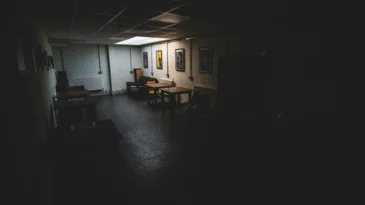
To me, the stage in the church Fellowship Hall has always been a special place. It showcased my debut in theater in great productions like “It’s Cool in the Furnace, Man!” which might also be called “How to teach 4th graders how to pronounce Abednego.” And, it was on the Fellowship Hall stage that I fully became the character Johnny, the sour older brother in the prodigal son musical, “A Barbecue for Ben.” I stomped my hi-top Reeboks as my awkward youth choir counterparts sang, “He’s mad as a hornet in a sycamore tree!” And on that stage, a newly painted wooden whale blurped out its song in the gripping production of “Oh Jonah!” Tears flowed. Parents beamed. If the local high school football game was Friday night lights, the youth musical at First Presbyterian was Sunday night lights.
The stage in the Fellowship Hall. Children gravitate toward it because it gives them a taste of fame while making them taller, a powerful combo. And to some extent, it houses the memories of a church that, for a time, was the only show in town, before children’s theater and youth sports gave parents countless other arenas in which to cheer for their children.
However, in many churches, the stage has become a storage place. Boxes of who knows what and a company of old tables do a tired dance to the groans of the staff and property committee. The families who remain in the church are too busy to be part of youth musicals. So, imagine my surprise when I saw a church that had repurposed its stage altogether in the midst of a crisis.
Our youth group ventured up to the Jersey Shore for a summer mission trip for Hurricane Sandy relief. Our final night, we stayed in Point Pleasant Presbyterian Church, located in the area hardest hit by Superstorm Sandy. Houses along the shore just a few blocks from its historic sanctuary were reduced to matchstick rubble or were tossed about by storm surge like children’s toys. And in the midst of a crisis affecting their community, the church offered itself as a Volunteer Village, a place where people from all over the country could stay as they came to “restore the shore.”
What had been meeting rooms at the end of the Fellowship Hall became dormitories, thirty-six bunk beds replacing what I’d bet were old tables. The kitchen was stocked with fresh milk, cereal and other sustenance for volunteers. And on that precious Fellowship Hall stage were newly constructed showers, with wood frames, pipes, shower stalls, materials of permanence, materials that communicated a mission shift that would not be easily undone.
I found myself marveling not so much that a congregation would reach out to its community in a time of great need, especially when its community found itself in the national spotlight. What struck me most was how the church made the most of a crisis.
Despite its ominous associations, crisis comes from the Greek word krino, meaning “to decide, to judge.” A crisis is a decision point. Installing somewhat permanent showers on a Fellowship Hall stage as opposed to allowing it to remain a collection of boxes represents a mission-minded decision. It represents a judgment about who the church will be in the community and in the world. Someone in a committee meeting in that church had to have the courage to say, “I know that VBS or the local jazz ensemble may use the stage once and a while, I know its not something other churches have done, I know its going to take a lot of flexibility, I know its not cheap or temporary, but this is where our church is called to be.” As the saying goes, “Don’t waste a crisis.”
What happened on that stage in the midst of a particular crisis can be a guide for how a church responds to any crisis, be it tragedy in the neighborhood, the departure of a pastor, the demise of a church budget, or the steady decline of a denomination. The question is usually the same regardless of the nature of the crisis. Do we choose to hear the cries of our neighbors and equip people to serve in Christ’s name, or do we continue to move around boxes of ministries from years past because its too hard to make lasting decisions? I think both decisions take tremendous energy but one results in renewal and cleansing and refreshment for an entire community.

Becca Messman is the associate pastor at Trinity Presbyterian Church in Herndon, Virginia. She leads “Lunch for the Soul” – a ministry with Hispanic day laborers. Her other passions are preaching and offering pastoral prayers, leading retreats, energizing church leaders to serve the community around them, youth and young adult ministry, and cultivating the “fear and trembling” holy journey of parenting. She lives in Arlington, Virginia with her husband Dave, her two young children, and her dog Luna.