Dig into the history of the nation’s heartland, and down nearly every country road you’ll find a common denominator: dirt.
 So when three synods in the central U.S. – the heartland of the country – decided to work together to form a common identity for ministry, they settled on the idea of using their shared natural resources (dirt) to grow food, and their produce as a means of ministry.
Three synods in the Midwest (Lakes and Prairies, Lincoln Trails and Mid-America) have joined forces in the just.good.food initiative, which is beginning to take flight, with the first harvest due this summer. The ministry stretches to about 50 congregations across 10 states with deep agricultural roots (Kansas, Missouri, Illinois, Indiana, Wisconsin, Minnesota, Iowa, Nebraska and North and South Dakota).
While the project is still in the early stages, congregations from across the region have planted gardens and are coming up with creative ways to use the food to connect with their communities and help the hungry.
With economic changes, some in those states have moved away from farming, but “it really is embedded in our DNA,” said Sarah Moore-Nokes, associate executive presbyter in Winnebago Presbytery. “You don’t have to go back very far in any particular family – maybe a generation, maybe two generations most of the time – to find a story about ‘Oh, my grandfather; oh, my uncle; I was raised by farmers.’ This is the story of who we are.”
About a year and a half ago, she said, the synods from the region began intentionally discussing, “If synods go away, what does it makes sense for us to still work on together?” Even if synods disappeared, what is the common identity of Presbyterians in that region, and on what would they want to work together?
Their answers: more efficient administration; education, through regional events; and a commitment to a shared mission focus. “We have tons of mission projects in our bounds, but there wasn’t one or a couple that really identified us as who we are together,” Moore-Nokes said.
 As a result of that conversation, just.good.food was born. Congregations that participate pledge to receive the program’s curriculum, plant a garden, distribute the food locally and report back about what they’ve learned.
At Hanover Presbyterian Church in Hanover, Ind., congregants dug up a stretch of grass along a road to build a raised-bed garden, where cucumbers, tomatoes, peppers and beans are growing strong and will be given to local food pantries. In the spring, students from nearby Hanover College helped with some of the heavy lifting to build the raised beds – students who aren’t necessarily involved with the church but like the idea of providing food to people in need.
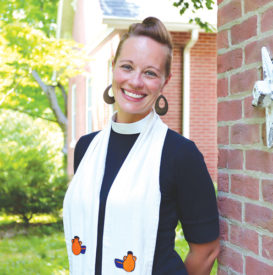
About 10 church volunteers help with weeding and watering the garden, and “people are really excited,” said Hanover’s pastor, Katrina Pekich-Bundy. “We have some talented gardeners … . And I think there’s real need in this community for fresh vegetables.”
Last fall, both members of the church and Hanover students participated in a Bible study, co-led by Pekich-Bundy and a Hanover chaplain and using the just.good.food curiculum. The focus was on caring for creation – in all aspects, from being more energy-efficient at church to understanding the complex questions involved in deciding what kinds of food to purchase and from what sources.
They talked about “how can we care for creation?” Pekich-Bundy said. “How can we slow our lives down so we can appreciate God’s creation?”
Many in the church “do recycle. We do plant gardens. We do those things that are pretty obvious. But when it comes to buying foods that are harvested for very little pay, do we know where all those foods are coming from, and how hard it is to buy just foods in a small community?”
Part of the sense of shared mission identity for these three synods is the recognition of the impact of rural poverty on many families. Some people live in so-called “food deserts,” too far from a grocery store which sells fresh fruit and vegetables. Many rural areas have increasing levels of poverty, with a disproportionate impact on children and the elderly, Moore-Nokes said.
“A lot of our congregations are in rural places where there is a church slapped down on three acres, where they’re mowing the grass three times a week,” she said. “Many of our congregations are land-rich but don’t have a lot of resources.”
The hope is that the just.good.food program will provide a framework and some encouragement – and that congregations will respond with creativity to meet the local needs. On Facebook, for example, one gardener said volunteers from her area convinced the vendors at a farmers’ market to donate the food they didn’t sell – collecting over 100 pounds of produce. First Presbyterian in Neenah, Wis., gives food to a local hospice organization – which will provide fresh produce to families experiencing illness and loss.
One small-town church, Philo Presbyterian just south of Champaign-Urbana, Ill., won a grant to help buy supplies; is using rain barrels; and is taking advantage of a local landscaping recycling project which turns trees into compost and mulch that can be used in gardens, said Bill Lawser, a contract employee with the Synod of Lincoln Trails working with the just.good.food program. The congregation’s new “It Takes A Village” garden is laid in on the south side of the church building, and church members used recycled bricks to build a spiral-shaped herb garden. The produce goes to a food pantry at a nearby Catholic church.
In Marshfield, Ind., church members plan to give canning lessons so that people can give away the garden’s bounty beyond the current growing season, Lawser said.
Being involved in growing the food can make some people more receptive to receiving it. Wisconsin, for example, has a very strong German-Polish ethnic heritage, in which “self-sufficiency is a big deal,” Moore-Nokes said. “It’s one thing to go to a food pantry. It’s another thing to have an opportunity to work side-by-side to raise food.”
Program organizers also hope just.good.food can connect with the concern many young adults feel about wanting food that is fresh and locally sourced. Moore-Nokes, in her late 30s, said “my generation is passionate about organic food, slow food. And many of my generation have absolutely no interest whatsoever in institutional church. None.” They may, however, “see a garden at a church and say, ‘I’m totally willing to go help out in the garden, even though I may never step foot in the sanctuary.’ ”
Some congregations, when they pass along the food, also will provide recipes. “Not many people know what to do,” Moore-Nokes said, “with a head of kale.”
Already, the organizers are seeing local creativity and energy at work. Some congregations grow herbs in pots in the south-facing window of the fellowship hall. Some hope to build partnerships with local schools. Some are urban gardens: in Indianapolis, Irvington Presbyterian Church is harvesting kale, lettuce, onions and pea pods.