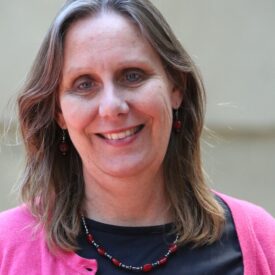
Interview by Leslie Scanlon, Outlook national reporter
 The 2014 General Assembly is being asked to confirm Linda Valentine for another four-year term as executive director of the Presbyterian Mission Agency – which would be Valentine’s third consecutive term since she came to work for the Presbyterian Church (U.S.A.) in 2006. As executive director, she leads the denomination’s national staff of about 300 employees and oversees a budget of more than $73 million for 2015.
On the cusp of her third term, Valentine sat down with the Outlook’s Leslie Scanlon for a conversation about challenges facing the PC(USA) – and places she sees for hope. Here are some of the highlights from that interview.
Q: As you look ahead to the next term, how do you see the challenges being different than the first term? What is it you see ahead?
A: “I came in at a time of change, to lead change, and we’ve made a lot of change. And what do we have ahead of us? I think we’re just on the brink of a lot of excitement on the things that are already underway. In some sense it’s a continuation, but I see even it as an acceleration, when I see how much excitement is building about New Worshipping Communities, New Beginnings, young adults, World Mission.”
Susan Davis Krummel just joined the staff, as director of Mid Council Relations for the PC(USA), arriving at a time of real flux for many mid councils. “Already there are more than 30 who have a combined stated clerk and executive. And more and more of them have no full-time staff – they might have a part-time stated clerk. And those that have executives, most of them being called now have in their title temporary this or interim that, provisional.”
Overall, the PC(USA) is adjusting to “a more flattened, networked mode of working . . . Now you’ve had things like NEXT Church up, the Fellowship (Community) grow up . . . And the issues they care about are the issues we’re involved in. So we’re leading a lot of things, but we’re not the only leaders… I personally have always been attracted to and flourish in large and complex organizations. So I find this all delightful, to figure out how to be useful and in service and in partnership in a lot of different configurations.”
Q: If the assembly were to allow Presbyterian ministers to perform same-sex marriage, some predict that a lot of churches will leave. How do you budget in that kind of environment?
A: “We budget knowing that things might change. We didn’t reserve a big contingency because it depends on who leaves and how many leave. But the reductions we’ve experienced in our budget – and the budget is now about half of what it was 10 years ago – have probably not been significantly affected by the churches that have left. The churches that have left for the most part have not been big contributors.”
If more churches leave, “we’ll change again. One of the things that positions us better now to make those adaptations is we’re much more focused on things we have discerned the church most needs that we can do best. Any time we have to go through reductions there are hard choices to make, because we’ve been doing good and valuable things. It’s not that you’re letting go of things that don’t have value.”
Q: If there are congregations that are thinking of leaving, what do you say to them?
A: Occasionally, presbytery executives or pastors have asked Valentine and others on the staff to meet with sessions considering departure. “We share accurate information and the value of what the denomination has to offer. We find there is a tremendous amount of misinformation and it’s not uncommon that we come back from these speeches with stories of people saying, ‘Why didn’t we know this before, before we got this far?’ ”
Valentine says she tells churches that if they leave the PC(USA), “you’re walking away from these mission relationships with partners in other countries that were started 177 years ago,” along with the resources of the denomination’s United Nations office – which helped advocate for peacekeeping troops to protect civilians in South Sudan – and the Office of Public Witness, which issued a call for advocacy through which 7,000 Presbyterians urged the U.S. government not to bomb Syria – both actions taken following the lead of the denomination’s international partners.
“What new denomination has that breadth and reach and depth of resources? . . . We try to be truth-tellers because there is a lot of misunderstanding about things. And also raise up a lot of the wonderful things, irreplaceable things, that the denomination is doing.”
Q: With declining membership, do you think people listen when the Presbyterian Church speaks? Should they listen?
A: “One, I think it’s not insignificant. We still have a tremendous amount of social capital . . . When we see the ecumenical community in Washington….that’s not insignificant. Because we are organized. We can embody a message that way.”
In 2010 the PC(USA) recast the Office of Public Witness to not only speak on behalf of the church, but to equip Presbyterians for advocacy. “That’s where I think we really have potential,” organizing Presbyterians at the grassroots on issues such as gun violence.
Q: What are some of the most significant takeaways from New Beginnings (a program to help existing congregations which need revitalization discern a direction for the future)?
A: “We borrowed it from the Disciples of Christ. It’s an example of our ecumenical efforts. Everything doesn’t have to be invented by Presbyterians, although we’re adapting it to our context. And it begin with an assessment,” looking at everything from the age and size and use made of the church buildings to the demographics of the congregation and the nearby community.
“It’s been described as holding a mirror up to a congregation – you’ve got this big building and it’s being used 5 percent of the time. And it’s costing you so much. All your budget’s going to that,” while the community has great needs.
The congregation begins a process of discernment, and “it’s really up to the congregation to determine ‘What’s your future story?’ . . . It helps them to test their readiness for change. You say you want to radically change. Are you really ready for that?”
Coaching is available to help congregations through change. For those who decide not to continue as a congregation, the Presbyterian Foundation can help channel the resources to be used by other for future ministry efforts.
Q: Has PMA forged new ways of working with the Foundation?
A: “Our relationship with the Foundation is radically different than in 2008. I’m here to report that we have very good relationships with the Presbyterian Foundation…. It’s a complete turnaround.”
Q: What would you say to folk about the wisdom of taking short-term mission trips? What would you say about your own experience; and as a leader of the denomination, knowing there has been reassessment of the real value of such trips, what do you think people should do?
A: “I guess I’ve gone on a personal journey on this myself, because going on the mission trips that I did – with our kids, you’re going to a place where you’ve never been, you’re exposing yourself and your kids to these different conditions,” in countries such as Honduras and Mexico.
“The other benefit I saw in our church were the people who had gone on that trip or series of trips form a community within a large church.”
After working for PMA, however, Valentine has become “much more exposed to mission in partnership and to letting the partner take the lead and to being culturally sensitive, and to all the lessons we’ve learned over a century and a half, many of them the hard way, about what is really empowering and transformative ministry, not just for the participants from the US, but for the partners. And I think World Mission too has come to the point of not just finger-wagging at short term mission as always being bad and imperialism,” but recognizing there are benefits and it’s a valuable experience – how do we make it better? . . . How do we learn to do trips in a way that is meaningful for all?”
Q: As the parent of three young adults, what do you think young adults think of the Presbyterian Church?
A: “I think our young adult ministries – talk about being on the brink of some surge . . . I think there are tremendous opportunities” to reach young adults which polls show increasingly are unconnected to organized religion, but still believe in prayer.
“When we think we want more young adults in the church, we think we want them to walk in the front door at 11 o’clock and sit still and stand up when you’re supposed to and sit down when you’re supposed to, and we’ll have a young adult ministry. That’s not how it’s going to happen. As we become more innovative and embracing and flexible, with varied expressions, we’ve got tremendous opportunity. Because yeah, I see in my kids- being in service; being social; and even having intergenerational experiences is important to them . . . There’s a lot to be excited about. Don’t think of leaving the Presbyterian Church. Look at what you’re leaving behind.”