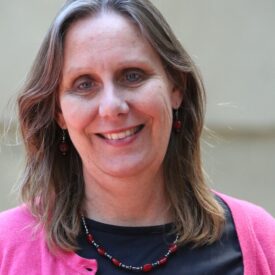
He’s the new guy.
So it will take some time for Jason Brian Santos, the new associate for collegiate ministries for the Presbyterian Church (U.S.A.), to figure out exactly how he wants to approach things — in part because he wants to first learn more about what’s happening on the ground with UKirk (meaning university church), the two-year-old network of collegiate ministries that the PC(USA) supports.
Santos starts work for the PC(USA) Oct. 20. He comes with ideas — the fruit of years of research and hands-on work involving spirituality and young adults. Some of what he’s thinking:
- College students benefit from being a part of the worshipping, intergenerational life of a congregation, not just from being set aside as a group unto themselves.
- Those working in campus ministry need time to spend with one another building relationships and sharing ideas.
- Young adults value contemplation — opportunities to quiet down and sense God’s presence in a stressful, fast-paced world.
Santos, 41, is coming to the denomination’s national staff from New Wilmington Presbyterian Church in Pennsylvania, where he has served as associate pastor to families, young adults, youth and children for about two and a half years. Last May, he completed a doctorate in practical theology from Princeton Theological Seminary — where he has done research both on young adults and spirituality and on the impact of the Taizé community in France on pilgrims from around the world.
“I was born a Methodist, born and baptized Methodist, joined the Assemblies of God Pentecostal environment at age seven, when my parents switched over,” Santos said in an interview. “I’m not a closet Pentecostal, but I definitely have Pentecostal roots.”
He grew up in Columbus, Ohio. Both parents had medical careers — his Filipino father is an anesthesiologist, and his mother a nurse — and the family was “very much evangelically-oriented,” Santos said.
In the summer between his freshman and sophomore years of high school, Santos began to discern a call to ministry — particularly to youth ministry. That year he began leading a Bible club for high school students and later led a junior high Sunday school program and worked with students at a summer camp.

For college, he went to North Central Bible College (now North Central University), an Assemblies of God school in Minneapolis, majoring in Christian studies. After graduation in 1995, he worked in youth ministry in London for a few years and flirted with the idea of law school. Santos opted instead to pursue a master’s degree in systematic theology at the Wheaton College Graduate School. While there, he met his wife, Shannon; started working at Community Presbyterian Church in Lombard, Illinois; and experienced what he describes as a “second awakening or second conversion, almost” as a result of his exposure to John Calvin’s “Institutes of the Christian Religion” and Calvin’s views of Scripture. Reading the Institutes, Santos wept in his apartment, “realizing that for so many years, what I thought was faith was based on what I did. I felt I had robbed God of the glory of calling me.”
After graduating, Santos saw an ad for a job in Germany — so he and his family (then including son Jonah) moved to Bonn, where he served as youth director of an interdenominational church. The plan: he would learn some German, then pursue a doctorate in systematic theology. What happened instead: the pastor of that church was a graduate of Princeton Theological Seminary — who provided a living example of academic thought combined with pastoral ministry. “It really got me thinking and praying about ordination,” Santos said.
After a year, he applied to Princeton and began studying for a master’s in divinity — focusing in his research on young adult spirituality, including the pull that some Gen Xers feel towards more contemplative and monastic practices.
He found funding for an independent study project with Darrell Guder, a professor of missional and ecumenical theology at Princeton, to spend time at the Taizé community in France. Santos said he arrived on August 16, 2005 — and that night, attending worship for the first time, saw a young woman stab to death Brother Roger, the community’s 90-year-old founder and first prior. “I was about 30 feet from him when it happened,” Santos said. In the days immediately following, thousands came to the community to pay their respects, and he interviewed as many as he could about why pilgrims from all over the world come to Taizé and what impact the practices there have had on their spiritual lives.
That project turned into the writing sample he submitted for the doctoral program in practical theology at Princeton Seminary — where he became a Timothy Scholar for the study of youth and young adult spiritual formation, under the mentorship of Kenda Creasy Dean. He wrote a book (“A Community Called Taizé: A Story of Prayer, Worship and Reconciliation”), worked for a short stint at University Presbyterian church in Seattle and then at the New Wilmington church. His doctoral dissertation focused on what happens to the Taizé pilgrims after they leave the community — how they can continue the practices they learn there in other settings. “The theme of journeying or pilgrimage has been a very strong thing for me,” Santos said. “I have three tattoos acquired over the last 10 years that all filter into the idea of pilgrimage.”
Now Santos is coming to Louisville — shaped by what he’s learned and experienced along the way.
He believes in the importance of intergenerational ministry for young adults — “debunking the notion that age-segregated ministry is the only way we can do Christian formation.” While grouping young adults together may be valuable at times, he contends that compartmentalization carries a price as well. “Our local churches also need to invite college students into the body,” to be a part of worship and other activities, “so they feel like they’re part of the community … Youth and college students need to be part of a community of faith that yearns and journeys and struggles together,” that makes space for questions and doubts and exploration.
Santos also thinks faith communities need to do a better job of helping young people understand what it means to be a Christian — to sort through the complicated questions of Christian identity. Too often, he said, young people “aren’t given a strong anchor identity of who they are as a Christian.”
Sometimes, parents “are so afraid to allow their doubts to be seen or heard by their children. What they don’t realize is that their children, particularly in their high school years, are being raised in an environment where they are looking for something that is real and authentic.”
If the parents seem disconnected or lukewarm about faith, or reluctant to engage significantly about questions of faith, “the kids sort of say ‘Well, this isn’t that important to my parents, why should it be important to me?’ Then they go on to college and they begin to explore other forms of thinking,” and many of them travel far away from church.
He also sees a hunger among many young adults to find space for contemplation and quiet in their frenetic schedules. When he lived in Seattle, he saw hundreds of young adults showing up on Sunday nights for the 9:30 p.m. compline service at St. Mark’s Episcopal Cathedral — a meditative service led by an all-male choir. “Young people would flock from all over the city, and they would bring pillows and they would lay on the floor and lay on the pews,” he said. “A lot of them would just sit and dwell … which allowed their souls to truly find some sort of respite.”
In his new position, Santos hopes to dig deeper into these themes — and to learn what Presbyterians already are doing through UKirk and other local ministries. Among the ideas he’d like to explore:
- How congregations near colleges can better serve students. “If you don’t connect yourself to a church within the first semester of college, the chances of you connecting after that become very slim,” he said. Often, “churches haven’t done a very good job of welcoming students” — sometimes just not being sure what to do. “We have a responsibility.” In college towns, “that is our local mission.”
- How to integrate contemplative spirituality into work with young adults.
- How to draw those working in college and young adult ministries into the idea of journeying together — perhaps through retreats or cohort groups or pilgrimage trips. He’s taken high school students to walk on the Appalachian Trail and likes the idea of taking groups of campus ministers off for retreats in the woods. “It’s sort of a reset button,” Santos said — an opportunity to share ideas, build relationships, mentor one another.
- How service work with young people could be developed in local settings or a national level with a distinctly Christian focus — to help others in ways that “are connected to how we understand our calling as Christians.”
- A question he wants Presbyterians to explore: How can service to others and the Christian commitment to social justice intersect?
Santos says he’s excited about the new job — he and Shannon will move to Kentucky with their two sons, Jonah, now 13, and Silas Desmond, who is known as Tutu because he shares a birthday with Desmond Tutu, and who just turned three.
“I’ve got a dog and a cat and lots of educational debt, and that’s life,” Santos said “I love being a Presbyterian and I’m thrilled to be part of this denomination … I find it to be a place of grace and redemption.”