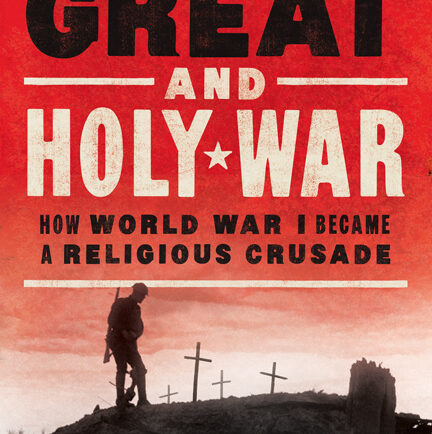
 by Philip Jenkins HarperOne, San Francisco. 448 pages
REVIEWED BY KEN KOVACS
Archduke Franz Ferdinand, heir to the throne of the Austro-Hungarian Empire, and his wife, Sophie, were both assassinated by Gavrilo Princip in Sarajevo on June 28, 1914, their wedding anniversary. In about a month, Europe was thrown into the cataclysm we know as the Great War. Thousands of volumes have been written on the origins of the war. Historians are still debating how two gunshots could hurl Europe and the rest of the world into the abyss — leading to 10 million military personnel and 7 million civilian deaths; devastating lands, peoples and cultures; destroying the youth of a generation; and leaving behind more than one million widows and millions of orphans. The centenary commemorations are upon us, particularly in Europe. One book that stands out marking the occasion is Philip Jenkins’ “The Great and Holy War.” He focuses on what studies of this period often overlook, offering a religious framework for the Great War and its aftermath, thus bringing to light the theological dimensions of the conflict.
“The First World War,” Jenkins claims, “was a thoroughly religious event, in the sense that overwhelmingly Christian nations fought each other in what many now view as a holy war, a spiritual conflict.” Japan, the Ottoman Empire and India were, of course, non-Christian states; nevertheless, they were all deeply influenced by centuries of Christian thought and practice. He makes the provocative claim that “Religion is essential to understanding the war, to understanding why people went to war, what they hoped to achieve through war, and why they stayed at war.” It was a “spiritual conflagration.”
Jenkins reveals the religious substructure of European society at the time of the war. He explores the worldview of the ordinary soldier huddled in the trenches on both sides of No Man’s Land, as well as the spirituality at the home front, including the militaristic, apocalyptic sermons preached from pulpits in Berlin, London, Paris and New York. The war marked the complete unraveling of a world. Jenkins demonstrates how nearly every contemporary geopolitical issue facing us today, in every troubled region of the world, can be traced back to the war. In particular, he places the contemporary struggles facing Islam within a broader context, exploring what happened to the Islamic psyche when the Ottoman Empire, and later the caliphate, were dissolved.
The Great War was, and remains, a scathing indictment of Christianity. Or better, an indictment of large portions of the church, on both sides of the conflict, with both clergy and laity who thought they were being faithful Christians, fighting to save “Christian civilization,” and slaughtering millions, all in the name of God.
We are living in the wake of that cataclysm. The rise of secularism has its origins here. Jenkins notes, significantly, that while WWI was essentially a religious affair, WWII, a generation later, was thoroughly secular. Offering the long view of the historian, he seems to suggest that perhaps the long, slow decline of the church in the West could well have begun in the ghastly trenches of the Somme and Gallipoli and Verdun and Ypres.
KEN KOVACS is pastor of Catonsville Presbyterian Church in Catonsville, Maryland.