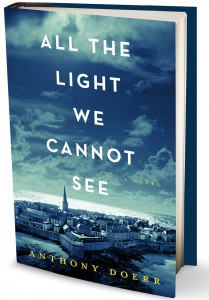
 by Anthony Doerr Scribner, New York. 531 pages
REVIEWED BY LAURA CUNNINGHAM
“None really knows why they are alive until they know what they’d die for.” Although Jesus seemed to live this way, and I try to follow Jesus, I’m wary of those who use this quotation of Martin Luther King’s without qualification. I want to ask, “What do you think makes for life? What is truly worthy of sacrifice? Once you figure that out, how do you live?”
The gospels allow us to wrestle with these questions, but so do many of my favorite stories, now including author Anthony Doerr’s page-turning World War II novel, “All the Light We Cannot See.” The parallel narratives of Marie-Laure, a blind French teenager who has fled Paris, and Werner, an orphaned radio prodigy working for the Nazis, converge in the walled Breton town of St. Malo days before the American liberation. As the chapters jump back and forth in time and place, Doerr builds suspense surrounding these young people’s futures, weaving a mythic tale of what makes for blindness and seeing, hearing and following, trust and betrayal, treasure and sacrifice, death and life.
Marie-Laure is in St. Malo because her father, a locksmith at the Natural History Museum, has brought her (as well as a mysterious valuable jewel) to seek refuge with her eccentric, reclusive uncle Etienne. She learns to navigate the multiple floors of his home, eventually discovering the attic occupied by an old radio system built to broadcast her deceased grandfather’s recordings.
Growing up in a German orphanage, Werner hears these broadcasts, science programs for children, from his homemade transistor radio. Although he and Marie-Laure have no knowledge of each other, her grandfather’s program opens up the world of light and electromagnetism, of the infinitely large and ultimately invisible spectrum that gives the novel its name. “Open your eyes,” her grandfather says, “and see what you can before they close forever.” These words propel Werner’s longing for the larger world, so that when he receives a scholarship to a prestigious military school, he accepts, only to discover that he will be working on a radio transmission program used by Nazis to ferret out enemies.
As Werner’s military work moves him closer to France and Marie-Laure finds safety in her new home, her uncle is slow to join the local resistance movement. His housekeeper reminds him “doing nothing is as good as collaborating,” imploring him to help by reading over the radio code that the baker has slipped into bread loaves. “Don’t you want to be alive before you die?” she asks. The question is not just for the uncle, but thematic for all of the characters, including Werner, as he prepares for his own moment of sacrifice.
“Don’t you want to live before you die?” is also for the readers, and for all who confront questions of good and evil, whether in their own hearts or in the world’s events. The image of life-giving resistance codes within a bread loaf invites readers of Christian faith to ask the question in the sharing of sacramental bread. This beautiful story invites all readers to qualify for themselves what or whom they’d die for, and then how they themselves might live.
LAURA CUNNINGHAM is pastor of the Nauraushaun Presbyterian Church in Pearl River, New York.