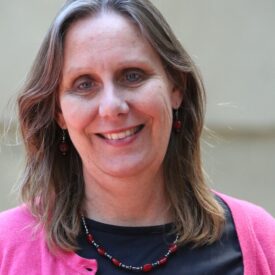
 Jill Duffield isn’t one of those Presbyterians who knew from the cradle that she would be a minister. Instead, she wrestled with her call — starting seminary at age 20, then leaving, and eventually coming back — keeping an open heart for what God had in mind.
Starting Feb. 1, Duffield will be editor and publisher of the Presbyterian Outlook, succeeding Jack Haberer, who stepped down in October to become pastor of a church in Naples, Florida. She is the Outlook’s first female editor.
Duffield, 45, comes to the Outlook as a parish pastor and writer — having served five congregations in North and South Carolina, some big and some small, some part- time and some full-time, during 20 years in ministry. Most recently, she was associate pastor for discipleship and acting head of staff at Shandon Presbyterian Church in Columbia, South Carolina. She also has been one of the Outlook’s benedictory columnists, dishing on subjects from grace to General Assembly — writing creative nonfiction is one of her daily disciplines, along with swimming.
She grew up in Mount Gilead, N.C., after having moved with her family from Halifax, Nova Scotia, at the start of fourth grade. “That was a pretty big change,” Duffield said. “Actually as a kid my first schooling was at a Catholic school, not because we were Catholic but because it was a good school and it was near my parents’ work.” Moving to a public school in North Carolina “was definitely a culture shock.”
The family moved because Duffield’s father, a physician, “had an adventuresome spirit” and “wanted to go somewhere he was needed,” she said. He took over a family practice in Mount Gilead, and her mother, who’d been a nurse in a children’s hospital, stayed home from then on, in part to provide care for Duffield’s younger brother who has a severe hearing impairment and had undergone a tracheotomy.
In the midst of so much new, church became the familiar place.
“My accent was different,” Duffield said. At school, “as I recall, we were studying states and capitals, and I was clueless.” The cadence of First Presbyterian Church — the liturgy, the Bible stories, the hymns — seemed familiar, although in Canada her family had attended a United Church of Canada congregation. First Presbyterian “was a small, close-knit community of people” where her parents both became ruling elders and her mom sang in the choir. “If I wanted to sing in the choir, I could sing with the adults even though I couldn’t sing (well). I remember Presbyterian Women coming to my house for their meetings. I remember making chrismon ornaments with the ladies of the church. It was a nurturing environment,” which felt like home.
Duffield got an early start on grown-up life: graduating from high school at 16 (she started attending community college while still in high school) and from the University of North Carolina at Greensboro at 19 with a degree in history (although she started as a theatre major). “I was clueless” about what to do next, Duffield said, so she began working retail. At a Christmas Eve service, she had “an epiphany, a ‘voice from God’ moment,” telling her to go to seminary. Not sure what to think, she went to talk to her hometown pastor, who, she said, was not surprised. “I was astounded. I never saw this coming.” Her minister, a graduate of Union Presbyterian Seminary, took her to Richmond and showed her around the campus.
She enrolled, “but I really struggled with my sense of call in seminary,” Duffield said. “I was young.” She got married at 22 — to her high school sweetheart, Grant Duffield — and left seminary, moved to Florida, worked in a new church development, did graduate work at the University of Pennsylvania, and eventually went back to Union Seminary. “I kept putting off the inevitable,” Duffield said. “I really struggled with whether God could use me, which is bizarre, because you look at the biblical record and God uses all kinds of people. I really did struggle with whether I was a fit for this role,” but during an internship at Bethesda Presbyterian Church in Aberdeen, North Carolina, she discovered that “I loved it. It got me hooked.”
Her first call after seminary was with First Presbyterian Church in Greenwood, South Carolina, a congregation she describes as tolerant of her inexperience and grace-filled. That experience taught her that in ministry “there are people who will love you despite your inadequacies and you can do incredible work together. I hang on to that.”
Despite her initial uncertainty, Duffield has grown to love ministry. “One of the things that is an incredible blessing is you’re invited in a lot of times to be with people during some of the most profound moments of their lives. When you are baptizing their children or visiting them before they have surgery or being with them at a time of death or walking with them towards confirmation, those are moments that are touchstones in their life journey or faith journey, and you get to be along side with them. Sometimes you’re invited in like no one else is to talk about things of the most visceral, life or death, ultimate meaning kinds of thing. To be invited into those conversations is just a remarkable gift.”
She also enjoys the variety of ministry — encompassing everything from fixing the broken air conditioning to the most sacramental of moments. She loves planning worship and preaching and she appreciates that “as Presbyterians, we’re not afraid of challenging questions, we’re not afraid of doubt, we’re not afraid to struggle with sin and evil … I try to look at all of it with a holy curiosity.”
Duffield has served as moderator of Providence Presbytery and in 2010 as a commissioner to the General Assembly in Minneapolis. She earned a doctorate with an emphasis in preaching from Austin Presbyterian Theological Seminary. Her husband, Grant, works for the South Carolina Workers Compensation Commission; the couple has three children — Joseph, Jessie and Marissa.
As Outlook editor, Duffield hopes to be a catalyst for thoughtful conversation on complex issues. “I feel like the Presbyterian church is poised to be a really important part of what God is doing in the 21st century,” she said. “We’re not afraid of hard questions, and we have a tradition of ecumenism and interfaith dialogue.”
Duffield says “I have deep respect and love for people with whom I disagree. I need their perspective, and I need them to be honest with me.”
In the secular culture, often “people are polarized and they can’t even talk to each other. I don’t understand that. Part of it is I was the only Protestant in a Catholic school; I worked in a Boys and Girls club where I was one of very few white people on a mostly black staff with mostly African American kids; I took Hebrew at a synagogue where I was the only Gentile; a lot of times I’ve been the only woman in the room. So I have some small slight sensitivity to feeling a little bit on the outside,” Duffield said. “When there’s something I’m convicted about, I’m not afraid to say it, but I want to say to say it in a way that doesn’t write somebody else off.”
As the PC(USA) takes on tough issues — be it divestment or same-gender marriage or declining resources — “we need to do it in a way that shows we’re in covenant community together, and God has put us together, and we are united in Christ, and nothing can undo that.”