by Elizabeth Hinson-Hasty
Westminster John Knox Press, Louisville, Ky. 223 pages
REVIEWED BY LYNNE TAYLOR CLEMENTS
Do not read this book … unless you are ready for a challenge and charge.
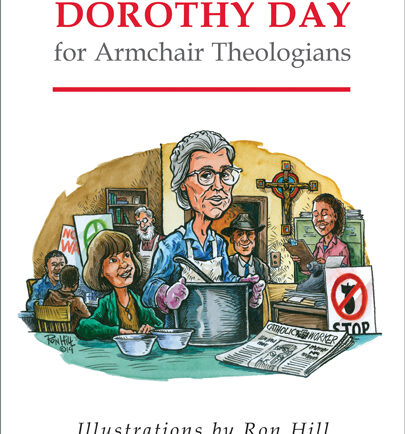
In a compelling narrative that spans the 20th century, Hinson-Hasty introduces the reader to the woman who began the Catholic Worker movement and dedicated her life to ending poverty and working for justice and peace. Hinson-Hasty, professor of theology at Bellarmine University, spent a year studying the life and works of Dorothy Day. Drawing on her exploration into the life of Dorothy Day, Hinson-Hasty illustrates how Day answered the call of loving service of one’s neighbor, which is at the heart of the authentic Christian life — a life not defined by church attendance or denominational hierarchy, but in community, radical hospitality and spiritual discipline. Enhanced by anecdotes and stories, Hinson-Hasty brings to life the multi-faceted elements of Day’s character as religious activist, socialistic and unlikely saint.
For those who wonder what made Day the ideal candidate for the first woman to be highlighted in the “Armchair Theologian” series, throughout the book, Hinson-Hasty provides evocative examples of Day’s “street cred” as a theologian. She examines the providential meeting between Day and the French philosopher Paul Maurin who helped her synthesize her concern for society and her Catholic faith. His ideas for discussion groups, houses of hospitality and farming communities would form the basis for the Catholic worker movement. Hinson-Hasty shows how the marriage of these ideas with Day’s background as a journalist gave birth to the Catholic Worker paper. Hinson-Hasty’s treatment of Day also includes a glimpse into Day’s deep connection to mystics such as Thérèse of Lisieux whose insights helped shaped the spiritual practices that steadied her in the chaos of the world around her. Hinson-Hasty also shows that Day saw her womanhood as a platform for caring for others at the same time she spoke out radically for the rights of others. Finally, Hinson-Hasty’s work shows Day’s pacifist engagement against war and the use of nuclear weapons while living by an ethic of peace. All of Day’s work as an activist and mystic is placed alongside stories of her family and her relationships, giving the reader a sense of Day’s personal world as well.
A distinctive feature of the book is the personal postscript included in the final chapter, an element that solidifies the impression that those who encountered Day were not left unchanged. Hinson-Hasty departs from the objective distance of a writer and invites the reader to consider that Day’s integrated and prophetic way of living demands a response. Hinson-Hasty asks the question that is on the lips of those who encounter Day, “How can I make a difference?”
This work pushes the reader to recognize the place of privilege, to resist the compulsion to engage in economic practices that contribute to generational cycles of poverty and to embody God’s presence right now. Hinson-Hasty’s urgency and passion is sure to raise awareness in the reader who must wrestle with the challenge to accept the radical charge to live one’s faith as Day demonstrated.
LYNNE TAYLOR CLEMENTS serves as director of Christian education at Westminster Presbyterian Church in Charlottesville, Virginia