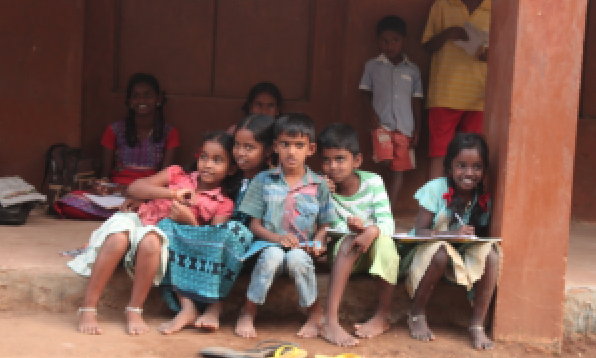
A visitor to India is first struck by what’s different: the ferocious swirl of honking traffic and color and smell and spice. This is a place  where an elephant zooms by on the back of a truck; where religious pilgrims walk barefoot for days, balancing their few possessions on their heads; where women in bright saris ride sidesaddle on the backs of motorcycles, sometimes clutching a baby or with a child or three squeezed in as well.
But don’t be distracted by all that seems different from the West.
The India of today also is struggling with questions of vital importance to people in the United States. Among them:
» What does it mean to practice one’s faith in a religiously diverse, multicultural world? What is the value and significance of interreligious dialogue?
» What impact is globalization having on the distribution of wealth, on the environment, on those with the least power and wealth?
» How is the role of women changing? What can be done about violence against women?
» What responsibility does a society have to care for those who lack education, power, food and a decent standard of living?

Consider, for example, the dynamics of life along the Alleppey Backwaters, south of Kochi — a region where vacationing tourists rent out hundreds of deluxe houseboats (one with 10 bedrooms), and where some of the residents live in shacks, beating their clothes clean against the rocks while the tourists sail by, taking pictures. Some of the waterways abut rice paddies, where during the harvest season the workers will be bent double in the heat, laboring on land which someone else may own, shielded from the tourists’ pleasure by a slim row of palm trees.
 “The people who live here depend on the water for everything” — for tourism, fishing, transportation, sustenance, said Father John Pozhathuparambil, a Franciscan friar who is from Kerala and who works in Kentucky with college students and young adults.
Kerala is one of the most affluent, literate, educated states in India — in some of its cities, the streets are lined with spacious homes. In Kerala, wealth is concentrated in the cities; many in the rural areas remain poor, Pozhathuparambil said. “They work in the fields, they have little to eat,” not enough access to health care and no indoor bathrooms. As in the United States, “there is a distance problem” between rich and poor.
Early this year, a group of graduate students from Louisville traveled to the states of Kerala and Tamil Nadu, near the southern tip of India, to explore these and other questions regarding the intersections of faith and justice. The students came from Bellarmine University, a Catholic college in Louisville where

Pozhathuparambil and several other Indian friars work, and from Louisville Presbyterian Theological Seminary. Their explorations were led by two professors, Elizabeth Hinson-Hasty, a teaching elder in the Presbyterian Church (U.S.A.) and a professor in and chair of the theology department at Bellarmine, and Tyler Mayfield, an assistant professor of Hebrew Bible and Old Testament at Louisville Presbyterian Seminary.
Their hosts: Franciscan friars from Assisi Shanthi Kendra in Karukutty who helped the students explore questions of how people of faith in India are struggling to respond to the challenges of a complicated and rapidly changing world.

Interfaith dialogue. Christians in India practice their faith as a religious minority. In Kerala, the population is about 80 percent Hindu, 17 percent Muslim and 2 percent Christian, with a smattering of other religions as well, Pozhathuparambil said. “At each junction of the town, you will see a mosque, a temple and a church. We believe we have different faiths, but we are traveling together.”
Despite that diversity, building bridges among the religions is complicated.
In Kalady, Jesuits in 1987 established Sameeksha, an interreligious spirituality and research center. The center was created as “an ashram, where people of different religions feel accepted, respected, at home,” said Father Sebastian Painadath, a Jesuit theologian who has written about interfaith dialogue. “Ashram is not a monastery, more a place of encounter,” where people of different religions and cultures can come together.
“Ashram also is built with a sort of ecological sense,” nestled along a river, with walking paths wandering through flowers and gardens and trees. “This closeness to nature is a prime value of ashram,” Painadath said. “Also an aspect of study, silence, meditative practice.”

The Jesuits here live simply — in small cottages, eating vegetarian meals — and remain connected to the community through their work with teenagers (providing guidance through relationships, drama and art) and with migrant workers who come from the less affluent areas of north India looking for work. Many of the migrants are Hindu and Muslim, doing difficult physical work for relatively low pay. Being alone so far from home “creates a lot of human problems,” Painadath said.
Sameeksha also is a place of interfaith study — with a lay training program in Christian theology, offering retreats in the study the classics of India and the Bible and a library for scholars.
While all are welcome, building mutual respect requires developing real relationships with those of other faith traditions, Painadath said. “The main blocks are the prejudices which have been built into us,” he said. “Unnecessary prejudices about Muslims, about the Jews, about others … That is a great challenge, to really know another and to respect another.”
That respect requires, he said, an understanding of the teachings of another’s faith. “How can you love a Hindu if you don’t respect their gods?” he asked. “How can you love a Muslim if you don’t love the Koran? … To love the Koran means to read the Koran. God’s word is vibrating in the Koran” — which poses a challenge to “our claims of exclusiveness,” and is an ongoing work of both the head and the heart together.
The Sameeksha prayer center is built with four doors, so people can enter from all directions, all faiths, or no faith at all. In the center a lamp is lit, surrounded by the symbols of many faiths and the holy scriptures of Christianity, Islam, Buddhism and Hinduism.

“We all meet at the divine center, the center of light,” Painadath said. “The whole universe is like one tree. We are all branches of one another.”
Where religious fundamentalism flares up, sometimes into violence, “let us not generalize and say that all Muslims are like that — that is the danger,” he said. “There are a lot of peace-loving Muslims,” and a need for all to consider the role their governments or faith traditions may have played in contributing to the tensions.
He recognizes also that increasing numbers of people do not align with any religious tradition, but sees connections there too in what Indians describe as “secular spirituality” — questioning religious practices (as Jesus did, Painadath said) but with concern for others and for the planet’s future, working together on issues such as the environment and public health.
“Today we live in a culture of competition, not compassion” as the dominant value, Painadath said. “Yet we all sense there is something that binds us together … In the heart of every human, the Holy Spirit is breaking down the barriers. This is happening. The Holy Spirit is breaking down the walls.”

Not far away, Swami Sivakantananda at the Sri Ramakrishna Advaita Ashrama, a Hindu ashram also on the Periyar River, spoke of unity as well. Hindus strive “to see the divinity of each human being,” the swami said — a compelling reason the Franciscans and others use to provide care for the least.
Religious tradition. Christians in Kerala trace their church’s heritage to the apostle St. Thomas, who is said to have traveled by boat down the Arabian Sea in A.D. 52, not long after Jesus’ death, and to have founded seven churches along the coastline. “Before Europe was Christianized, we already were Christians,” Pozhathuparambil said.
While the historical accuracy of St. Thomas’ journey may be debated — Did he come? Where exactly did he land? — there’s no question the tradition remains strong and meaningful to the Christians of south India. Both the Mar Thoma and Syro-Malabar branches of Christianity trace their lineage back to St. Thomas; celebrations are held each year in his honor; and throngs of pilgrims — some of them hoisting huge wooden crosses — ascend the rocky flank of St. Thomas Mount, where the apostles footprints are said to be visible, each Lent and Easter to pray.
Even on a routine Sunday, a steady stream of Indian Christians climb the steep slope, stopping to pray at each of the 14 Stations of the Cross — families with small children, the women wearing saris and flip-flops; young men who vault up the hill in the heat; a silver-haired woman of at least 80, barefoot, her lips moving in prayer.
Christians are in the minority here — so this piety is lived out side-by-side with neighbors who are Hindu, Muslim and from other faiths. Before entering a place of worship or someone’s home, most Indians remove their shoes — a sign they are entering holy ground.
Many homes have a prayer alcove or shrine — a place where the family gathers to pray. In Hindu homes, it’s not uncommon to see the image of Jesus nestled in among the Hindu gods.
Land of complexity. Kerala is full of religious and political complexity; one of the most affluent and literate states in India; a place both culturally conservative and in transition.
Increasingly, women are being educated, so “they can stand on their own. The income is there — she does not have to depend on her husband,” said Mini Tom, a mathematician and doctoral student. Child care is often seen as the mother’s responsibility, even if she is working, Tom said. Arranged marriages are still fairly common, although some Indian women are marrying men they meet in college or at work. In Kerala most women dress conservatively, but often with flair.
As in the U.S., there’s no single picture that captures all the realities. Pozhathuparambil describes the complexity of his home country by saying: “It is not India, it is Indias.”

Thomas John is a retired minister of the Church of South India. A graduate of Pittsburgh Theological Seminary, John worked for a year as a mission pastor in residence at the PC(USA)’s national offices in Louisville and served as a site coordinator for the denomination’s Young Adult Volunteer program when that program had a site in India.

John told the Louisville students that “in Kerala the churches are full,” but that doesn’t always translate into concern for the poor or giving for mission. In a country with a history of colonialism, parishioners often contend it’s the government’s responsibility to help those in need and look to donors from the West to provide funding, he said.
 The caste system, formally outlawed for decades now, “is going through a transformation,” John said. Dalits or Harijans — a variety of terms are used — were once considered outside the caste system, “untouchable,” oppressed, as were tribal people, but there have been changes. Some jobs and educational opportunities are reserved for Dalits, although the laws aren’t always enforced. There has been progress too — in 1997, Indians elected a Dalit, K. R. Narayanan, as the country’s president.
Still discrimination and violence persist, particularly against Dalit women. “They remain on the outside,” John said — with many Dalits still poor and uneducated.
Migrants come to Kerala from other parts of the country, looking for work, and “all of the hard labor is done by them — they are living in the most extreme squalor,” John said. Hunger is an issue for many: the World Bank reports that nearly 22 percent of those in India live in poverty, with others vulnerable to not having enough food.
Globalization also plays a role — Indian farmers who purchased seeds from large corporations have been faced with increased costs and falling prices for what they bring to market.
John personally is involved in some grassroots movements — for example, to push for sustainable agricultural practices and the preservation of native seeds. But he said many church leaders are reluctant become involved with grassroots movements for social and political reform. Many church members are more concerned with religiosity, with personal piety, than with social justice, John said.
“My struggle is how to continue to convince the church to be concerned about people.”
Despite all of this, “I am hopeful,” John said. “I expect a backlash in the near future — younger people are going to ask very serious questions of the church. They are more responsive to human tragedies … There must be serious questioning from within.”