by Julie Vidrick Evans
Most of my colleagues agree there is great satisfaction in leading a church music program. We lead choirs (vocal and instrumental), congregational music-making and the church by attending and actively participating in committee meetings. This has always been challenging work, but most church musicians will also tell you the challenges today are different. We must adapt if we are to successfully lead our congregations in the praise and worship of God into this new century.
For most church leaders, one of the greatest challenges is that fewer people are attending worship and making church programs and events an integral part of their lives than in the past. And the people who do attend have busy lives. In many families both partners work and the children are consumed by the demands of school, sports, extracurricular activities and sometimes even music lessons. The result is that there are fewer people able to give significant amounts of time to the work of the church. To adapt to this challenge we need to make efficient use of the time people are able to give. Paradoxically, I have found that people who are active participants in church music programs often are active in many other aspects of church life.
If music is to be successful in complementing worship and fostering spiritual growth, it is important that the music be well prepared and performed competently. I am not talking about professional performance standards, but singers, handbell ringers and trombone choirs all want to feel good about their offerings to God.

Youth. One cannot discount the effect of the reduction of music education in the schools. We can no longer assume that children or even younger adults have had a minimal level of instruction in basic music. At one time, children had music every day; band, orchestra and chorus rehearsed during school hours. Today, music is thought of as a luxury and is supplanted by sports and other extracurricular activities. We are approaching a generation of parents whose children will be even less musically literate. This is an opportunity for church music to fill a gap and be a blessing and opportunity for the young.
Variety of expression. Here is our opportunity as the church: To illuminate aspects of the service, the church musician has the entire scope of musical experience to draw from. Our opportunity is that the whole corpus of expression is open to us. The challenge is to choose which part of that spectrum answers the spiritual “requirements” of the day. There is no necessity that there be a unified style for any one service. We can choose music from any time in history or from any culture or place – from the earliest chant to the most current tunes and rap, from the songs of Africa to the pentatonic melodies of Asia, from the polyphonic anthems of Tudor England to the spirituals that were sung in the cotton fields. It’s all available and it is all God’s music. At Chevy Chase Presbyterian we consistently “mix it up,” stretching our musicians and congregation. The service is richer and more expressive because of a varied repertoire. Providing a variety of musical styles with substantial and meaningful texts is imperative.
Introducing new music. Without the right leadership, it is intimidating for a congregation to experience singing new hymns and multicultural songs or even to listen to a choir or soloist presenting unfamiliar material. New hymns that a congregation is invited to sing can be uncomfortable. The honest preparation by the director of music to present and introduce the new and unfamiliar can build trust between the music director and congregation.

concert.
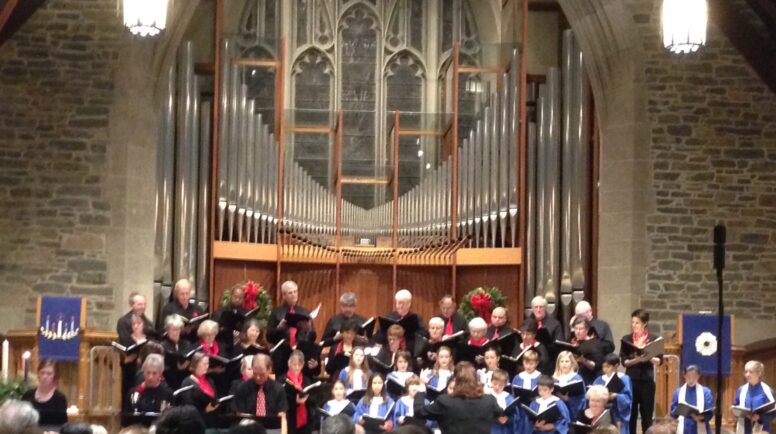
Worship choirs. In my church, the Chancel Choir is the engine of the music program. They rehearse and participate as worship leaders on a weekly basis. Used well, a strong choir strengthens congregational singing and invites worshippers to listen and think about important texts. Building a strong choir takes a competent, sensitive director and a strong leader for each choir section. Section leaders are used for more than solos. They model musical styles proposed by the director and are ministers (or shepherds) to their sections. Section leaders read and understand music, are compatible with the director, have a mentoring and leadership roll, make the choir secure in multipart harmony and assist in building the core sound of the choir. When introducing a new hymn or other congregational song, it is the choir that provides the example and their leadership assists the congregation.
Audio. I have found that microphones can be counterproductive to the goal of encouraging the congregation to participate in hymn singing and service music. When a worshipper sees a person with a microphone, they become a member of an audience not a member of a singing congregation. Microphones create barriers. When we eliminated microphones for our first service singers, the size of the group more than doubled and congregational singing became more robust. The congregation could hear each other. Singing became a more corporate experience.
Challenges of other choirs. Handbell choirs require an entirely different discipline. Whereas singing choirs are resilient to the occasional absence of a member, a handbell choir is not. When one member of a handbell choir is absent, two or more notes are missing in the scale. It can be difficult to find an adequate substitute for more challenging handbell music. This makes handbells a unique opportunity to teach the importance of teamwork and the subordination of individual glory to the corporate experience.
When our church had 1,400 members, we had at least three handbell choirs. There was a critical mass of people wanting to participate. Now there are fewer people in church and fewer willing to commit to weekly rehearsals. We have found opportunities for a select group to play appropriately challenging music after committing to a series of four rehearsals. In addition we have restructured the handbell program so that we can offer basic music literacy classes informed by handbell ringing. We do this for a defined time period for children grade 3 to adults. There has been great energy in this intergenerational effort.

Congregational gifts. The effective church musician must always be open to opportunities to use the talents of the congregation or even visitors. This takes the form of soloists or small groups participating in appropriate sections of the service. It’s not always possible to anticipate these occasions so the music leader must be opportunistic and flexible.
Church music leadership has always been challenging and creative music leaders have had to adapt to the conditions of their time, but the rewards are great. There are the great joys of fostering and nurturing musical and spiritual growth in persons directly involved in the music program and expanding the spiritual experience of the congregation through hymns and service music. Great are the joys for anyone called to be a music director.
JULIE VIDRICK EVANS is director of music and organist at The Chevy Chase Presbyterian Church in Washington, D.C.
Click here to read a piece about church music in smaller congregations.