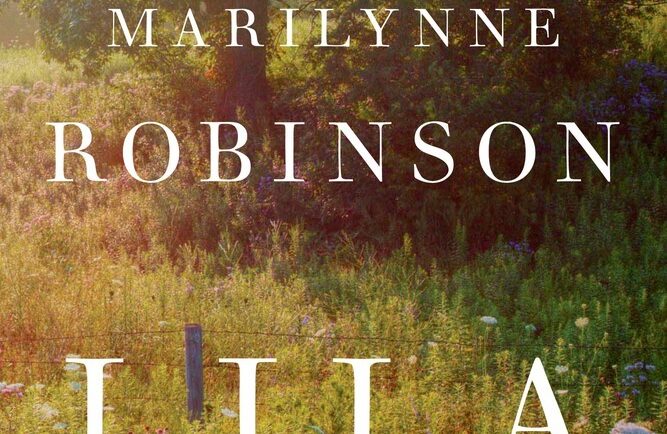
 by Marilynne Robinson
Farrar, Straus and Giroux, New York. 261 pages
REVIEWED BY LAURA CUNNINGHAM
If the first book of her Gilead trilogy established Marilynne Robinson as the patron novelist of misunderstood American Calvinism, the third book, “Lila,” secures her place. In the first novel Congregationalist preacher John Ames writes to his young son, in part to tell him the unlikely story of meeting and marrying the boy’s much younger mother, Lila. The latest novel tells Lila’s own story of tragedy and loneliness, kindness and redemption, as she finds her own balm in the small Iowa town.
Don’t read “Lila” expecting another “Gilead.” Lila’s Depression-era story of growing up orphaned, yet sheltered by a group of Midwestern migrant workers, differs in tone and style, reflecting the difference in her character. While both she and Ames are lonely, Robinson weaves Ames’ personal reflection and theology to tell his story while Lila’s relies on the grit of the character’s existence. Lila asks the difficult questions of her own life’s secrets without using difficult language, underscored by the terse sentences and word choice throughout the novel. “Lila” itself is a character study of Ames’ claim in the first novel that we humans are truly secrets from one another, that we each have our own separate language, aesthetics and jurisprudence.
In this alternate aesthetic, beauty grows as the tragedies in Lila’s life — her loss of her protector, her lonely journey — become a source of grace. Lila’s difficult childhood, lack of resources, brush with prostitution and longing for a child mean she wrestles with bitterness, yet she often acts out of compassion. She tends the unkempt grave of Ames’ dead wife, planting roses without telling him. She offers her coat to a man who left home afraid he killed his father. Based on my own irritation with people who try to convert others, one of her kindest acts is to offer herself as someone her Nazarene traveling companion could bring to Jesus. (Spoiler alert: it doesn’t happen.)
In “Lila,” depictions of grace contrast significantly with those of Flannery O’Connor, another writer shaped by the Iowa Writer’s Workshop where Robinson teaches. If O’Connor depicts grace in a young, irritated college student throwing a book on human development at another woman’s small-town ignorance, Robinson finds grace in a slightly older uneducated woman’s discovering love in a small town. As opposed to O’Connor’s sardonic, hard-knock grace, Robinson’s is tender kindness, born of ordinary moments. The difference may stem from each author’s contextual frustration: O’Connor’s as a southern Catholic affronted by evangelical pietistic platitudes, Robinson’s as a Midwestern Calvinist tired of atheistic intellectual snobbery. Either way, grace is not easy.
In an increasingly secular age, however, Robinson’s grace is the necessary one. In her reading of Calvin, “the aesthetic is the signature of the divine.” We may perceive a life as beautiful and discover grace in it, even if it seems a failure by other standards. In a culture often disdaining the art of discovering sacredness in the ordinary, unable to recognize miracles at work in personal darkness, “Lila” invites readers to engage the countercultural, difficult, and even biblical questions of how light can shine in darkness and of how love grows between unlikely people and new life comes when least expected. In our reading, we find grace.
LAURA CUNNINGHAM is pastor of the Nauraushaun Presbyterian Church in Pearl River, New York.