“Educate a Child, Transform the World” — the General Assembly of the Presbyterian Church (U.S.A.) approved that new initiative in 2014, the kind of feel-good (and do-good) idea that pretty much all Presbyterians can get behind. But what does it mean, exactly?
Meeting the need
The intent is for Presbyterians to provide education to one million children both in the United States and overseas over the next four years, one tool for giving people a foothold out of poverty. At the assembly, Presbyterian Mission Agency leaders acknowledged that the initiative is better funded and the ideas better developed internationally than for the U.S. — and they welcomed suggestions from Presbyterians on exactly what types of education partnerships to pursue.

At the grass-roots level, some Presbyterians have long been involved in working with children, teenagers and their families — both in direct service and in public policy advocacy — and find the work both challenging and worth doing.
In part, that’s because of the immense need. According to the Children’s Defense Fund:
- One in five children — more than 16 million children — lived in poverty in the U.S. in 2012. Children of color were disproportionately affected — nearly one in three were poor — and the poorest children were the youngest, under age 5.
- Working families are struggling. More than two-thirds of poor children lived in families where at least one person had a job.
- School performance lags. More than a quarter of public school students either don’t graduate on time or drop out, and nearly 60 percent of all fourth and eighth grade students could not read or compute at grade level in 2013.
Presbyterian call to action

How can Presbyterians get involved? According to Shannon Daley-Harris, a Presbyterian minister who is religious affairs advisor for the Children’s Defense Fund and coordinates its Children’s Sabbath program, there are examples all over the country — both of providing direct services and of public policy advocacy. Among them:
- Some Presbyterian churches, including Covenant Presbyterian Church in Charlotte and First Presbyterian in Germantown (in Philadelphia) serve as sites for the Freedom Schools program — a seven-week summer program in which young adults work with children to bolster academic and leadership skills.
- In Rochester, New York, a network of 10 PC(USA) congregations called Urban Presbyterians Together works to improve education in the area — tutoring elementary school children, collecting school supplies and winning an $8,000 grant to study urban public education successes in Raleigh, North Carolina. The work also includes public policy advocacy for increased funding for early childhood programs.
- Nassau Presbyterian Church in New Jersey helped to start the Trenton Children’s Chorus in 1989 — which now has grown to serve 140 singers who perform throughout the region and involves church volunteers helping with homework and tutoring and serving as chaperones.
In Los Angeles, some of the PC(USA)’s young adult volunteers work with teenagers and families at La Casa de la Comunidad community house in the Hollywood neighborhood. According to director Matthew Schmitt, what used to be a tutoring center has evolved into more of a gathering space in “the homeless capital of the country.” High rent means whole families might be crowded into one bedroom, and “there’s a lot of tension about becoming homeless” — many people teeter just on the edge.
To get a little space, people from the neighborhood come to La Casa — parents use the tables to help their children with homework, volunteers tutor, kids play basketball. In the summers, teenagers in the neighborhood are hired for a program called Discern, to host short-term mission groups, learn leadership skills and help explain to visitors what life is like in this low-income urban neighborhood. La Casa occupies the front of the duplex; young adult volunteers live in an intentional community called Dwell in the back — assisting the children and families and learning from them too.
“We’re trying to create this dynamic of mutuality” at La Casa, Schmitt said. “Let the neighbors show them (the volunteers) the hospitality and welcome them into the neighborhood … . My mission is to create space for the spirit to do the spirit’s work.”
Trina Zelle, national organizer of the Presbyterian Health Education and Welfare Association (PHEWA), said successful programs generally grow out of relationships, by listening to what people from the community identify as their greatest needs. “Do not try to start a ministry of any kind without bringing stakeholders in on the ground floor,” Zelle said.
To get started, Daley-Harris encourages congregations to think about “what do we especially have that we can offer? What are the ways people want to contribute? … That’s what helps it be sustainable. If it doesn’t feel like their greatest gift, it is not going to sustain itself.”
She also suggests that Presbyterians look intentionally “at some of the systemic issues and
policy changes that we can work for. This is not where most people are comfortable” — compared to something like tutoring a child, “meeting with a member of Congress or picking up the phone to call an elected official can be a lot more daunting … But we need folks to go out on those skinny branches.”
Congregational activity
Here are some more examples of what congregations are doing:
Backpack Blessings. Early every week during the school year, someone from Austell Presbyterian Church, a congregation outside Atlanta, picks up backpacks from Hendricks Elementary School. Following the Wednesday night church supper, volunteers fill those backpacks with food — a main dish such as tuna or a can of soup, a fruit cup, oatmeal, crackers, a granola bar, sometimes more. Every weekend, the backpacks go home with about 85 children who qualify for free or reduced price lunch at school — children who may not have enough food at home to eat. It costs the Austell church $150 to $200 per week to provide the food — and the school counselors say the food makes a big difference, even though it may not seem like much.
“That may be the important thing — that they can count on it,” said Elizabeth Jefferson, an Austell volunteer who coordinates the Backpack Blessings. “We’ve had little ones at that school who would get sick and who would not want to go home until after they ate lunch.”
The backpack program also has led to deeper connections between the school and the church. The congregation helped pay for an end-of-year field trip for fifth graders, provides a back-to-school breakfast for the teachers and “teacher of the month” gift cards. After the 2012 shooting at Sandy Hook Elementary School in Connecticut, Austell’s pastor went to Hendricks at a teacher’s request to pray with staff members before school started.
Adopt a School. In Jackson, Mississippi, Fondren Presbyterian Church has been a partner with George Elementary School in the local “Adopt a School” program for about 25 years — sharing the responsibilities with a local Baptist congregation. “It’s been a good partnership,” said ruling elder Jan Taylor, who’s been a “book buddy” for 15 years, reading every Wednesday with a first grader and sometimes staying to read for the whole class after lunch — recently, it’s been “The Secret Garden.”
The Fondren congregation buys books to send home with the children over the summer and gives every child in the school a book at Halloween. The church provides Christmas presents for the families of 40 children (selected by the teachers) every Christmas; sends judges for the school science fair and volunteers to tutor math. George Elementary is “a regular little elementary school” — a neighborhood school that over the life of the partnership has become one of the highest-achieving elementary schools in the district, Taylor said.
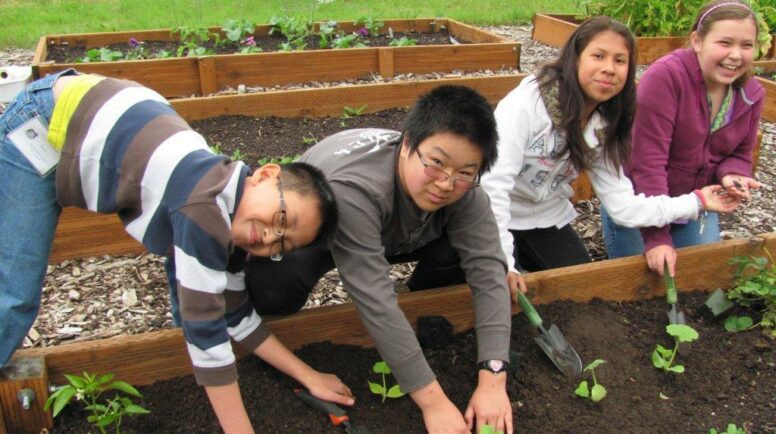
That idea led to research, grant applications and a cooperative project that has involved the school, the church, the Boy Scouts, the local water utility company and the neighborhood. A volunteer from the congregation, Phyllis Kirkwood — herself a farmer — is the garden coordinator who works “boots on the ground in the garden with the kids,” Sievert said. The church rents out some of the 16 raised bed plots to community folks; the children harvest food and study about plants and the environment; and Clean Water Services, the local utility, donated a cistern to collect rainwater from the church roof.

“Reedville has as its motto ‘there’s a place at the table for everyone,’” Sievert said “We mean that, at its core, the Eucharistic table, but also all the other tables around which we gather.”
The Reedville school and community includes the families of migrants and service workers, many of them transitory. “One of the needs that people face is hunger and the need for belonging,” Sievert said. “We see this as a way of being Jesus out in the community. What would Jesus do? He might start a community garden. He was kind of a gardener of sorts. This is a way of being faithful stewards of the resources we have — namely, land, know-how, people … Everything we can do to connect to the underlying sinew of the community life makes it a little bit more like heaven on earth. That’s what we’re praying for on Sundays.”
“A lot of these kids don’t really have anybody at home who takes time to read to them,” she said. “It makes so much difference when they can be read to — and they read to me. It also gives them opportunities to have conversations with an adult.” Often, at home, their working parents are busy, so “they get instructions, they get scolded, but they don’t really get to converse” — to describe things, to be imaginative. “They like feeling books and touching books and going to the library and taking books off the shelf.”
George Elementary is a nurturing environment, where “all the teachers know all the kids” — a good stepping stone to a larger middle school. At Fondren, some Presbyterian volunteers give money and others give time; some love to shop for the children’s families at Christmas; and a group of the men always cooks breakfast for the George Elementary teachers and the staff at the end of the year.
For the children, “probably the most meaningful thing to the kids is the personal interest of the folks coming into their school,” Taylor said. “It doesn’t cost anything to have a Book Buddy program” — you can read books you’ve checked out of the library. What matters most to the children: “Grown-ups think they’re important and want to spend time to them.”

Community gardens. Reedville Presbyterian Church, a congregation of about 50 people in an unincorporated area west of Portland, Oregon, has a tight relationship with nearby Reedville Elementary School — the same family donated the land on which the school and the church now sit. Reedville’s pastor, Jeff Sievert, has served as chair of the school’s site council — and about a half dozen years ago, a teacher at the school asked him if the congregation would be willing to offer some of its land for use for a community garden.