 Fifty years after Martin Luther King Jr. spoke in Montreat’s Anderson Auditorium, almost 1,000 participants gathered to remember King’s message and consider how the church of today is called to address racial divisions and continue his work. “Dr. King’s Unfinished Agenda: A Teach-In for Rededicating Ourselves to the Dream” was held August 21-23 at Montreat Conference Center in North Carolina. Woven throughout the three-day event were videos with photos and audio of King’s speech from 1965. The resonance that those words had all these years later was striking. Words like, “We do live in days of emotional tension when the problems of our nation and of our world are gigantic in extent and chaotic in detail.” Words like, “When the church is true to its nature, when it is true to the gospel of Jesus Christ and when it is relevant, it is always active in any period of social change seeking to guide and direct, seeking to bring the eternal veritas of the gospel to bear on the particular situation. This is the great challenge facing the church today. This is the great challenge facing every Christian in these days of racial tension.”

The challenge of relevancy and bringing the eternal veritas of the gospel to bear on our time of racial tension was taken up by each of the speakers. Pulitzer Prize winning columnist Leonard Pitts Jr. used the metaphor of travel, pointing out that as a country we have made progress, however we are far from the destination and there is still much work to be done. Pitts likened it to setting out with a friend to go from Miami to Seattle, stopping for a break in Kansas City and having your friend refuse to go any farther. Pitts said the passengers couldn’t deny that progress had been made – yet they must also admit that they did not complete the journey. Edye Bender, a Christian educator at Faith Presbyterian Church in Providence Presbytery, attended the conference with her family and said of Pitt’s speech, “One idea that has stuck with me was the metaphor of traveling from Florida to Washington and getting stuck in Kansas City. I identify with that person who turned in the question that basically said ‘I was born in Kansas City and was told it was Seattle.’ I think it’s very easy, as a white person, to look around and say ‘We’ve come so far!’ but to not even realize the many hidden ways that white privilege shows up in my own life.”
Charles Blow, a columnist on politics, public opinion and social justice for the New York Times; a commentator for CNN; and the author of the 2014 New York Times bestselling memoir “Fire Shut Up in My Bones” also recognized the reality that as a nation, and indeed world, there are still great prejudices toward people of color. He emphasized the need for the scales to come off of people’s eyes in order for these injustices to be addressed. During the questions-and-answers segment following Blow’s talk, he was asked how public servants can ensure they do not become complicit with systems of racism. “Until we realize that we have been conditioned and trained and baptized in bias,” necessary steps cannot be taken to consciously search oneself and ensure that one is not perpetuating bias. Blow pressed listeners to examine their spheres of influence and try to operate in that sphere. “That is where you are most powerful, because that is where you are most intimate.” Organizers of the conferences picked up on Blow’s advice, as well as participants’ persistent question “What do we do now?” and invited everyone to make a commitment to working toward ending racism in their current contexts. Commitment forms were distributed during closing worship and over 400 were collected pledging actions including becoming involved in Moral Mondays and starting intentional discussions within a congregation. Conference leaders plan to follow up with attendees to see how those commitments are bearing fruit.

In addition to the keynote speakers, worship was an integral part of the weekend. Powerful preaching, thoughtful liturgy and theologically rich music made for inspiring worship. Preachers included Yvette Flunder, founder of the City Refuge United Church of Christ; Vashti Murphy McKenzie, bishop of the African American Episcopal Church; and William Barber II, president of the North Carolina State Conference of the NAACP and founder of Moral Mondays. In keeping with the theme of Martin Luther King Jr.’s unfinished agenda, Barber preached, “What we need are not people who will erect monuments to Dr. King, but people who recognize that imitation is the best form of flattery.” Barber said that gatherings, such as the one taking place at Montreat, need instead to be held in statehouses. The church must stand up, he said. He asked if the crowd could imagine what would happen if the church fully embraced the prophetic responsibility to moral dissent. It “would change the discourse,” he said. It’s all right to have a retreat, he continued, but as Dr. King advised, when you come down from the mountain, you have to have a revolution.

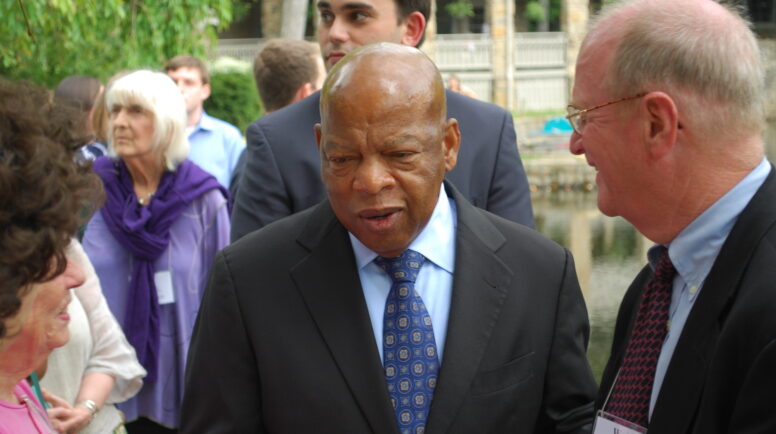
John Lewis, U. S. Representative for Georgia’s 5th congressional district, spoke to a packed auditorium on Saturday evening. He began his remarks as he slowly walked from one side of the chancel to other reflecting on being in the place where 50 years ago his friend walked and spoke saying, “It is almost too much.” Recounting his experiences of that time, Lewis talked about growing up and being admonished “not to get in trouble.” But he said, “The spirit and the words of Martin Luther King Jr. and the actions of Rosa Parks inspired me to get in trouble… the teaching of Jesus inspired me to get in trouble.” He said emphatically, “It is time for the church to get in trouble again.”
Speaker after speaker called those gathered to get involved, echoing King’s call 50 years prior for the church to be true to its nature through being active in social change and bringing the truth of the gospel to bear on the current situation – a current situation that includes a racially motivated massacre at a historic African- American church, police shootings of unarmed African Americans and the #blacklivesmatter movement.
The energy of those gathered on the mountain was intense and palpable. Animated conversations were evident around meals and on the benches surrounding the auditorium. Clearly, the time was right for a conference such as Dr. King’s Unfinished Agenda. Those in attendance included some who had been present for King’s speech 50 years ago, Presbyterian ruling and teaching elders well acquainted with the Western North Carolina conference center, and many visiting Montreat for the first time.

Arreasha Bryant, music director for Holsey Chapel CME Church in Columbus, Georgia, and a member of a Seventh-day Adventist church, was one of the first-time attendees to Montreat. She learned about the conference through Johnson C. Smith Seminary’s social media posts. She said she believes that “knowledge is power” and came hoping to learn more about improving racial relationships. But she found more than she bargained for.
What did she expect? She said the thought she’d see a lot of African-Americans like herself talking to each other, having the same conversations and wondering, “How can we impact white people?” Instead, when she entered the auditorium to see so many white Presbyterians, she thought, “Woah!” She said she realized, “my willful ignorance was beyond my scope.”
As the conference drew to a close, Bryant praised the tone and content of Unfinished Agenda and said she hoped to have further opportunities to connect with Presbyterians, returning home with hopes to share community with Presbyterians in her area and the possibility of bringing the youth she works with to one of Montreat’s youth conferences. Thinking over her experience at Unfinished Agenda, Bryant said, “We have one God, one church” – adding God’s coming back for God’s servants, “not coming back for a denomination.”
It was also Denise Anderson’s first time to Montreat. Anderson is the pastor of Unity Presbyterian Church in Temple Hills, Maryland. When asked what she expected she said, “I expected and hoped for some cogent, intelligent and moving reflection on Dr. King’s work, his visit to Montreat and its implications, and how we are to continue that work in our own context. I expected excellent preaching and insightful plenary addresses, which we definitely got.”
 She said of the weekend, “My experience was largely positive. I came away from Dr. King’s Unfinished Agenda very proud to be both black and Presbyterian. Reflecting on King’s legacy gave me renewed pride in the past, and wrestling with contemporary issues made me hopeful for the future. It was heartening to see the diversity present and to know that some who were there 50 years ago had joined in the assembly. I think I was in awe of that. I was also pleasantly surprised when stated clerk Gradye Parson put forth the need for confession and repentance of the sins of racism on the part of the church and the denomination. It was refreshing to hear church leadership make that so plain.”
She also expressed disappointment about “an unfortunate outburst during a memorial litany for the Charleston nine.” Following a remembrance of the nine who were murdered at Mother Emmaunel in Charleston, a member of the congregation shouted out the name of the alleged shooter in an attempt to include him in the litany. Anderson said it was “an outburst that many of us found racially insensitive, and Montreat’s subsequent silence about it. Though they weren’t responsible for what happened, I half expected it to be addressed by Montreat leadership at some point and was disappointed that it wasn’t.”
Attendees also questioned the presence of armed police at the conference, wondering on social media and in casual conversations whether this was commonplace at Montreat events and asking why this was not publically acknowledged and explained during the event. In response to an Outlook query, Richard DuBose, president of Montreat, said, “The safety of our guests is always our top priority and we provide security for all of our large conferences. Because we held registration open through the weekend, we expected a very large gathering.We also considered the needs of our speakers and the guidance of local law enforcement as we determined our security needs.”
 A return visitor to Montreat, David Bender, pastor of Faith Presbyterian Church in Fort Mill, South Carolina, was drawn to the conference due to his study of King and his interest in hearing John Lewis. He came expecting “intelligent issues surrounding racism and injustice to be explored. I expected the critiques to be both introspective and the product of good research. I expected to leave feeling a bit guilty about my role and the role of the white society from which I came in the perpetuation of racism and injustice.”
And what did he experience? “I guess I experienced all of those things. I appreciated several metaphors that the presenters utilized – how white folks see the cup as half full and African-American folks are more likely to see the cup as half empty. The image of the journey from Miami to Seattle, and being stuck somewhere in Kansas City. I also appreciated the idea that the white cop didn’t get up that morning expecting to kill an unarmed black man, but that it was the nature of society which led the white cop to de-value and maybe even to fear the black man.”

When asked if anything about the conference surprised him he noted, “I’ll admit – I was surprised by the racial make-up of the conference attendees. Maybe that racial make-up simply speaks to the racial make-up of the Presbyterian Church as a whole. But, I was still surprised.”
After three days of expectations met and exceeded, three days of honest, motivating preaching and teaching, three days of a Spiritfilled mountain top experience, what comes next is yet to be seen. Martin Luther King Jr.’s agenda remains unfinished but at least 1,000 people of faith have made commitments to continue the work and remain in Kansas City no longer.