Some Presbyterians write because they have to — those frantic Saturday night sprints, pounding out a sermon. Others write because they feel a whisper, a nudge, they sense the words pushing to spill out. Can writing be a spiritual practice? The answer, for many, is yes.
Even when they’re not getting paid for their words, people of faith write prayers, novels, essays, blogs, poetry and more. Some write for publication, some in private journals. They write because they can.
For a few folks, here’s how that works.
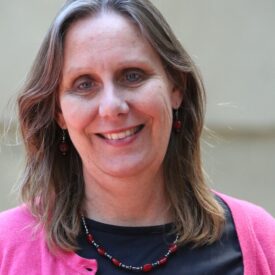
 Brad Wigger, the teacher. Wigger, a professor of Christian education at Louisville Presbyterian Theological Seminary, just finished teaching a weeklong seminar called “The Writing Pastor” — offered in partnership with the Collegeville Institute, and for which 70 people applied for a dozen slots. Wigger also teaches a class at Louisville Seminary called “Writing for the Church,” focused on creative writing rather than crafting sermons. Wigger himself has written in a variety of genres, including a book on parenting and faith; a book of prayers based on the Psalms; a nonfiction book on science and religion; and a picture book for children.
Wigger introduces his students to books on the writing craft — including Anne Lamott’s “Bird by Bird,” Peter Elbow’s “Writing with Power” and Annie Dillard’s “The Writing Life.” He brings in speakers who work in different genres — such as a songwriter, a novelist, someone who works in denominational publishing.

And he often starts the classes off with short writing exercises to get the energy flowing. Such as: Write a three-minute piece of fiction. Start with the phrase, “The bus shook and rattled” — and keep going from there.
Is writing a spiritual practice? “There are a lot of analogies with prayer or contemplation,” Wigger said. “When you’re really focused or engaged in trying to write, it is almost an alternate state.” When he’s immersed, he says “I lose track of time and forget to eat … the process of writing gets in touch with something deep. At times it can feel sacred.”
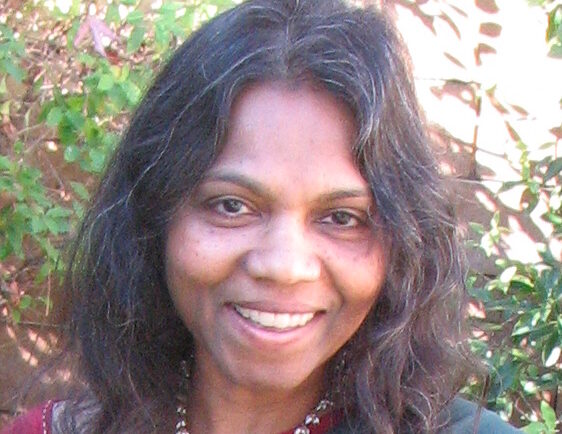
 Anita Coleman, the professor. For Coleman, an author, an immigrant from India and a California blogger who started her career in academia, writing helped her find her faith again at a time when she was pretty sure she’d lost it. She had finished her doctorate, but left her job as a college professor to stay home with her family and felt like she was losing touch with both her belief and her creativity. In college, Coleman had written short stories and poetry, but years spent on academic research had stomped out that spark. At her father’s urging, she began to journal.
“It was definitely a spiritual practice,” Coleman said of that first year — when she would read that day’s lectionary passages from the Bible, then set aside an hour to write her thoughts about what she had read. “For me, the hunger to read God’s Word and to study it — it was so deep, it was worse than a physical hunger,” Coleman said. She thought of the journal entries as private love letters to God.
In time, though, Coleman began to share her writing with others — through blogging and publishing books ranging from spiritual reflections and devotions to a children’s book. She has also written about issues related to justice such as racism, immigration and the debates within the Presbyterian Church (U.S.A) about ordaining gays and lesbians. She’s now a board member of the Presbyterian Writers Guild.
“God opens all the doors and takes you, uses you,” if you’re willing to be humble and to learn, Coleman said. “It is very much a lived experience. … Every morning, 8 o’clock, I drop everything and write.”
Margaret Irwin, the poet. For close to 20 years, Irwin has been involved in an evolving writing ministry at Montclair Presbyterian in Oakland, California. It started in 1997 with a life-story writing group, which was supposed to last for a few months and “went on and on and on,” Irwin said. Among the seeds that have sprouted from that ongoing ministry:
- An annual church anthology — published 16 times so far, filled with poetry, essays, opinion pieces, vignettes and short memories written by Presbyterians from the congregation.
- Faith journeys — shared with the congregation during worship.
- Open mic sessions — held at the church, where people share their creative writing in five-minute chunks. One participant, a man who served as a pilot in Vietnam, couldn’t get through his reading the first time he tried — his wife had to finish it for him, Irwin said. “Now he reads all the time.”
- Works in progress — giving a few people longer periods of time to showcase their writing. One day, a series of congregants shared pieces they’d written on aging. Others were one-person shows: a woman writing about her work as a teacher, another telling of her experience with cancer.
Building on her experiences at church, Irwin now visits five places each week (two senior centers and three assisted living facilities) to help older people write about their memories, their travels, their gardens, their lives. “It gives them a voice, it gives them a chance to think about their lives, to share and to talk with other people,” she said. “We’re supposed to be living in community, and not isolated. … Some people have never felt they had much value. They don’t feel they have something to say. Of course they do.”
Irwin, 84, has self-published a series of volumes of poetry, which she shares with her family and friends.
At Montclair, she finds the opportunities for storytelling help people to go beyond superficiality, create a sense of trust and honesty and establish community. “We’re adults — we’ve all been through stuff,” Irwin said. “You can’t be a real family in the church if you’re only there to show a positive face. It has to be deeper than that.”
Dan Wakefield, the professional. Wakefield, an acclaimed novelist, screenwriter, journalist and memoirist, has been teaching workshops on the art of spiritual autobiography for nearly 30 years — in churches and synagogues, retreat centers, even Sing Sing prison. He has written his own spiritual memoir, “Returning,” about how he found himself in his late 40s living a life eroded by alcohol, drugs and loneliness; he headed east from Los Angeles to reclaim his health and his faith. His book “The Story of Your Life: Writing a Spiritual Autobiography” was written to help others learn to tell their own stories.
For some students the first impulse is to look for dramatic moment — the conversion experience, “something like lighting coming out of the sky,” Wakefield said. He encourages them instead to be “looking for the Spirit in every day events and occasions,” and to write about something deep and memorable if they can’t think of anything overtly spiritual.
The act of writing, Wakefield said, is “a form of meditation,” of clearing the mind, a road to honesty and self-understanding. One man wrote of growing up in a house with no central heating; of how his mother would turn on the gas stove to warm up the house and put orange peels on the burners to send the aroma through the house; of lying in his nest of blankets in the dark and hearing the spoon clink against the cup as his father made his coffee. “It was as spiritual as any church bell,” Wakefield said. “He came to realize that when he was a father himself.”
Wakefield quotes James Carroll, a former priest turned writer: “The very act of story-telling, of arranging memory and invention according to the structure of the narrative, is by definition holy. We tell stories because we can’t help it. We tell stories because we love to entertain and hope to edify. We tell stories because they fill the silence death imposes. We tell stories because they save us.”
 Maureen Purcell, the student. Earlier this year, Purcell participated in a series of spiritual autobiography workshops Wakefield led at Northminster Presbyterian Church in Indianapolis. Wakefield instructed the students to picture a home they’d lived in during childhood, near adolescence, and to draw a picture of one of the rooms. Then, he said, write about what you remember.
Purcell drew a picture of the front room, with a stairway, a piano with her mother’s music, “and off that room was a huge wonderful oak door that actually led to a small bathroom.” Her father was an alcoholic. She wrote about standing in that bathroom at age 12 or 13, when “my hands would cramp up in times of stress in my family. I would go in the bathroom and shut the door and soak my hands in the sink. The steam would rise up. I would be looking in the mirror, and say all the things in the mirror I couldn’t say on the other side of that door.”
Purcell has practiced writing spiritual autobiography for years, bit by bit. She was a drama major in college; became a copywriter; and wrote a monthly column for Northminster on mission work. Her brother, who teaches writing at a college in Florida, introduced her to a series of writing exercises, including one that begins, “I remember.” She began writing personal memories — including those involving her dad, a small-town doctor who got sober and entered recovery with the help of Alcoholics Anonymous (AA), and who died in a car accident two years later with “a lot of things not settled at the time of his death,” she said.
She wrote about his friends from AA who would come over “on random afternoons, sitting around drinking coffee and smoking cigarettes,” and “I got very flowery,” describing the smoke “hovering on the ceiling like tongues of fire” — her family was Pentecostal. That image stuck with her, teasing her consciousness for a decade, until at Pentecost one year she heard someone voicing a certain discomfort with the Holy Spirit and the tongues of fire.
Purcell started poking at the subject again, writing of how in AA the first day of sobriety is considered a birthday — celebrated with candles, with fire. She wrote of the people her father met in AA; of how her father helped a man he found drunk and passed out in the street after the man’s third failed attempt at a recovery center in Louisville; of the people in AA who minister vigilantly to others.
“They’re the saints,” Purcell said. “Talk about the Holy Spirit, being Spirit-filled. Talk about speaking in tongues — they were the only people who could go to other alcoholics, because they had the same language.”
Eventually, what she wrote — the stories of people from AA, interspersed with the acts of the apostles from the Pentecost story — became a liturgical play that has been presented three times in worship at Northminster. The last time, Purcell read her narrative while a good friend read from the Bible about what happened to the apostles at Pentecost.
“It just fit,” Purcell said. At the end, “the congregation was absolutely quiet,” until she heard someone murmur softly, “Whew.”
Her pastor, Teri Thomas, asked as she was writing: “What’s the theology?”
Purcell responded that “it’s saying to me the Holy Spirit exists. And the Spirit exists through these people.”