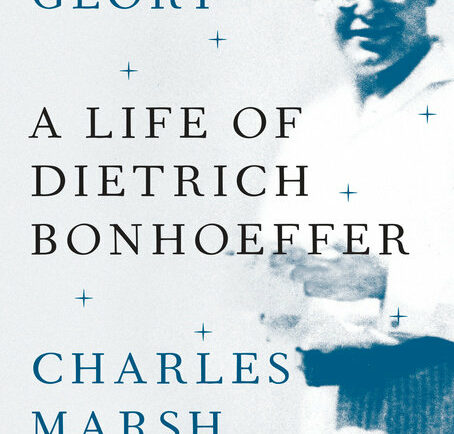
 by Charles Marsh
Vintage Books, New York. 528 pages
REVIEWED BY R. KENDALL SOULEN
Charles Marsh’s “Strange Glory” is a splendid biography, by turns graceful, enthralling, humorous, terrifying and inspiring. Marsh is a skillful writer, but what gives his book its power is the uncanny serendipity of Bonhoeffer’s own life. Karl Barth was the greater theologian, Martin Luther King Jr., the more consequential church leader. But it was Bonhoeffer’s fate to live closest to the point where so many great tectonic plates of the last century collided. At the risk of flippancy, Bonhoeffer was the real-life Forrest Gump of the first half of the 20th century, albeit one equipped with a first-rate theological mind. In his short life, Bonhoeffer experienced the last great flowering of liberal Protestantism in Berlin, the social gospel movement in New York, the birth of the modern ecumenical youth movement, the vibrancy of black religion and culture in Harlem, road-tripping through the American south, sparring with Karl Barth, correspondence with Gandhi and so on. And all of this before he committed himself to years of spiritual leadership and political resistance inside the ever tightening noose of Nazi Germany. A good biography illuminates its subject, but an excellent biography also illuminates the times. Readers of “Strange Glory” get a powerful, three-dimensional sense of young Dietrich, but also of the tumultuous and perplexing times in which he lived.
Marsh writes in a manner that is rich in primary sources and restrained in editorial comment. Near the center of his tale he places Bonhoeffer’s friendship with his student Eberhard Bethge, Bonhoeffer’s junior by three years and his first biographer. In 1935, Bonhoeffer spearheaded the formation of the Emergency Training Seminary of the Confessing Church, the famous school that was eventually located in the Polish town of Finkenwalde. Bethge was one of the school’s first students. From the outset, the seminary was by Bonhoeffer’s design as much a monastic enclave as a center of teaching and learning, and so Bonhoeffer and Bethge related to one another not only as teacher and student, but also comrades in Christian discipleship. In time the two became inseparable friends. They shared travels, vacations and even a joint bank account. Marsh portrays Bonhoeffer as “smitten” by the younger student, while making clear that Bethge could not return Bonhoeffer’s affections in the same way. Throughout his account of their relationship, Marsh proceeds with appropriate discretion and restraint. He makes evident the intimate bond that grew between the two men, while refraining, by and large, from adding his own voice to those of the two friends, who are permitted to speak to and for themselves.
Marsh has written a biography that is theologically interested and perceptive. “God, the Eternal,” Bonhoeffer wrote to Bethge in 1944, “wants to be loved with our whole heart, not to the detriment of earthly love or to diminish it, but as a short of cantus firmus.” While Bonhoeffer’s understanding of what this might mean changed over the course of his life, the insight itself seems to have been present from the beginning. That is the strange glory that radiates from Bonhoeffer’s life.
R. KENDALL SOULEN is the director of the master of theological studies program and professor of systematic theology at Wesley Theological Seminary. He is the author of “The God of Israel and Christian Theology” and “The Divine Names and the Holy Trinity: Distinguishing the Voices.”