For many people, retirement means choices and lots of questions to answer. Do I want to stay in my present location or will I call some place else home? Would my life be better in a warmer and sunnier climate? Should I move closer to my children and grandchildren? Can I afford to move into a community that will provide the care I will need throughout my life?

Like many baby boomers who have lived in several locations in our increasingly mobile society, my wife Lenore and I were not sure where our retirement home would be. We had lived in several pleasant communities and each one offered retirement possibilities. But we decided we were not ready to settle back into one of the comfortable and predictable contexts of our recent past. It was time for a new chapter, a new beginning. We visited friends living in a unique retirement community called Pilgrim Place in Claremont, California. After that visit we decided to move across the country from Richmond, Virginia, to Pilgrim Place. And as the saying goes, “the rest is history.”
Claremont, a town of approximately 35,000 people, is part of the sprawling Los Angeles metropolitan region. It is located within a network of crowded expressways, endless housing developments and strip malls, most of which were built since the 1950s. Sandy beaches, Hollywood, Disneyland and the Queen Mary are well known southern California tourist attractions.
But Claremont is not at all typical of what many people think of as southern California. Located 30 miles east of Los Angeles, Claremont identifies itself as “a city of trees and Ph.D.s.” Five very good colleges, a distinguished graduate school and the Claremont School of Theology have attracted hundreds of Ph.D.s and approximately 6,000 students to what was at one time a rural citrus-growing community.

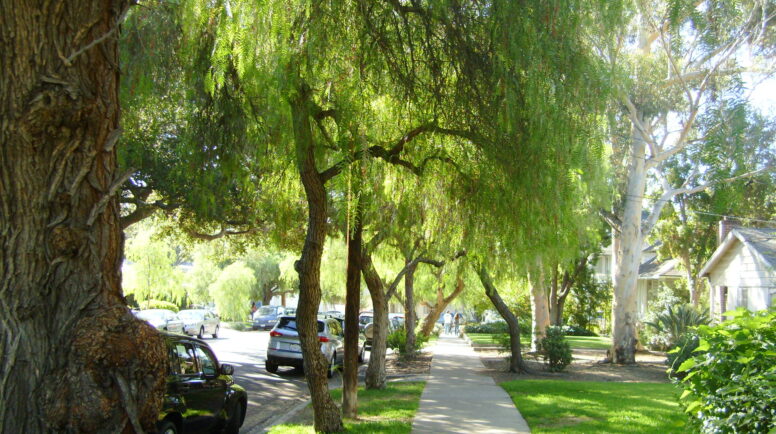
One hundred years ago, a missionary named Margaret Porter and key leaders of Pomona College, a liberal arts college founded by Congregationalists with deep roots in New England, established the Claremont Missionary Home. Their plan was to provide a furlough and retirement home for congregational missionaries and pastors. From that modest beginning in 1915, a retirement community has developed into what is now a home for some 320 residents. Incorporated as Pilgrim Place, the community occupies a beautiful 32-acre campus with tree-lined streets that bear names like Mayflower, Plymouth, Alden and Leiden Lane. Pilgrims, as the residents are sometimes called, live in 120 private homes or apartments, 62 accommodations for assisted living or in the health services center. Pilgrim Place is an independent continuing care retirement community licensed by the state of California. It is governed by a board of trustees and administered by a professional staff.
While the initial founders of Pilgrim Place proudly embraced the New England Congregational tradition as its name suggests, it has evolved over the years into an intentional ecumenical Christian community. According to its mission statement, Pilgrim Place exists “to sustain an intentional community offering quality senior living and care for persons who have served in careers in religious or charitable non-profit organizations and to serve the wider community by providing short-and long-term care services.”
Location
Pilgrim Place is located in the Pomona Valley of Southern California between Los Angeles and San Bernardino. The San Gabriel Mountains provide a picturesque backdrop, abundant hiking trails and even occasional skiing. Within walking distance, the village of Claremont has many restaurants, medical offices, a public library, a post office, several churches, the Rancho Santa Anna Botanic Garden and several locally owned shops (chain stores like Wal-Mart are not in Claremont, but in neighboring towns). The Claremont Colleges and the Claremont School of Theology offer library facilities, public lectures, concerts and cultural activities (most of them free of charge) and a limited number of classes open to senior citizens.
The George Aquatic Fitness and Exercise Center includes a swimming pool and a spa. Two personal trainers offer yoga classes and help residents stay physically fit. A group of residents regularly work on their race-walking skills on the Pomona College track. Several of them won medals at a recent international competition in Lyon, France.
The Mediterranean climate of southern California offers cool evenings and warm sunny days much of the year. Many Pilgrim Place residents take advantage of the mild climate to grow a variety of vegetables and fruit trees in two community gardens. Even a prolonged drought has not lessened the profusion of colorful drought-tolerant native California plants. A very affordable Metrolink railway system provides
public transportation to Los Angeles and environs as well as San Bernardino. The Pomona Valley Hospital and the Kaiser Permanente Health Care facilities offer nearby medical services.

Community
In its 100 years of existence, Pilgrim Place has embodied an evolving understanding of community. Initially Pilgrim Place was only open to residents who were Congregational missionaries and ministers. Today, a significant number of retired United Church of Christ pastors and missionaries attest to the vitality of the Congregational heritage of the community. Over the years, however, Pilgrim Place has welcomed persons who have served in an ecumenical variety of religious denominations and nonprofit humanitarian agencies. In addition to Congregationalists, this intentional Christian community now includes United Methodists, Episcopalians, Presbyterians, American Baptists, Roman Catholics, Quakers and Unitarians among others. Residents have served in such agencies as the YWCA and the YMCA, the Wycliffe Bible Translators, Church World Service, Heifer International and a variety of community organizing groups.
What is an intentional Christian community? The 320 residents of Pilgrim Place collectively might provide 320 different answers to that question. Most of them would include the following characterizations in their answer:
- We are an inclusive and affirming ecumenical community that welcomes people between the ages of 62 and 78 without regard to race, ethnicity or sexual orientation.
- We are a community of people who care for each other in a variety of ways. We share one meal each day at noon around tables of 6 or 7 with rotating seating assignments. Residents are free to request seating with other residents of their choice, but usually a random computer-based list of seating assignments assures that residents gradually get to know all the other residents of the community. Many stories and much laughter make our mealtimes interesting convivial experiences.
- Some residents have been trained to be patient advocates and supportive listeners. They are available for residents who wish to have a patient advocate to accompany them to doctor appointments or for admission to a hospital for medical treatment.
- Our annual Pilgrim Place Festival welcomes approximately 10,000 residents of the greater Claremont area for two days of activities for children and adults. Booths offer food for sale and a variety of wares produced by pilgrims. Proceeds from the festival go to a fund that supports Pilgrim Place residents who have financial need.
- In preparation for the festival, residents work together in groups throughout the year to produce a tempting variety of baked goods, jams, jellies, and marmalades, much of them made from fruit grown on our campus. Others sell their paintings, books they have written, items made in the woodworking shop, hand-woven or knitted items, pottery, greeting cards and hand-made decorative pieces at the festival.
- Many residents work together in advocacy groups to speak out for peace, justice and ecological sustainability.
- Pilgrims plan and lead worship services and provide pastoral care for residents in assisted living units and the health services center.
- Pilgrim Place has developed a program called the Napier Initiative in cooperation with the Claremont Colleges and in honor of former residents Davie and Joy Napier to offer mentoring and modest grants to students who develop projects designed to further peace, social justice or ecological sustainability. Some residents also join college classes that are part of the Napier Initiative.
One of the distinctive features of Pilgrim Place is the significant role residents have in guiding the policies and day-to-day activities of the community. Residents frequently meet with administrators in community meetings to discuss concerns and participate in planning conversations. Resident and staff advisory committees meet regularly to consider facility maintenance matters, budgetary concerns, food service, and health and wellness programs. Each year several residents of the community are elected to serve on the board of trustees, which has the final authority in budgetary and personnel matters.

The character of a community is rooted in and shaped by the hearts and minds of the people who are its members. People are the heart and soul of the community. Shared commitments and aspirations nurtured in an atmosphere of mutual trust and respect enable Pilgrim Place to be a community in which all members can flourish. While the sense of community is strong, it is never smothering. Pilgrims march to their own drummer and are free to pursue their individual agendas.
Residents of Pilgrim Place have had distinguished careers nationally and internationally in ministries of education, health care and community development. As leaders of church ministries and humanitarian service organizations, pilgrims have served as living messages of the gospel of Jesus Christ for over a century. When they moved, they did not have to choose between location or community. In Pilgrim Placed they found both. As our centennial drama noted, “pilgrims do not really retire, they simply relocate!”
 JAMES A. BRASHLER is professor emeritus of Bible at Union Presbyterian Seminary in Richmond, Virginia. He writes the weekly Outlook standard lessons.