RECENTLY, IN THE CHURCH I ATTEND here in Austin — on, ironically, the feast day of Christ the King — there was a meeting after worship in our Great Hall. The session had called it to hear from any of the two dozen of us in attendance regarding whether or not we should post a certain sign on all the doors of our property.
The sign is ugly. It is also official and serious and apparently necessary. Its letters are too large, but we have no control over that. At the top of the sign, there is a drawing of a handgun with a red circle surrounding it and a red diagonal line slashing across the middle of it so as to convey the message: No guns. Beneath the drawing is this instruction: Pursuant to Section 30.07, Penal Code (Trespass by License Holder with an openly carried handgun), a person licensed under Subchapter H, Chapter 411, Government Code (Handgun Licensing Law), may not enter this property with a handgun that is carried openly.
The sign, if our session elects to post it, will indicate that our congregation won’t allow “open carry” on our property. Open carry is shorthand for a new law enacted this year by our state legislature. When it goes into effect, it will permit people to carry openly their handguns — presumably because they have taken the time and energy to register them (something that, literally, almost anyone can successfully accomplish in Texas, given the laxity of meaningful restrictions). Students at public universities can openly carry their handguns to class, citizens can openly carry their handguns to most other public facilities and — here’s why we were in the Great Hall on the afternoon of Christ the King Sunday — worshippers can openly carry their handguns to church. I can’t yet imagine what difference this new “freedom” will mean to a student angry about a bad grade or a bad break-up, or a library patron exercised over an unfair late fee, or a parishioner upset over a long service or a bad sermon.
But unless we post this ugly sign on each of the numerous doors on a beautiful urban complex of buildings, we will have no ability to memorialize that we don’t want guns carried openly in our sanctuary. Or to our font or our Lord’s Table. Or in our children’s church school classrooms. Or in our choirs’ rehearsal spaces. Or in the offices and meeting areas where our staff and volunteers counsel, pray and labor to coordinate so many of our ministries. Or in our food pantry from which we provide weekly the staples and nourishment that prevent those in greatest need from going hungry.
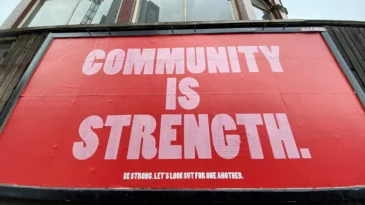
If we had no problem with open carry, we would not be required by law to put up any ugly signs. So the ugly signs themselves are intended, I suspect, to call us out. They are rather like ecclesial versions of scarlet letters — signifying to the larger public that perhaps our church is a trouble-making, non-cooperative, non-compliant collection of do-gooders objecting to what is otherwise in this state (at least in the imaginations of its legislators) a dominant paradigm.
But what are we to do? So many of us are, to varying degrees, smitten with the notion of a blessed community whose ruler is Christ.
My dear friend, the late John McCoy — a beloved alumnus of the seminary I serve, a brilliant pastor/ theologian who was also the chair of our board — once said these words to me. “The opposite of love is not hate,” he said. “It’s fear. That’s why Scripture says, ‘Perfect love casts out fear.’”
In these days where everything feels so precarious, pray for perfect love to cast out our fear. Pray that it render irrelevant all of our ugly signs.
 THEODORE J. WARDLAW is president and professor of homiletics at Austin Presbyterian Theological Seminary in Austin, Texas.