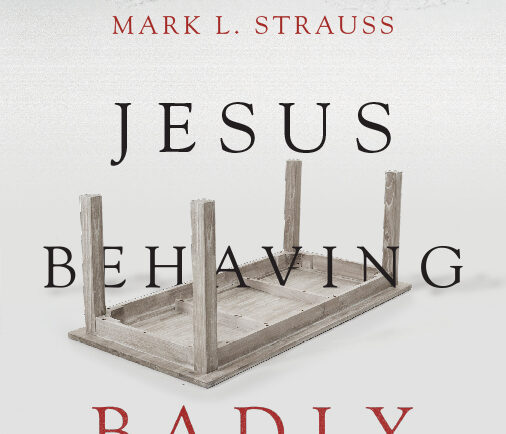
 by Mark L. Strauss
IVP Books, Downers Grove, Ill. 223 pages
REVIEWED BY THOMAS W. BLAIR
In a day and time when many people are just trying to get a handle on life, to find a template, a no-fault guide for surety and peace, Mark Strauss offers up a varied smorgasbord of a life lived for the ages, with more highs and lows than the average reader might expect. Jesus’ life and message was not a smooth transmission of truth and revelation bestowed upon devoted followers attuned to our Lord’s holy frequency. Those who may think this is so would do well to read “Jesus Behaving Badly.” Not everything Jesus said and did was fully understood by even his closest disciples, much less current scholars. Mark Strauss provides a wealth of well-chosen material to craft a moral compass from representative sayings, conversations, actions and the complex dynamics of Jesus’ ministry.
This work is a fairly straightforward and appropriately “punny” anthology of Jesus’ ministry framed in the context of his time and is well constructed for group or personal study. We are given an up-close-and-personal background of a suitable assortment of Christ’s teachings and actions, inviting us to evaluate our own presuppositions on our critical journey with Jesus.
Well versed in scholarship and unafraid to use it, Strauss analyzes some of the prophetic, paradoxical, whimsical, troublesome and dangerous words and actions of Jesus, placed in the context of his time, framed through the lens of history and popular understanding. Solid in historical scholarship, the reader is presented honest, hard-earned summaries and questions posed in response to Jesus’ message.
This is a very accessible book, in some measure a primer in first century religion and politics, inviting both those new to Jesus and those well acquainted with the Gospel accounts to take a fresh look and consider a different perspective.
Not having read an InterVarsity Press book in some years, I had forgotten the feel of the living room Bible study that its authors often employ, giving illustrations the “homey” feel for those of a certain suburban “soft” evangelical group. There’s a tendency for the author to head down a rabbit hole in a few opening anecdotes, but the detours never last too long. Strauss consistently draws the reader in with his light-yet-disciplined and well-schooled scholarship, so that the reader knows we are moving forward in his argument.
He is keen in crafting his chapters with an eye toward orthodoxy, posing questions first in a negative, then a positive light. His underlying agenda is made plain: “Knowing about Jesus is one thing; knowing him is something else.” This distinction is made clear in the best chapter of the book with a short-running debate with the skeptical writings of Bart Ehrman regarding the resurrection. In response, Strauss passionately evidences both the “hundreds of millions of people who have experienced miracles” and the “changed lives of the disciples who had seen [Jesus] alive.”
In a day and time when many people are trying to get a handle on life, “Jesus Behaving Badly” provides a clear, thoughtful and engaging forum to begin framing a new or renewed relationship with the Word made Flesh. This book is a treasure.
THOMAS W. BLAIR is the pastor of The Second Presbyterian Church of Baltimore.