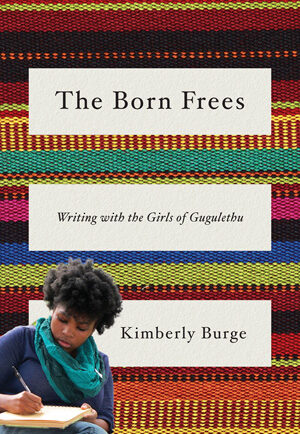
 by Kimberly Burge
W.W. Norton & Company, New York. 348 pages
REVIEWED BY HENRY G. BRINTON
At the J.L. Zwane Presbyterian Church in South Africa is a remarkable writing club called Amazw’Entombi, which means “voices of the girls.” The girls in this group are part of the Born Frees, the first generation of black South Africans born after apartheid. Journalist Kimberly Burge tells their story in this moving book after spending a year with them as a Fulbright Scholar. Today, South Africa has a progressive constitution that prohibits discrimination. But the country has one of the world’s highest levels of violence against women and the third-highest level of income inequality — a gap between rich and poor that is greater than it was during apartheid. In the face of these challenges, the girls of the writing club discover that they have a distinctive power in their hands, what Burge describes as “the ability to define themselves with a pencil, a notebook and a circle of listeners.” Their achievements support what is called The Girl Effect, a belief that the education, health and financial literacy of girls can break the cycle of poverty.
The Born Frees are brutally honest about the challenges they face. In a poem called “My Name Is HIV AIDS,” one of them writes, “I love people who let me do what I want. And when I am doing what I want, I will kill you.” Many of them have lost parents to AIDS and are part of an orphan support group at J.L. Zwane. And yet, they remain hopeful about the future. In a poem titled “Proudly South African,” one writes that her country is “a place where the mistakes and errors of yesterday are not forgotten but corrected.”
Burge writes with love, clarity and insight about the lives of these girls, although she sometimes offers more detail than is necessary. Entering as fully as possible into their struggles, she shares her own pain and vulnerability with them. Through her experience in South Africa, she gives an eyewitness account of young women expressing themselves and finding the strength to do battle with stress, depression, poverty, sexual violence and HIV.
Presbyterians will be interested in the church that hosts this writing group, J.L. Zwane. The congregation started small, but was active in the anti-apartheid movement. Focused on the needs of its community, it was one of the first congregations to address AIDS openly, and written above its doors are the words “Never Give Up.” In worship one Sunday, a Born Free spoke of her experience in the writing club, “Now that I put my thoughts down into words, I feel like I can begin to change my own life and to change my community.” Her testimony captures the power and the promise of this book, challenging readers to see the link between honest speech and effective action in every time and place. Certainly her words are in line with the biblical understanding of the power of words to create a new reality, from the Genesis account of God’s speech-based creation of the world to John’s testimony of the coming of Jesus when “the Word became flesh and lived among us” (John 1:14).
 HENRY G. BRINTON is pastor of Fairfax Presbyterian Church in Fairfax, Virginia.