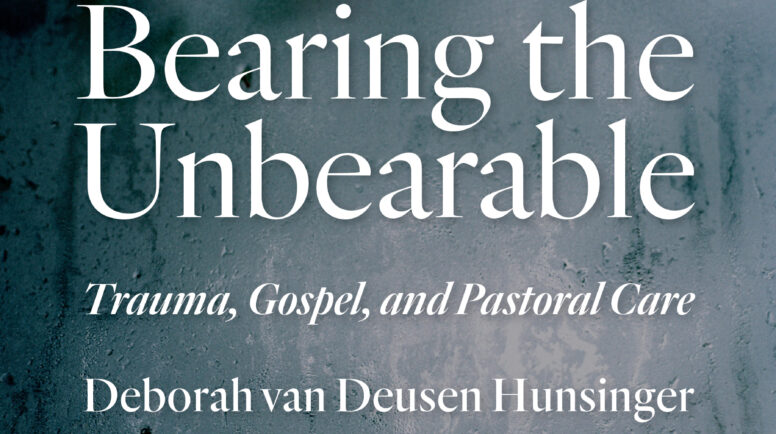
 by Deborah van Deusen Hunsinger
Wm. B. Eerdmans Publishing Co., Grand Rapids, Mich. 179 pages
REVIEWED BY LESLIE A. KLINGENSMITH
One member of a family forced to take out a restraining order against another. Two little boys refusing to visit their father for the weekend because of fear of violence. A group of high school students reeling from the accidental death of a beloved teacher. A young adult who has given her life over to heroin, and the attendant sorrow of her family. Bewildered and grief-stricken parents lamenting the loss of their first child to sudden infant death syndrome. The murder of a session member. Countless older adults mourning the deaths of their own grown children. These are just a few of the pastoral care scenarios that I have faced in 20-plus years of ministry. Any pastor can recount such incidents — moments when we have drawn in breath and prayed for God to help us find the right words to comfort our people. Or, for God to help us know when to close our mouths and simply be present to people in their pain.
Once we are out of crisis mode after an intense pastoral situation, pastors often think about what we should have done differently. We wonder if there are tools of which we are unaware that we could have offered to hurting people. On the flip side, we worry that we were (or are) in over our heads, wading into the deep waters of counseling and psychotherapy without appropriate training. Too often the lines get blurred between pastor and family therapist/addiction counselor/psychologist. When pastors know just enough psychology to be dangerous, we can do more harm than good when offering care to our congregants.
“Bearing the Unbearable” does not solve the problem of pastors overstepping the boundaries of their expertise, but it does offer pastors and other faith leaders guidance as to what falls within our realm and what needs to be referred to professionals with more specific training. Deborah Hunsinger keeps each chapter grounded in theology — her chapter on laments is especially so. Her assertion (with examples from the Psalms) that a lament is not a cessation of relationship with God — but a determination to communicate with God through our pain — could be a life rope for people who are in the midst of raging at God.
Hunsinger pays particular attention to the gifts that pastors can offer that are unique to our vocation — namely presence and community. She points out what a holy privilege it is to bear a piece of another person’s sorrow — which is congruent with my own experience as a pastor.
One concern I have with the book is the breadth of topics Hunsinger attempts to cover. There are brief discussions of PTSD, family systems theory, object relations theory, empathy, nonviolent communication and restorative practices. They are all interesting and potentially helpful, but each subject needs more exploration if we are to be able to use the theories wisely. Nevertheless, “Bearing the Unbearable” is a useful addition to any pastor’s library. Hunsinger provides excellent introductions to each of these subjects and more. Anyone who wants to delve deeper into one subject or another can utilize her footnotes for further reading.
LESLIE A. KLINGENSMITH is pastor of St. Matthew’s Presbyterian Church in Silver Spring, Maryland.