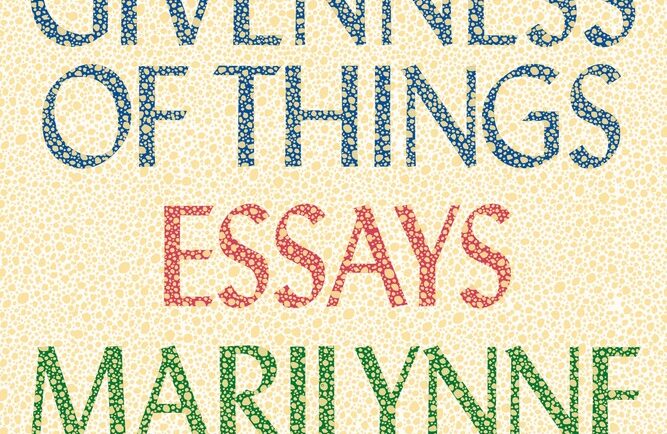
 by Marilynne Robinson
Farrar, Straus & Giroux, New York. 304 pages
REVIEWED BY LISA KENKEREMATH
Robinson’s new collection of essays is a reflection on the brain and consciousness, mind, self and soul. Returning to themes she explored in “Absence of Mind,” with neuroscience rather than evolutionary psychology as the subject of her critique, Robinson rejects rationalistic, reductionist views of the human mind just as physics has rejected a mechanistic view of the universe. Neuroscience’s methodology, which is restricted to the examination of what its own imaging technology can show, can only give a sadly deficient account of who we are. The essays touch on the thought of Shakespeare, John Wycliffe and the Lollards, Locke and Descartes, Jonathan Edwards, Bonhoeffer and, especially, Calvin as resources for an inquiry into what it means to be human. The book is a defense of the beauty and mystery of human beings, creatures “fearfully and wonderfully made.”
The contemporary behavioral sciences’ dismissal of the mind and what we have traditionally called the soul reflects a general propensity in contemporary American culture. The eclipse of the humanities by science and technology, motivated by a misplaced sense of urgency among policymakers, signals a societal devaluation of the human person.
“Givenness” refers to the reality of a phenomenon — love, fear, the soul — even if we cannot give an account of it in scientific or purely material terms. And part of this “givenness” is the fact of human brilliance, depth, variety and even sacredness. Robinson insists that as a species we do, in fact, have a God-given loveliness, despite our many villainies.
Robinson’s high anthropology is consistent with, and flows from, her high Christology. Taking as her texts John’s Gospel prologue and Colossians 1:15-19, Robinson asserts that the nature of Christ is intrinsic to creation; humanity partakes of a “quality and substance” at the center of Creation that is Christ. Robinson writes as a Christian and an American deeply troubled by trends in thought and speech that are undermining what the church and America have to offer the world. She laments the capitulation of the mainline churches to the false imperative of “relevance” that has led them to abandon their own theology, culture and traditions, a loss that has rendered them silent as “Christianity” is represented to the world as a redoubt of ignorance, intolerance and self-righteousness. She also decries the hypocrisy of Christians in the public sphere who can speak of the undeserving poor, allow the existence of for-profit prisons, and promote the death penalty. Her essays are an appeal to American generosity, once assumed but now in question.
These essays are passionate, even angry, at reductionist ways of thinking, at meanness of spirit in politics and governance, at the low valuation of human beings evidenced by so much of our economic thought, political discourse and pseudo-scientific intellectual trends, but they are also pervaded by a sense of wonder and joy. The question these essays ask is a haunting one: Why do we human beings no longer take pleasure in our own brilliance, and what has happened to our capacity for wonder? To honor who we are as a species is to offer grace to each other. The hardest question Jesus puts to us, Robinson says, is not whether we believe in him, but “whether we believe in man.”
LISA KENKEREMATH is the interim pastor of Grace Presbyterian Church in Springfield, Virginia.