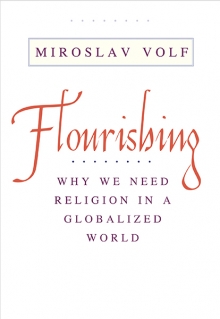
 by Miroslav Volf
Yale University Press, New Haven, Conn. 304 pages
REVIEWED BY WILLIAM F. MAY
In this major apologetic book on world religions, Miroslav Volf singles out for study Buddhism, Hinduism, Confucianism, Judaism, Christianity and Islam. Despite their differences, universalist claims and contentions across the centuries, he argues that they show structural features that let these religions (at least potentially) not only coexist, but aid and abet human flourishing in an increasingly globalized world.
Volf believes that world religions can contribute to this flourishing not by the conquest of one religion over the others or by the distillation of a single “essence” common to them all, but rather by the recognition that each of the traditions carries within itself salient and beneficent themes to which adherents can appeal in their own intramural debates and that outsiders can recognize and honor as they engage in conversations across boundaries.
Volf borrows from sociologist David Martin the image of these religions as “repertoires of linked motifs internally articulated in a distinctive manner.” In the course of time, Volf argues, “some motifs from its repertoire are backgrounded, others are foregrounded; and most are ‘played’ with various degrees of consonance and dissonance.” The passage reminds one of the different backgrounding and foregrounding in the shift of the Catholic tradition from Benedict XVI to Francis II.
However, Volf may be too optimistic about the immediate future. I find it telling that his book does not include religious dualism among the world religions today. Frederic Spiegelberg in “Living Religions of the World” more soberly recognized Manichaean dualism as “the most persistent and alive religion in the West and in parts of the world touched by the West.” Religious dualism has penetrated and nested persistently in the three great Abrahamic traditions of Judaism, Christianity and Islam. While invoking the language of monotheism (good vs. evil), dualists have wrongly elevated Satan to God’s coequal and variously split the human race into a combat between the two rival kingdoms.
Such religious dualism has embedded itself in (and distorted) the world of politics and economics in our era. After the Cold War, the key dualist conflict shifted: It was no longer order vs. malevolent order, but order vs. chaos — the political term for which is “anarchy.” The great societies of the West have found themselves at loggerheads in dealing with the threat of chaos, without and within. From without — the chaotic threat of terrorists and climates out of control; and from within — great asymmetries of power and waves of refugees crossing porous borders.
The religious dynamics at work in all this is darker than in Volf’s account. But, St. Augustine warned us not to paint the agenda ahead too dark. He wrote against the dualists of his time (while recognizing the dualist in us all). However, Augustine also urged monotheists not to create a reflexive dualism of their own, identifying the bad guys with any given set of threatening dualists and the good guys with themselves.
Believers in God as the Alpha and Omega owe God a more hopeful, open, penitent and confident politics than that as they work toward building spacious, humane and habitable institutions in the rough terrain of politics. A rough terrain, indeed, but whoever said that pursuing the common good would be easy? Everything considered, Volk has written an important and ultimately hopeful book on human flourishing.
WILLIAM F. MAY is a teaching elder in National Capital Presbytery and the author of several books on ethics, including “Beleaguered Rulers.”