 by Dan Hotchkiss
Rowman and Littlefield, Baltimore. 264 pages
REVIEWED BY JOHN WIMBERLY
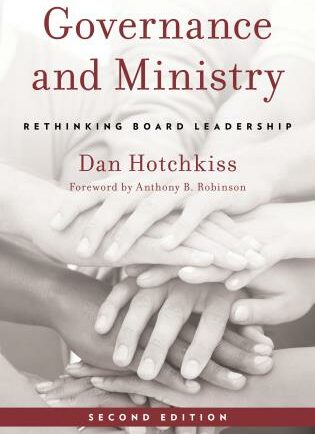
For years, I have been recommending to congregational leaders that they read Dan Hotchkiss’ outstanding book “Governance and Ministry.” In my consulting work with congregations, I regularly find that they are in need of a significant overhaul of their governance system. Too many congregations have systems created in the 1950s with large governing boards, more committees and boards than they can fill with members and not enough teams doing the nitty-gritty work of ministry. In addition, governing boards tend to be knee-deep in management (usually, micromanagement). As a result, there is little strategic thinking about where the congregation is and where it needs to go in the future. Our failing governance systems are struggling because younger generations are more interested in doing hands-on ministry rather than governance, and older generations are burned out after serving on boards and committees for decades.
Thus, I was delighted to hear that Hotchkiss recently updated, expanded and refined his thinking on governance in a second edition of “Governance and Ministry.” It may be a second edition, but it reads like a totally new book. The first six chapters will be familiar to readers of the first book. However, even in these chapters, Hotchkiss has refined them based on his work with congregations implementing the strategies for governance he made in the first edition. It felt like new reading to me. In the next five chapters, Hotchkiss adds totally new material along with several very practical, helpful appendices.
Of the new chapters, Hotchkiss’ thoughts on congregational size were extremely enlightening. We have all been taught the classic paradigm of family-pastoral-program-corporate church size. However, many of us have had the experience of being the pastor of a congregation that feels and acts like a family-pastoral-program church simultaneously with a touch of corporate tossed in. Hotchkiss sheds new light on how size is important in understanding congregations. He helpfully concludes, “We all can learn from the whole spectrum of congregation sizes because a healthy congregation, however large or small, is both a family and an institution.”
The biggest trick in changing governance systems isn’t the theory behind the changes needed, but the implementation. Isn’t that the case with most things in congregational ministry? Therefore, one of the most useful new chapters in the new edition deals with “life after governance change.” I particularly appreciated Hotchkiss’ differentiation between the roles of the governing board and staff in the new governance system. Too often, these two key players in congregational leadership step on each other’s toes. Unclear about who is doing what, they compete for power and authority.
Having read the second edition of this classic book, I am convinced that it will have a similar level of success in helping pastors and church members alike understand their roles as well as the difference between governing and doing ministry. At its heart is a profound message: “A congregation that invites people to participate in organizational life appeals to only a few, but a congregation that invites people directly into spiritual growth and service appeals to many.” He commends the movement, controversial as it may be in some congregations, “to reduce bureaucracy to make room for ministry.”
 JOHN WIMBERLY is a PC(USA) teaching elder who serves as a church consultant with the Congregational Consulting Group.