LOUISVILLE (Outlook) – The Promised Land is far off. We’re on the journey. But we’re not as far along as we thought.
That’s a bit of how mid council leaders attending the Fall Polity conference in Louisville Oct. 30-31 assessed the progress of the Presbyterian Church (U.S.A.) in antiracism work.
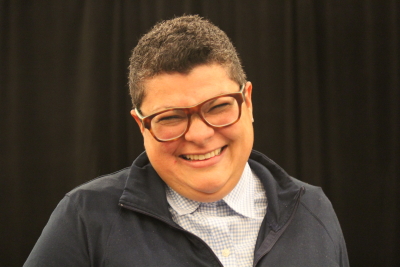
Jessica Vazquez Torres and Lori Adams, both from Crossroads Antiracism Organizing & Training, led three sessions of anti-racism training – including discussions of white cultural dominance and ways Presbyterians can work to become a force for antiracism.
Here’s a look at some of what they talked about.
Antiracism work as a continuum

The work involves a progression, Vazquez Torres and Adams said – an intentional journey along a continuum to shift from being monocultural in focus (with the PC(USA) being about 91 percent white) to becoming an antiracist multicultural institution.
The starting spot for many predominantly white churches is the idea that “we don’t have problems here” – that antiracism is not their struggle, because they don’t see any or many people of color, Vazquez Torres said. A next step might be to seek some “manageable” kind of diversity – wanting “the right kind of diversity. The people who look and sound like everybody else.”
Antiracism work involves a shift from a club mentality – an inward focus – to developing a missional or discipleship understanding of what it means to be church, Adams said.
“It does not matter whether you are in the most rural white town in America or whether we are in downtown Chicago,” she said. In both settings, the dynamics of white supremacy are at work. “Being antiracist means working against the power arrangement that holds all of that in place … so we can become the church that God has called us to be.”
Don’t inflate the grade
When taking a hard look at where an institution like the PC(USA) falls on the continuum, don’t be too generous with the grade, Vazquez Torres said. And listen to the voices of people of color and their assessments of what still needs to be done.
Do not assume that making that some progress – such as electing an African-American stated clerk, two women as co-moderators of the General Assembly and a gay Latino as interim executive director of the Presbyterian Mission Agency – equate to having actually reached the kingdom of God and “that’s all we have to do,” Vazquez Torres said.
“What it takes to actually get to the other side of the continuum is internally being driven by the need to be different, not to look different,” she said.
And making this change is not about the survival of the institution.
“Let me assure you, the world can live with one less white church,” Vazquez Torres said.
Opening hearts and minds
Some say “we live in an all-white presbytery. Our congregations are all white. And our communities are majority white” – so they don’t see a starting spot (or a need) for anti-racism work, Adams said. Look at the bigger context, she said – at the needs and concerns of people of color who may live just a few miles away; at the way racism contributes to the hurt of the world.
At this point in the discussion, Jan Edmiston, co-moderator of the 2016 General Assembly, tweeted: “We have no race problems. #ScaryStoriesin5Words”.
Being open to change means letting go of judgment, cynicism and fear – becoming open to the idea of something new, Adams said.
Some of the greatest battles she’s seen have involved people trying to hold on to something in church life that they cherish – such as mid councils that “can’t let go of their camp and conference centers. The camp and conference centers are breaking the backs of the collective people who could do all kinds of mission in different ways,” but some in the church refuse to let them go.
Those in antiracism work need to “understand the importance of opening our will, to letting go so that something else can come,” Adams said.

Abundance, not scarcity
“We will not change if we spend 75 percent of our time pastoring to the grieving,” those who see scarcity all around and mourn the loss of the way things used to be decades ago, she said.
Another model: Appoint a small group to pastor to the grieving. Then “spend 75 percent of our time focusing on the strategy for how we move,” Adams said.
The way things used to be often did not involve people of color, Vazquez Torres said. A new vision may lead to a church “where they can finally be themselves, and truly themselves.”
So a question for pastors is: “How do you cultivate courage?”
And “How do we preach about this on Sunday morning?” Vazquez Torres asked.
Instead of always thinking of scarcity – too few people and dollars – think about the resources that are available in imagination, energy and creativity, she said. How can we use our space differently – or get rid of the building altogether? How can we view others doing similar work as collaborators, not competitors? How can we be transparent about who has power and who doesn’t, and the ways in which racism has held the organization back?
Strategies
Vazquez Torres and Adams also suggested four strategies for moving an organization farther along the continuum.
- Develop a shared systemic analysis of racism and white supremacy. Develop and share lists of reading materials, videos and opportunities for people to learn about systemic injustice.
- Interrogate the worldview upon which the institution is built. That includes asking “Who are your leading edges?” – the people who are farther ahead in antiracism work, and supporting their work.
- Shift from an identity of being allies of people of color to being co-conspirators.“This is about having skin in the game,” Vazquez Torres said. She wants white people to understand they pay a price for racism too, that they are caught up and ensnared in it, and that by doing antiracism work the are liberating themselves, “not liberating me.” Being co-conspirators means “to breathe together,” Adams said. “I live because you live. I live because we live in community with each other,” not because “I’m the great white savior.”
- Mandate a group to lead the change. This means accountability. If it’s everyone’s work, it’s no one’s work.
The slides from the antiracism training are available online here:
- Oct. 30 sessions (Introduction to anti-racism / White Cultural Dominance).
- Oct. 31 session (Becoming an Antiracist).
- Crossroads Continuum Tool.