MONTREAT, N. C. – What can churches and pastors do to make things better? What are ministry practices for responding to systemic injustice?
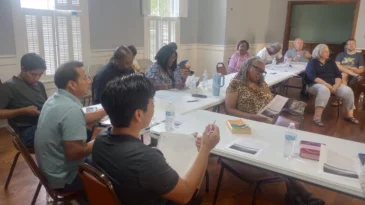
In a panel discussion titled “Worship as Resistance,” held Oct. 12 at the DisGrace gathering at the Montreat Conference Center, the participants offered some answers – and, as much as anything, a sense of solidarity that others are struggling with the same questions too.

For those committed to ending injustice, “the work is constant,” as Presbyterian Church (U.S.A.) teaching elder Lindsey Anderson put it. There can be no breaks, except for self-care. “This is the work of the gospel, and we need to do it continuously.”
A Detroit example. Anderson is a pastor with the Detroit Cooperative Church – a ministry which serves four Episcopal and Lutheran congregations in Detroit, and whose pastors have started a podcast.
While the population of the city of Detroit is more than 80 percent black, the state legislature is majority white, Anderson said – there is considerable tension in the relationship.
For example, people’s water gets cut off because they can’t pay their bills. “The water department doesn’t seem to care or be interested in turning the water back on,” Anderson said. “Teachers in the city of Detroit no longer need to be licensed” – a statement that made people in the audience gasp.

“There is a very clear racist and racially-motivated agenda to destroy the city of Detroit,” she said.
So her church – 95 percent black – works with others to make an impact on the city’s problems. Historically, the African American church has been a source of strength: of organizing, strategizing, faith and comfort, with worship the fuel that sends them back out into the world to fight injustice. In that context, “survival is resistance,” Anderson said. “That is anti-racism. That is fighting against the system.”
Amy Kim Kyremes-Parks, director of spiritual formation at Fairmount Presbyterian Church in Cleveland Heights, Ohio, said people need to go out into the community, and to bring their children. It’s time to show up and do the work, she said, because it’s the right thing to do.
Dangerous imagination. This summer, Marcia Mount Shoop accepted a call to be pastor of Grace Covenant Presbyterian in Asheville, North Carolina. Since then, she’s been talking to the congregation about the idea of “dangerous imagination.”
She’s told them that “a dangerous imagination interrogates power, especially abusive power.”
They’ve talked about whiteness and white supremacy culture. “Talking about how even though we like to think we’re the good white people, we are still the ones who are holding fast….to white ways of doing things that we think are normal or good,” or polite, Shoop said.

She’s tried to teach people to tune into their bodies, “to listen and breathe, and be uncomfortable and incompetent.” Try something new. “Be incompetent. You don’t know how to do this. You still need to do this.”
And “they’ve heard some things that make them uncomfortable from the pulpit. I have seen people willing to take a risk,” to tell her they don’t necessarily agree with her but are willing to discuss it, to stay, to stick around and engage with the difficulty. It’s important to engage with difficult, uncomfortable issues, she said. “Jesus was a pretty dangerous guy in that way.”
Own your story. Shoop also said many Presbyterian congregations have a well-developed “muscle twitch” regarding injustice – that the right thing to do is send people on mission trips and work in soup kitchens. While those things are worthwhile, Presbyterians need to develop new muscle groups, she said.
“Middle-upper-class progressive educated white people sometimes have a high degree of aversion to personalizing racism,” she said. They might be willing to tell stories of that reprobate uncle who tells racist jokes at the Thanksgiving dinner table. They’re less willing, Shoop said, to tell their own stories – to dig into their own complicity in racism. Understanding whiteness as a carrier of injustice “is the last great frontier,” she said.

And pastors need to be more transparent about their own failings as well, Kyremes-Parks said. “It’s uncomfortable” and may feel unprofessional to talk personally from the pulpit. “But being professional hasn’t done us a lot of favors.”
Anderson said that as a mixed-race woman, “I have been formed by the black community of my father’s side of the family and I’ve been formed by the white people of my mother’s side of the family. And I’m also cognizant that I show up white. A lot of people who see me think I’m white.”
Acknowledging that – telling her own story – can help in conversations with people her congregation.
Even though Anderson could pass for white, and historically many like her have chosen to do so, she choses intentionally not to do that. Her choice to claim and describe the full complexity of her identity carries meaning, she said, in the wider black community.
“What we do for each other when we show up authentically like that is we help deconstruct those things that are in us that our moderator (Denise Anderson) named so well as sin.”

Segregation and the institutional church. Are segregated churches a problem, asked the panel’s moderator, Carolyn Browning Helsel, an assistant professor of homiletics at Austin Presbyterian Theological Seminary? Why do some persons of color choose to be part of a mostly-white church?
Anderson said she’d ask a different question. In congregations, she sees reflected an institution “that was built on and is riddle with white supremacy. And we know – if you don’t know, I’m going to let you know – that it is dying. Now I know some of you can’t hear me any more, because of the fear and the grief and the anger that plugs our ears when we hear that…If I am completely honest, I am not sad about that,” about the possibility of that death.
If people of faith want to pour energy into fighting injustice, “why don’t we just do that in the world?” Anderson asked. “Why don’t we just go out into our communities and do that, and leave behind this cumbersome institution that has been pulling us back and back and back, and be a new thing in the world?”

Go out into the world, into “all those places we’re afraid to walk down the street in,” she said. “The rest can go.”
Kyremes-Parks said this of the PC(USA): “We’ve been walking around limping and trying to pretend that we’re briskly walking.”
Shoop, a fourth-generation Presbyterian minister, said she has been redefining her relationship with the institutional church – something that’s painful because she finds the institutions “not real life-giving to me,” but feels she’s in some ways parting from the history and contributions of people in her own lineage and in the pews that she holds dear.
With tears on her cheeks, Shoop said “I came into this call a completely different person than I would have been 10 years ago. I am no longer here to maintain the institution. I’m here to follow Jesus.”
Not seeing the problem. How can churches use worship as resistance when some in the congregation don’t see “that systems of racism exist?” Helsel asked.

Shoop responded that she’s not serving that kind of church now. But she has worked in places where “we could have spent a lot of energy on that, and the whole conversation of race is a trigger.”
She’s learned instead to come at it a different way, by saying: “Let’s talk about bodies. Let’s talk about why it’s so hard for us to sit and just be quiet. Let’s talk about what scares the living daylights out of us about not being in control. Let’s see what that feels like for a minute.”
It can also be useful to talk about power, Shoop said. One tool is to invite flexibility “about things that people would never guess have anything to do with race” – for example, about how to pray or involve children in worship. Engage a muscle group “that tells us what it feels like to surrender, to share power, to not know what’s going to happen next.”
Kyremes-Parks said she’s grateful the PC(USA) has chosen leaders of color – including Anderson as co-moderator, J. Herbert Nelson as its new stated clerk, and Tony De La Rosa as interim executive director of the Presbyterian Mission Agency.
When those denominational leaders speak out against injustice, she draws on their words – such as this statement Nelson released in July after the police shootings of Philando Castile in the Twin Cities and Alton Sterling in Baton Rouge.
“The time is right to act!” Nelson said. “However, the time has always been right to act.” He referred to actions the 2016 General Assembly took against racism, including adopting the Belhar Confession from South Africa, and said the assembly’s decisions “have no meaning unless we as people of faith act to eradicate racism in our nation. Our efforts must begin in our own communities and require courage. Racism is a cancer that has historically pervaded our society. It blatantly disrupts the flow of building Jesus’ call for the Beloved Community.”
The PC(USA) has chosen prominent leaders of color – a visible witness, Kyremes-Parks said. “Use their words…We’re in a place where we can quote them,” to our congregations and to the world.
She has also found that personally – and she paused, a little teary and saying: “God, this conversation just gets me!” – that as a Latina woman and mother, and now the only person of color on the program staff of her church, she has drawn strength from other Presbyterians of color. She grew up in Utah, in a mostly-white environment. In the connectional Presbyterian church, she found “people of color who spoke language and life into me,” and who now are “breathing the same life into my children.”

Both Kyremes-Parks and Anderson are of mixed racial identity.
“There’s an insidious lie that racial identity is simple,” Anderson said. “It’s complex…Simplifying it is an abuse.”