MONTREAT, N.C. – What’s the next step? How to move from conversation in the church to action on racial equality?
And what’s it like to be a person of color and an advocate for justice in the vastly-white Presbyterian Church (U.S.A.)?

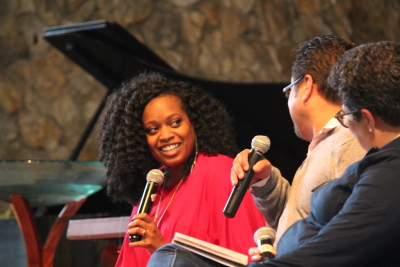
Those were among the questions a panel of Presbyterians, moderated by Brian Ellison, executive director of the Covenant Network of Presbyterians, discussed Oct. 11 at the DisGrace gathering at Montreat Conference Center. The participants:
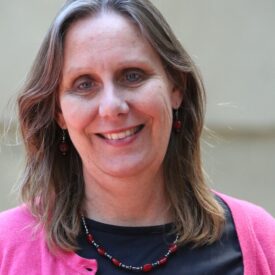
- Jessica Vazquez Torres, an anti racism educator who has worked with Crossroads Antiracism Organizing and Training.
- Bruce Reyes-Chow, a former General Assembly moderator (elected in 2008) and a pastor, consultant and author from San Francisco.
- Denise Anderson, co-moderator of the 2016 General Assembly and pastor of Unity Presbyterian Church in Temple Hills, Maryland.
Here’s some of what they had to say.
On what work for justice can or should look like:
Part of the struggle for Presbyterians is “we’re focused so much on what we look like” – on whether a congregation is multi-cultural enough and how to attract more people of color – rather than “how do we actually transform who we are and what we do,” Reyes-Chow said.
What matters is not the survival of the institution, he said. Presbyterians need to be willing to participate in “some of the death of what we know and love” to make room for something new. Thinking like that “forces us to ask ‘How much are we a resurrection people?’ ”
If transformation of those already present isn’t at the heart, the work is “bankrupt and it’s hollow and it doesn’t feed any of us.”

Vazquez Torres recalled attending a meeting, when she was younger and working for a program involving another denomination. An older African American man interrupted her presentation with this question: “Are we prepared to die?”
She fumbled for what to say, but also described that as a moment “of being convicted. I remember getting so still inside, and looking at him. Because he said, ‘If you say we won’t die, I’m leaving. Because I’ve been in this conversation my whole life,’” with the church creating new programs and sending new young people like her to sell them. If she couldn’t say “ ‘the church will die in order to not be this,’ then I’m leaving.”
What he wanted: a church willing to be transformed.
On identity:
Some want to shift the focus from what people look like or from labels used to categorize them to who they are internally.
Vazquez Torres said she’s struggled with wanting not to lose parts of her identity in the struggle for justice. The Crossroads website said that, “a native of Puerto Rico, Jessica identifies as a ‘1.5 generation Queer ESL [English as a Second Language] Latina of Puerto Rican descent.’ ”
She told the DisGrace crowd that “when I came out, all of the people who were queer that I knew were white people,” and finding a way to name and claim her identity became “a really hard place.”
In time, she leaned in to the tension of having a complex identity – including as an immigrant, a woman of color, a queer, resisting any single definition or false separations.
On confession:
“God is calling us to name racism exactly what it is: sin,” Anderson said.
A question Vazquez Torres asks herself: “What do I have to dismantle in me?” What does she need to confess, to be willing to change?
If you are a church leader, “it is up to you to bring this conversation to your congregation,” Vazquez Torres said. “It is our call to do that, to live into our baptismal vows. We are so afraid we will cease to exist that we would rather basically die the slowest, most painful death, tricking ourselves into thinking we’re living. I’d rather basically claim a decision to die with integrity….than to be a dying body that is telling itself every day that it is alive…If your building is more important to you than this conversation, then you are already in a dead church.”
Presbyterians need to take seriously the practice of confession, Anderson said. “Confession is not nice news; it’s good news. It’s good news that we can be honest about where we have been as a church.”
To name one’s specific complicity in racism doesn’t make that person particularly sinful, she said. “We are all broken. In naming that, you’re in a much more qualified place to be able to put it away and rebuke it.”
On whether it’s “a good time to be a part of the PC(USA),” with a black co-moderator of the General Assembly (Anderson); a new stated clerk who is black (J. Herbert Nelson); and a gay married interim executive director of the Presbyterian Mission Agency (Tony De La Rosa).
More good news is that the PC(USA) voted to adopt the Confession of Belhar, “the only confession we now have that doesn’t originate out of Europe,” Anderson said. But “we have a whole lot of work to do.”
Vazquez Torres said she’d flip the question around, to ask: “why did it take that long” for a black to be chosen to serve as stated clerk, or a queer person to be head of a church agency. “You can tell that story two ways,” she said, “including how hard it was to get there…It’s not that I don’t want us to celebrate. But I don’t want that celebration to cause us to forget. Because then you’re not being accountable to the people who fought so hard for so long to make that moment happen.”
Reyes-Chow said when he served as moderator, he never was fond of the PC(USA) tradition of people standing up when the moderator enters a gathering, as a way of honoring the office. He was thinking of asking people not to do it when a mentor of color told him: “Don’t let that white church not stand for you.”

Only about a third of the teaching elders in the PC(USA) are women, Anderson said. Some congregations are reluctant to call ministers who are women or people of color or not married heterosexuals. “The optics are different” now in the PC(USA), she said. “That doesn’t mean the reality is different.”
And Reyes-Chow challenged the 400 people at DisGrace to consider micro-aggressions, and how they interact with people of color. “The folks that are here – you want to be here,” to consider questions of racism and injustice. “If we don’t name stuff that happens in this space, then we’re in trouble.”
He gestured to Anderson, and said: “The number of times you’ve been asked about your hair.” The number of times people walk up to him, a third-generation Chinese/Filipino, and start speaking in Tagalong or Chinese. He never answers in those languages, because he doesn’t speak them. But people look at him and other people of color – and based on appearances or their own biases or view of the world, make assumptions.
Reyes-Chow also said that, despite all the opportunities he’s been given and that he cherishes, “it’s exhausting to be brown in the PC(USA).”
On engaging congregations in justice work:
Don’t assume that people in a congregation aren’t ready or willing to discuss hard issues related to racism, Reyes-Chow said. Give them a chance, and some credit. If pastors don’t discuss issues of racism and injustice out of a presumption that people will get angry or defensive, “we’ve wasted an opportunity for God to move in some way.”
Too often, “we cultivate comfort in the church,” Vazquez Torres said. “How do we cultivate discomfort, and how do we build courage?”
Presbyterians also need to be able to bring up issues of injustice and systemic racism, and not have it be branded as political. For church people, “when we don’t want to talk about something difficult, we label it political,” Anderson said.
Her response: “Jesus was political.”