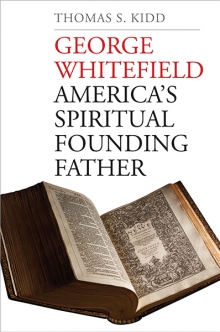
 by Thomas S. Kidd
Yale University Press, New Haven, Conn. 344 pages
Reviewed by John M. Mulder
George Whitefield (1714-1770) was a drama king.
He was, without doubt, the greatest preacher of the 18th century — certainly more powerful than Jonathan Edwards (who notoriously stared at the bell rope in the back of the church, rather than the congregation) and more popular than John Wesley (who preached in the open air, like Whitefield, but stayed in Britain). Whitefield (pronounced “Whitfield”) was a handsome, cross-eyed, honey-voiced itinerant who fearlessly crossed the Atlantic 13 times and became the best-known preacher of the time in both Britain and the American colonies. In fact, according to Thomas Kidd, he was “the first ‘British sensation,’” more than 200 years before the Beatles.
As a boy, he fell in love with the theater and acting. As an adult and after his conversion, he criticized the theater and bit the hand that nurtured him. Yet he retained a lifelong love of drama and eloquence. For Whitefield, every pulpit was a stage, the congregation merely penitents.
Working to evangelize the masses, Wesley may have slain thousands, but Whitefield slew his ten thousands. Admittedly, he exaggerated the size of his crowds in his newsletters, but he might not have been too far off. He became a close friend of Benjamin Franklin, an odd couple if there ever was one in American religious history. Franklin was intrigued by Whitefield’s promotional skills and the stories about his crowds, so when Whitefield — the evangelical — preached at the Philadelphia Court House, Franklin — the Enlightenment Deist — did an experiment in estimating crowds. He concluded there were 30,000 people who could hear Whitefield’s voice.
The preacher and the printer forged a mutually beneficial relationship. Both of them knew how to promote ideas. Amazingly, in later years, Whitefield even proposed to Franklin that they join forces and start a new community in Ohio. Franklin replied gently that he was too old.
Whitefield was ordained in the Church of England and held to a mild form of Calvinist predestination. His English compatriot, John Wesley, was also ordained in the Church of England, but espoused a form of Arminianism that gave freer rein to the human will in the process of salvation. The two clashed repeatedly and bitterly throughout their ministries — partly over doctrine and partly over personalities. Whitefield acknowledged to Wesley, “I never read anything that Calvin wrote,” but ignorance didn’t end the rivalry. Eventually they were reconciled largely because Whitefield couldn’t see the point of continued acrimony. As Stuart C. Henry wrote, Whitefield “professed Calvinism, lived by an Arminian faith, and preached them both.”
All this and more is in Kidd’s splendid biography: Whitefield’s love of God and Jesus Christ, his founding of an orphanage in Georgia where slaves were employed, his strange and stilted marriage, his amazing stamina and zeal to travel despite terrible health, his passion for conversion and his infatuation with his own eloquence. Kidd concludes, “perhaps [Whitefield] was the greatest evangelical preacher the world has ever seen.” That may be a bit much, but so was Whitefield.
 John M. Mulder is associate minister for stewardship at Second Presbyterian Church in Louisville, former president of Louisville Seminary and editor of “Finding God: A Treasury of Conversion Experiences.”