by Bill dePrater
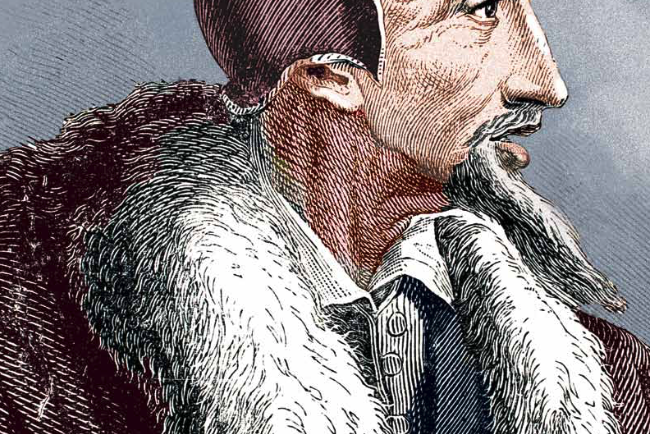
One morning my wife and I received a phone call from Katherine, our youngest daughter. “Dad, I am walking into the hospital. When can you and Mama come?” I told her that we would be there ASAP. Quickly packing our bags, checking the gas in the car and picking up our eldest daughter, we were on our way. Arriving at the hospital, Katherine was still in labor. Finally, a nurse came out and told us that mother and son were doing fine. The parents named him Jacob, after one of the biblical patriarchs. Jacob, likewise, shared a birthdate with the Reformation leader John Calvin. His name and his birthdate connected him with the church’s story.
We all agree that it is important to learn about our family ancestors. As Christians, it is also important to learn about our biblical ancestors. But why should we learn about our Reformed ancestors and their contributions to the Reformation movement?
William Faulkner, in his novel “Requiem for a Nun,” wrote these words: “The past is never dead. It’s not even the past.” Likewise, John G. Turner, in an article in the Christian Century wrote: “Christians should love history. Ours is an historical faith oriented around the life of a man who lived 2,000 years ago. … In America, Christians have discarded much of that past.” Turner goes on to express Margaret Bendroth’s thought that secular time has replaced liturgical time. Secular time is linear with a progressive focus. “If time is always moving forward, the past is always becoming more distant and more irrelevant. But that was not always so.” As living witnesses to the present, the Reformers’ theological decisions are seen today in who we are as Presbyterians.
Reformed compass for decision-making: Reading and hearing Scripture
In the Roman Catholic service, the Eucharist was the central focus of worship, with an elevated altar and rail separating the chancel from the nave. The Roman Catholic Church certainly honored the Scripture by carrying the Bible around the sanctuary with great ceremony. Yet the priest rarely read or preached from the Bible. Further, as the service was in Latin, the people could not understand what was being said during the worship service. The church leadership, however, did not feel that the people needed to understand the Latin as long as the priest pronounced the words correctly. The result was the spread of superstition. For example, the phrase, “hocus pocus” was a corruption of the Latin phrase, Hoc est corpus meum. “This is my body.” Frequently bishops and priests were ordained to office with little or no theological education.
 The Reformers, in contrast, elevated the reading and preaching of Scripture as the central focus of worship. The baptismal font, the Lord’s Table placed in the midst of the people, an elevated pulpit with an open Bible resting upon it and the whitewashed walls of the sanctuary all became the architectural expression of Reformed theology. While many of the Reformers disdained music during worship, Calvin understood the important role of music in faith development. He insisted that the texts be in the language of the people. Further, that there be only one note per syllable, such as in “Old Hundredth.” In encouraging the singing of the Psalms, Calvin compiled the Genevan Psalter. Translated into French, it became an important instrument in the Huguenot movement.
In contrast to the Catholic understanding, the Reformation leaders rejected the popular view that clergy were a special caste apart from the laity. They insisted that clergy only differed from the laity in the special functions of ministry. Expressive of this new role, the Reformed pastor wore, not a liturgical garment, but rather the black Genevan gown, the same worn in the universities. This emphasis stressed that the clergy were educated in theological and biblical studies. This scholar-preacher-teacher model is an integral part of our Presbyterian identity. The symbols that Presbyterians chose to use in the ordination service further expressed the importance of Scripture. In the Roman Catholic ordination service, the bishop gave the newly ordained priest the keys to the parish, the font cover, a missal used for conducting the service and a chalice to hold the Eucharistic wine. In contrast, the presbytery gave a Bible to the ordained Reformed minister, as well as a key to the pulpit. Reformed worship became distinguished in its emphasis on the hearing and the preaching of the Word of God.
Reformed roles: Redefining church and society
In Roman Catholicism, poverty was taught to be a virtue; as one suffered poverty in this life, one might look forward to the riches of heaven. Further, the church promoted institutional poverty in the form of the Begging and Mendicant Friars. In contrast, the Reformers stressed the state’s responsibility in the transformation of society for the betterment of all persons. Beginning with Martin Luther, many towns banned begging, requiring public resources to be used for needy persons, and schools to be established.
This transformation appeared in the understanding of the role of women. The Catholic Church understood sexual abstinence as a divine gift, after the example of the Virgin Mary. Yet, the Catholic Church encouraged prostitution as a means of relieving the sexual tensions of young men. In contrast, Protestant communities closed houses of prostitution and promoted marriage as the proper place for sexual gratification. Moreover, marriage became a role of the state. Calvin and his colleagues enacted the “Marriage Ordinance of Geneva,” with specific rules governing marriage.
While Martin Luther was not prepared to promote women to church leadership positions, he appreciated women’s intellectual gifts. In 1520, Luther proposed that women learn to read the Bible in Latin or German. Later, he suggested that the funds previously used by the Begging Friars instead be used to establish schools staffed by women for the express education of girls and women.
Reformed thought: Liberal arts and sciences
Soon, advancements in liberal arts and the sciences began to flower. Key Reformation leaders, such as Calvin, were trained in humanistic thought. They established primary and secondary schools to teach people to be able to read and understand Scripture and basic humanistic thought. In May 1543, Nicolaus Copernicus, a Polish canon and astronomer, asserted that the earth was not the center of the universe; rather, the earth rotated around the sun. The Catholic Church condemned his writings. Even Luther and Calvin questioned Copernicus’ assertions. However, they felt that such scientific studies must continue. Within a month, Andreas Vesalius published “On the Structure of the Human Body,” describing basic human anatomy. In 1545, Ambrose Paré published his book on surgery. In 1628, William Harvey advanced his theory on the blood circulatory system. With the floodgates opened, a number of additional publications appeared in geometry, arithmetic, botany, zoology, geography and ballistics.
Reformed theology for today
Remember my grandson, Jacob, whom we last left as a helpless newborn infant? Jacob currently is tall for his age, active, verbal and a rough-and-tumble 4- year-old who loves the beach and plays soccer. Jacob, in many ways, is the same person he was as an infant, for his DNA and other inherent characteristics continue to shape him as he matures. This same idea can be applied to the church. We are shaped by the past, yet we cannot return to the past but must move forward into the future. Moreover, we face different challenges from those challenges of the Reformers. Although the Protestant Reformation was a part of the transition from the Medieval Era to Early Modern Europe, the Reformers still had strong ties to medieval thought patterns. Further, when Luther was born, Columbus had not sailed from Spain. When he became a monk, the Jamestown settlement was a century away. When Luther defiantly stood before the Diet of Worms, the Puritans had 110 years before they sailed for America. Moreover, during the 15th and 16th centuries there were no paved interstate highways, no harnessing of electricity, no air conditioning or central heating, no televisions and no antibiotics extending lives. No longer do our maps show the earth as the center of the universe. Rather, Voyager I, a spacecraft, in 2012 traveled outside our solar system, and set sail upon the uncharted cosmic seas. We have walked on the moon, and we have plans to establish a permanent settlement on Mars. The Reformers never could have envisioned today’s world. Yet, despite the 500 years of earth-shaking change from the Reformation era, their witness to God’s liberating and sustaining power remains. Their testimony continues to engage as we seek to be faithful to God in our own era. Today we are able to continue the theological conversations begun 500 years ago. We are “the church reformed, always to be reformed according the Word of God.”
 BILL DEPRATER is a retired Minister of the Word and Sacrament living near Chapel Hill, North Carolina. His book on the Protestant Reformation, “God Hovered Over the Waters,” was published last year.