by Paul Roberts
Recently, I heard a churchgoer discuss her husband’s disdain for the church. Her husband considers the church leaders flashy. “For my husband, it’s all about the optics,” she said.
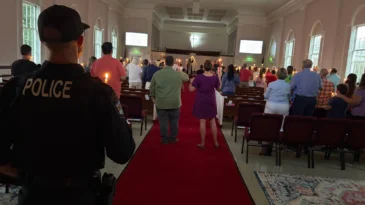
Coincidentally, I’ve been reflecting on the optics of Presbyterian Church. Since our denomination met in Portland for the 222nd General Assembly, I’ve carried images of the elections of the denomination’s first co-moderators, Denise Anderson and Jan Edmiston, and first African-American stated clerk, J. Herbert Nelson II.
I’ve carried less publicized but equally impactful images, too. The area in the assembly hall where commissioners were stationed was adorned with tall floor banners printed to look like stained glass. Gothic in style, none of them replicated the erroneous, racially-biased depictions of biblical characters seen far too often in our worship spaces, but were purely color stained. After J. Herbert Nelson’s election, they seemed to dance as I viewed them through tears of joy.
Also memorable are images of casual gatherings of people during break times. I often happened upon conversations among people of varying ages and complexions. I witnessed youth in athletic gear and men in white collared shirts praying together. I watched Mexicans and Koreans and residents of the Carolina low country create room for one another at the microphones. I took a selfie with two young male advisory delegates — one black, one white — who I preached to a couple years ago at a Montreat Youth Conference.
Thanks to these optics, I left GA222 hopeful that our denomination is living into a new identity — one marked less by the narrative of numerical decline and internal discord, and more by the qualities of grace, welcome, temperance and hospitality.
To be sure, there’s danger in placing too much emphasis on appearances. In the early 1990s tennis star Andre Agassi became the spokesperson for Canon, Inc. His flowing hair and fast lane lifestyle made him a good candidate for the manufacturer of cameras and other optical equipment. Agassi became the champion for their slogan “image is everything.” Subsequently, he was dismissed for being “more form than substance.” Eventually, he proved his critics wrong, but not before a steep slide in the rankings forced him to retool his game.
Images are illusory and can be misleading. They also can be powerful tools for change. The turning point in the Civil Rights Movement of the 1950s came when images of black women and children doused by fire hoses in the Deep South were broadcast around the world.
Likewise, images can fuel our faith. Who among us is unaffected by the tranquil images of green pastures and still waters from Psalm 23? Or by the images of rushing wind and tongues of fire from the story of Pentecost? Or by the noisy gong and clanging cymbal images of 1 Corinthians 13?
Churchman and scholar Andy Crouch writes, “Today, we are entering the third great transformation in the way human beings engage and interpret their world. The first was orality, when information was passed from one generation to another orally. The second was literacy, when information was written down and oral information became secondary in importance. Today it’s visualcy. We communicate our most compelling and significant information visually.” Crouch’s analysis has implications for those of us who preach, teach, and otherwise share our faith.
At a time when images of divisive American politics, unjust policing, warring factions in Syria and catastrophic weather damage predominate on our screens, I’m grateful for the optics of our faith which have the capacity to inspire us toward acts of justice, mercy and peace.

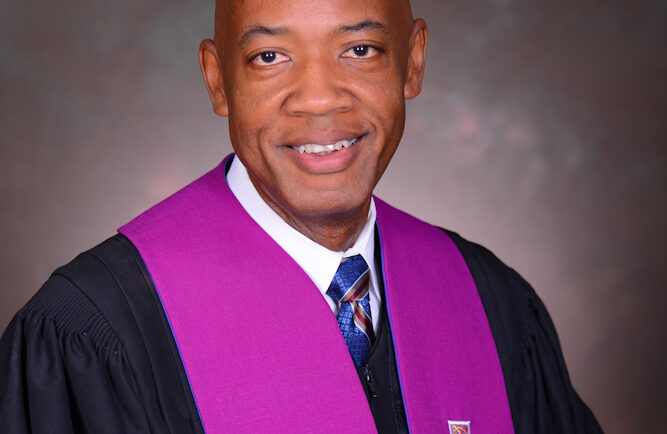
Paul Roberts is the president of Johnson C. Smith Theological Seminary in Atlanta. He has been married to Nina for 23 years and has three teenage children.