With a new year comes new commitments – or at least the hope of a fresh start.
For some, that means a deepening commitment to spiritual practices – to a regular, intentional discipline of taking the time to draw closer to God.

People both inside and outside of churches are using all sorts of practices – such as centering prayer or walking a labyrinth or using lectio divina to read Scripture. Some have roots in ancient practices of early Christianity. Some involve silence; some seek God’s presence through art or movement.
Some tap into technology – using apps such as Pray as You Go, which draws from Ignatian spirituality and gives folks material to listen to while out for a walk or commuting to work or school.
Practicing a spiritual discipline can be communal work as well.
“One of the most important things a congregation can do is establish a group that holds silence together,” said Katie Crowe, senior pastor of Trinity Avenue Presbyterian Church in Durham, North Carolina. “It really helps anchor a congregation into the fact that this is about participating in God’s work to transform the heart of the world through love.”
Praying in Durham, North Carolina
Crowe is passionate about centering prayer – she says it “saved my life and certainly saved my ministry” during a difficult time. She’s completing a doctorate in ministry at Pittsburgh Theological Seminary, with a focus on Reformed Christian spirituality. And she’s integrating silence and centering prayer into the life of the congregation she serves.
In theological terms, “there’s always something within us that has to die in order for Christ to more fully live,” Crowe said. Going deeper into a spiritual practice “is sort of about the crucifixion of the I” – the death of personal and congregational longings for security, success, control and more, to make more space for God.
When she came to Trinity Avenue more than four years ago, Crowe began intentionally introducing people to a range of spiritual practices. Each month, the session would read one chapter from a handbook on spiritual practices, with a ruling elder then leading an experiential exercise in that practice. “The idea was to fill their toolboxes with spiritual practices,” and to give leaders a sense of the breadth of contemplative and spiritual disciplines available, Crowe said.
During Lent, congregants have been encouraged to join covenant groups, which involved a commitment to spend time in community, to be authentically present and to spend some time together in silence – “to be still and know that I am God,” as Crowe put it.
“The first year we did it, it was like pulling teeth,” she said. The second year, they had to create more groups to accommodate the demand.
“All we are asking people to do is to take a step towards one another and towards God in a way that is intentional,” she said. “The psalm is right when it says that deep calls to deep. … In centering prayer, silence is the means, the mechanism by which I grow in relationship with God, and it is the relationship with God. It is not an intellectual endeavor.”
Her own life has been transformed by centering prayer, practiced both with a group at church each Friday and in silence privately twice a day. Crowe also describes it as a portable practice – which can be done anywhere, anytime.
“If I don’t rise early to do the practice, the day will just leave me behind,” she said. “You will not automatically feel more peaceful,” but with consistent practice “you are being changed. It’s less you and more Christ in the world.”
Seeking God’s presence in Pittsburgh, Pennsylvania
Mary Lynn Callahan, director of spiritual life ministries at East Liberty Presbyterian Church in Pittsburgh, describes a spiritual practice as “anything we do with intention to open us up to the presence of God. A couple of things are important about that. The intention is important, because it’s not always how successfully we do it, how well we do it, but the intention that matters. And the acknowledgment that God is already present in us. … So many of the practices involve silence.”
East Liberty offers opportunities to learn and practice spiritual disciplines including silent retreats; working with prayer beads; mindfulness meditation; prayer with icons, journaling; working with the enneagram; and more.
Many of these practices are used to quiet busy minds, “so we can learn to be open and present to God,” Callahan said.
Some Presbyterians resist particular practices – with meditation, for example, “I’ve had some people say it’s not Christian,” Callahan said. “If you empty your mind, won’t demons, won’t negative things come in? That’s where it comes to intention. … The idea is not to empty your mind, but to become totally present to what is,” to the indwelling presence of God.
She has also found spiritual practices to be an open door into the church for people from the community. She’s met people who will come to walk the labyrinth (offered twice a week) to or practice yoga “who would never think of coming here on a Sunday morning,” but who will stay for the Taizé service. Callahan also teaches centering prayer in the Allegheny County jail.
For some regular churchgoers, accustomed to a more cerebral approach to Christianity, certain spiritual disciplines may not be intuitively comfortable. “Most people who are sitting in the pews today have grown up with a very intellectual view of Christianity,” Callahan said.
What got pushed to the side in the Reformation were spiritual practices from early Christianity and the Eastern church that relied less on words and explanation, she said, and more on listening, faithfulness, relationship, silence. As St. Augustine put it: “You have made us for yourself, O Lord, and our heart is restless until it rests in you.”
Different spiritual practices work for different people, Callahan said. It’s kind of like exercise, she said – some love to run or bike outside, while others prefer aqua aerobics or kickboxing. With spiritual disciplines, “try different things and find what works for you.”
Communal formation in Greensboro, North Carolina
At First Presbyterian Church in Greensboro, North Carolina, spiritual practices are woven into the congregation’s life – an intentional, deepening focus for at least the past four years. In the beginning, Donna Chase, the director of Christian formation, co-led a series of Companions in Christ spiritual formation groups with the congregation’s senior pastor, Sid Batts.
Through Companions groups, dozens of people were introduced to spiritual disciplines. This year, ruling elders were asked to lead groups to help others grow spiritually – now they are leading seven small groups, and the entire congregation is being introduced to eight spiritual practices this year.
Each month, congregants are introduced via the church newsletter to a spiritual discipline –Scripture and Bible reading; prayer; worship; personal reflection and service; silence and meditation; fasting; Sabbath-keeping; and journaling. People are given information about the practice and suggestions for resources including books, websites and apps.
“A lot of it has to do with helping people move a little bit from a head understanding of God in the Scriptures to a transforming heart understanding of Scripture” – coming to a lived understanding of the presence of God, said Wendy Duncan, the director of adult formation and discipleship. That sense of connection, of relationship, can “carry them through the joys and the sorrows in their lives, always sensing the presence of God.”
For some, “it is a little bit easier to be academic about God and the Bible” – focused on an intellectual understanding. “We Presbyterians are really good at that. We are the educated Christians, a lot of times we like to be proud of that,” Duncan said.
 The Greensboro church, however, has made a shift from speaking only of content-based Christian education to emphasizing spiritual formation. Spiritual practices “really help us to go to a different level of understanding of God,”— with an example being lectio divina, which lets a passage of Scripture soak in slowly and quietly and be absorbed, Duncan said.
The Greensboro staff also uses the liturgical seasons, particularly Lent and Advent, as times to introduce people to spiritual practices – holding contemplative services to remind people to slow down their hectic lives, focusing on fasting during Lent. Some say they’re too busy to sit in silence for 20 minutes a day. Start small, Duncan said – for example, practice five minutes of intentional silence every day while driving in the car with children.
“I think is the skill to just be still and know that God is God,” Duncan said. “We really need to teach people how to do that. … Especially in our world that’s so noisy – there is sound and technology with us all the time. People have to be taught how to quiet themselves and quiet their world in order to hear God and sense God in their lives.”
Lectio in Jacksonville, Florida
At Palms Presbyterian Church in Jacksonville Beach, Florida, Polly Dirvin is part of a group that has been gathering weekly for about five years to practice lectio divina. They meet on Wednesdays, and typically work with the Scripture passages that will be read in worship the following Sunday.
“We read through it once,” Dirvin said. “We take quite a bit of time, pausing and thinking,” then spend time in silence as each participant scribbles down thoughts on paper. Then each person shares a word or phrase carrying particular resonance for them. Then they read the passage again and repeat the process of mulling, praying, writing.
Finally, each person shares with the group what stood out most from the passage for them.
“The thought is, ‘This is God’s word for me today,’” Dirvin said. “It makes it very personal. The thing that we come out with is not necessarily the intent of the author,” but how the passage speaks to those individuals on that particular day.
The experience has changed her personal devotional time as well.
She recently decided to read Romans, and finds herself reading through the chapter “until I come to something that just stops me.” She marks the spot with a sticky arrow, then stops to reflect and write. When she resumes the next time, she starts wherever the arrow is and reads until the passage speaks to her again.
Exploring in Conway, Arkansas
Last January, pastor Mike Ulasewich started the year at First Presbyterian Church in Conway, Arkansas, with a sermon series on seeking – “the idea that we’re all looking, we’re all seeking,” trying to connect with the presence of God. For Lent, he followed with a series on spiritual practices.
Ulasewich introduced one spiritual discipline each week during Lent as he preached, shortening his sermon to make room for a communal experience of the new discipline – exploring prayer journaling, guided meditation, Taizé worship with silence, lectio divina and prayer postures.
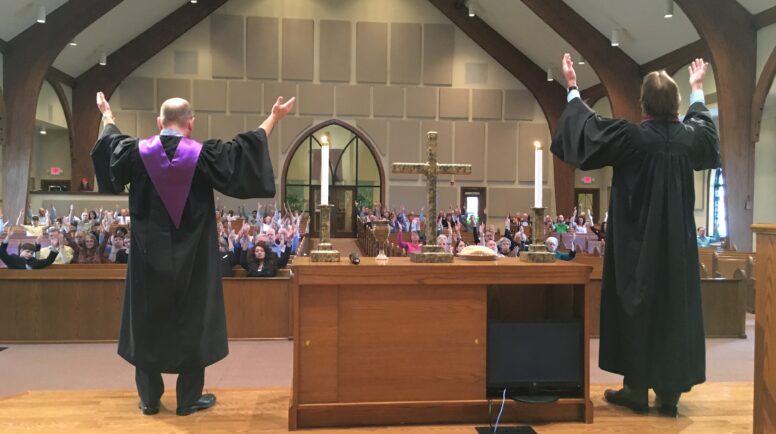
For example, when prayer journaling was introduced, people were asked to write a response to a photograph shown or to a passage of Scripture that was read aloud. Another week, they tried holding their bodies in a variety of positions for prayer, to discover how moving the body might open people up to different types of prayer.
Some congregants were skeptical, but most were willing to give it a try, and to explore the idea of connecting with God through mind, heart, spirit and hands.
“I reminded them every week that you may find this practice today really isn’t for you,” Ulasewich said. “But the idea is maybe in the course of five weeks, you’ll find one or two things you really like.”
He believes that “so many of the things people are seeking, whether they realize it or not, can be found in a deeper relationship with Jesus. … I think people are really starving for a deeper connection with God. And our folks were very willing to try things, especially in a safe setting like our worship service.”
Sometimes, Christians will adopt the practice of giving up something for Lent. Ulasewich encouraged them instead to take on something new –to intentionally try a new spiritual practice and to stick with it over time.
“We tried to emphasize that there’s not just one way to connect to God, that Jesus will meet us in a variety of ways. … Even in the midst of our busy lives, we can find those way, whether it’s praying in the car or when you go for a walk. It’s really over time that those practices begin to remold or reshape us. That’s a wonderful gift.”