 Larry W. Hurtado
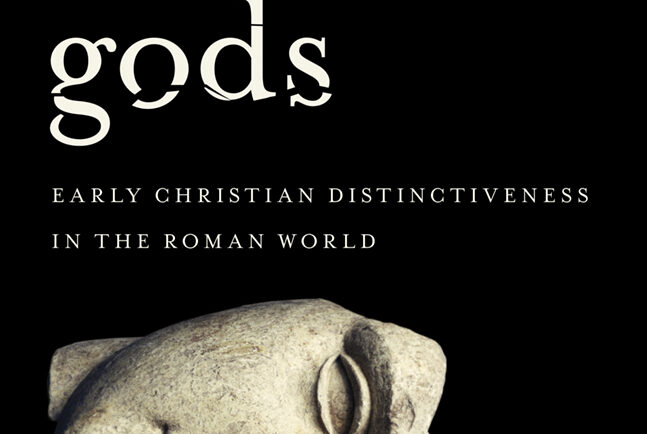
Baylor University Press, Waco, Texas. 304 pages
It has to be a very different experience to be part of a small minority group than to belong to a dominant majority. Members of a minority, particularly one held in disregard, must surely have a clear idea of who they are and why it is worth paying the costs of nonconformity. Majorities may have a more relaxed view, inclined to take their identity for granted since it would seem to require no clarification and is likely to cost them nothing. Christians today, even in post-Christian societies, still tend to think of themselves as majorities, which, when technically true, is not necessarily culturally true.
Many otherwise educated people presume that the secularized certainties of the post-Christian culture are self-evident and autonomous, their Christian origins obscured. “Even modern atheists presume there is only one God to doubt!” Should there actually be such a God, the presumption is that the unlikely deity’s character would be to love, no? Along with these specifically theological presumptions, taken for granted as though no other possibilities exist, other identifiably Christian values have been so thoroughly absorbed by Western societies that they pass as secular.
Larry Hurtado, professor emeritus of New Testament at the University of Edinburgh, reminds us that early Christianity emerged as a profoundly countercultural movement, one that could never be mistaken as mirroring the values of its environment. In the Roman Empire, what we might call “religion” (considered as a separate and optional sphere of life) was inconceivable. Service of the gods was interwoven with everyday affairs. Rituals honoring the various national, local and household deities were inextricably linked with geographical and cultural identities. Declining to participate led to familial conflict as well as charges of atheism and dishonoring the emperor.
Into this milieu came the Christians. They had no images of their God, no altars or sacrifices, temples or shrines. “Even the practice of assembling weekly for corporate worship … was unusual among other religious groups of the time.” For Christians, a loving God was believed to seek a direct relationship with people — actively seeking their redemption — notions alien to the pieties of the period. Twenty-first century people “cannot easily realize how utterly strange, even ridiculous, [Christianity] was in the Roman era.”
Unlike popular religions, Christians were devoted to authoritative written texts, in which the person of Jesus played a key role. They were committed to “mutual love”— in other words, to know and look out for the people with whom they worshipped, transcending lines of gender and social status. They were committed to showing hospitality to strangers, to looking out for the imprisoned and praying for those undergoing tortures. They refused to expose unwanted children, objected to blood sports as entertainment and challenged the sexual morality of the time, including the double standard.
Hurtado maintains that “this distinctive early Christian group identity is perhaps the earliest attempt to articulate what moderns would recognize as a corporate religious identity that is distinguishable from, and not a corollary of, one’s family, civic, or ethnic connection.”
There are worse things than being a cultural minority. We are already in a position to begin exploring the compensations that accompany such a status.
 Ronald P. Byars is professor emeritus of preaching at Union Presbyterian Seminary in Richmond, Virginia.