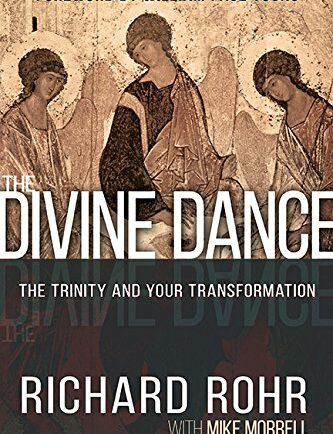
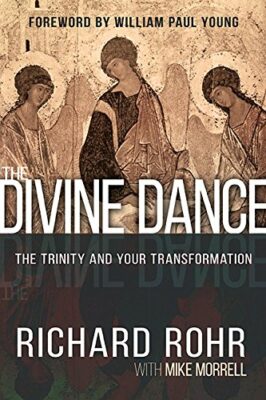
 Richard Rohr
Whitaker House, New Kensington, Pa. 224 pages
Reviewed by Leslie Klingensmith
“The Trinity has GOT TO GO. It’s outdated and patriarchal and I have no use for it.” These words were spoken to me (by a Presbyterian) at a dinner party several years ago, and took me aback. While I fall squarely into the “liberal” wing of Protestantism, it never occurred to me that we could (or should) jettison a doctrine that has been as important to our development as the Trinity. That person’s statement has raised questions for me. Are there ways we perceive the Trinity that are unhelpful or even damaging? Is there a more expansive perspective available to us? Is the Trinity the end in itself, or an avenue to a deeper experience of God?
One can understand how someone would have problems relating to some part of the Trinity, or even the whole package. Someone who had been abused by their earthly father finds the image of God as “father” brings up bad associations. Some women who have suffered in a male-dominated society have difficulty relating to the male savior Jesus. The set of relationships is complicated, and the questions that arise from them are legitimate. Even though I have been aware of the difficulties with the Trinity, I still believe there is enough value in the doctrine that we owe it to ourselves to prayerfully consider how we understand it and how it shapes our relationship with God now. Instead of pitching the whole thing, we have a call to update and expand our understanding of the Trinity and contemplate how we can apply it in the most life-giving way.
That’s what Richard Rohr invites us to do in “The Divine Dance.” Instead of getting stuck in a quagmire where we feel required to believe “impossible things” and therefore do not believe anything, Rohr suggests that we focus primarily on the Trinity as a set of relationships that is always open, a community waiting for us to join in. He writes, “Whatever is going on in God is a flow, a radical relatedness, a perfect communion between Three – a circle dance of love.” Rohr is quick to point out that this is not New Age jargon, but is rooted in the earliest stages of Christian thought. He draws upon St. Bonaventure, Duns Scotus and Hildegard of Bingen (among many others) to take us back to our inclusive, expansive roots and away from a rigid, doctrinaire and sexist understanding of the Trinity. I finished “The Divine Dance” more hopeful than I have been in a long time for the future of Christian dialogue and interfaith relations (see the section titled “Interfaith Friendship”).
Father Rohr has a gift for recognizing the theological underpinnings present in literature, music, movies and other areas of our culture. He uses examples from all of these to illustrate how Trinitarian nature permeates not only our interactions with each other, but potentially our relationship with creation as a whole. At a time when much of the conversation in our world is divisive and fear inducing, Rohr invites us to celebrate the cosmic connection we all share. This is an important, optimistic book that I will return to again.
Leslie Klingensmith is the pastor of St. Matthew’s Presbyterian Church in Silver Spring, Maryland.