DENVER – The All Agency Review Committee continues to try to refine what the focus of its work should be – including the question of whether it should look specifically at the work and interactions of the six agencies of the Presbyterian Church (U.S.A.) or more broadly than that, potentially including aspects of the functioning of the General Assembly.
The committee has convened its second face-to-face meeting, gathering May 1-2 at Central Presbyterian Church in Denver.
 Among the questions under discussion May 1 were these:
- Should the committee focus particularly on exploring the feasibility of possibly combining the Office of the General Assembly (OGA) and the Presbyterian Mission Agency (PMA)? In a conversation in late April, a subgroup of the Way Forward Commission suggested that might be something the All Agency Review could take on in depth, according to several members of the committee who participated in that conference call.
- What should the committee tell the assembly about the progress the six agencies have made since their last individual reviews – and about the emerging issues that each agency faces?
- Should the committee also focus in part on what committee member Debra Avery, a pastor from California who participated via phone, described as a “rooftop view” – trying to describe the “overarching vision and mission” of the PC(USA)?
Some history, some questions
Part of the difficulty is that the 2016 General Assembly, which appointed the All Agency Review Committee, did not give it specific instructions.
The All Agency Review is part of a denomination-wide process of review, which the General Assembly initiated in 2008. This involves a six-year cycle (from 2010 to 2016) of in-depth reviews of each of the PC(USA)’s six agencies: the Office of the General Assembly; Presbyterian Mission Agency; Board of Pensions; Presbyterian Investment and Loan Program; Presbyterian Publishing Corporation; and Presbyterian Foundation. The reviews are done two at a time in two-year cycles.
Then, from 2016 to 2018, an All Agency Review is to take place.
The 2016 General Assembly appointed the members of the All Agency Review Committee, but did not provide detailed directions for how the committee should conduct the review, or exactly what it should look at – what the scope of its work should be.
There’s even a bit of confusion about the name – whether, technically, it’s the All Agency Review Committee (which it calls itself most of the time) or the Review Committee on the Whole PC(USA). That decision could involve more than semantics, if the committee attempts to speak in some way about the whole of the church beyond the specifics of the agencies.
“We might be making recommendations and critiquing the General Assembly itself,” said committee member David Davis, a teaching elder from New Jersey.
The task also may go beyond assessing how well the agencies are doing in their current work.
“Part of our job is to look at what’s not there,” or perhaps at what’s there and doesn’t need to be, said Deborah Block, a pastor from Milwaukee and the moderator of the committee. “Are there pieces that don’t need to be there any more? If so, would we replace them, and with what?”
Avery suggested that the committee might look at three levels:
- At the dance floor: determining the mission directives for each agency, and the evaluation criteria to determine their effectiveness;
- From the balcony: looking at the whole, and at how well the six agencies work together;
- From the rooftop: considering whether the PC(USA) has a unifying churchwide mission statement, a sense of overarching vision and mission whose effectiveness can be articulated and measured.
One question is whether, in attempting a rooftop view, the committee might overlap with the work of the 2020 Vision Team, which the 2016 General Assembly also created and tasked to create a “guiding statement” for the denomination.
How broadly should the All Agency Review Committee envision its task?
“Our concern needs to be articulating an ecclesiology for the Presbyterian Church (U.S.A.) in this day,” Block said. And something that’s tangible, said Eric Beene, a pastor from Georgia – with criteria by which to evaluate whether the mission is actually being met.
Way Forward Commission
A subcommittee of the All Agency Review held a video conference at the end of April with a subcommittee of the Way Forward Commission – part of the ongoing effort to coordinate the work of those two groups and of the 2020 Vision Team, all entities that will report to the 2018 General Assembly. There has been concern about whether the work of the three groups might overlap – so representatives have been communicating to offer updates on their work and coordinate the process.
Block said that recent call “was much more collegial and collaborative” than a call in February with Mark Hostetter, moderator of the Way Forward Commission, and there was a sense that “the daunting magnitude of this task really persuades a division of labor.”
One possibility discussed in that call, participants said, was that the All Agency Review Committee might take the lead in exploring the wisdom of proposing an OGA-PMA merger. Some committee members expressed concern about that – including about whether they’d have enough time to do that work and whether there’s any consensus that consolidating the agencies is the right way to go.
“We’re talking about the OGA-PMA thing as if it’s a decision that’s been made,” possibly putting the cart before the horse, said Claire Rhodes, a ruling elder from Arkansas.
“We don’t want to do something to meet a time frame,” Block said. “We want to do something that meets the need.”
The Presbyterian Mission Agency Review Committee, which reported in 2016, didn’t take a position on whether merger should happen, but did say “this question needs to be decided once and for all,” said Beene, who served on that committee and also is on the All Agency Review.
“At some point, somebody has to make some decisions,” said Chris Mason, a ruling elder and lawyer from New York. “It’s damaging the church” if that doesn’t happen.
Mission statements
A committee subgroup has been reviewing the mission statements of the six agencies – and also considering the matter of how what agencies claim in those statements trickles down to Presbyterians in local churches.
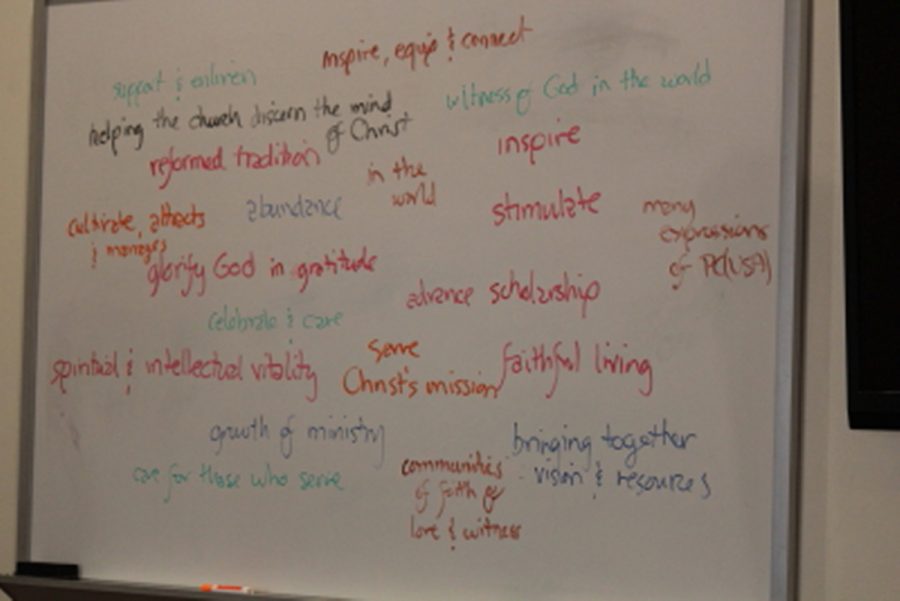
Representatives from each of the agencies summarized those mission statements – and the committee made a list of key words those statements contain (from “abundance” to “in the world” to “glorify God in gratitude”).
Marco Grimaldo, a ruling elder from National Capital Presbytery, said, “There’s not much there that I think is the wrong thing to do,” but “the question is how are we going to live that out in effective ways that help us be a better church together?”
There’s also a question of efficiency – of whether it makes sense for the PC(USA) to have six agencies, each with their own leaders and boards. “No business would do this,” said Jim Wilson, a lawyer and ruling elder from Ohio. “We Presbyterians have chosen not to govern ourselves in a very simple way,” but in a way that in some respects creates chaos.
Perhaps the committee can speak to the church about “the creative chaos, the always reforming,” Block said, and about the normalcy of transition and change.
Part of the message might be that “there isn’t going to be a single voice” and there will be “conflicting visions” in the PC(USA), and “that puts a stress on our agencies that we need to acknowledge,” Wilson said.
Reviews of the reviews
Another subgroup looked at the reviews conducted of each of the agencies from 2010 to 2016, and about the progress that’s been made addressing concerns or issues raised in them. Representatives from each of the agencies came to the meeting and responded to those summaries – and their conversations with the committee offered glimpses into areas of collaboration and partnership, what’s already been done and what are some emerging issues in the PC(USA).
The conversation was wide-ranging – from what to do with church buildings when a congregation shrinks to a handful of members, to new ventures and the economic challenges in denominational publishing.
For example, Andy Browne, vice president of church relations with the Board of Pensions, said the board’s new motto is to “serve more, serve better, serve the church” – achieved in part by expanding the board’s services to include employees of groups such as those working for Presbyterian conference centers and affiliate groups.
That led to a conversation about how best to provide retirement and medical benefits to those working in emerging ministries, such as new worshipping communities, and the difficulties in providing benefits for leaders of small congregations that can’t afford a full-time pastor.
For the Presbyterian Mission Agency, Grimaldo (who wrote the summary for that agency), suggested that the challenges and big questions for the agency moving forward are these:
- How will Presbyterians be more engaged in mission and the work led by PMA?
- How will PMA raise funds that supports their work and connects with the mission that Presbyterians value?
- How does PMA asses its own effectiveness?
A discussion about the Office of the General Assembly included the question of how the office assists mid councils, a growing challenge when so many presbyteries and synods have cut staff or reconfigured (meaning they do their work in a wide variety of ways) and now lean more heavily on the national church for support.

That led to discussion about the General Assembly’s repeated consideration of whether to reduce the number of synods (so far, the answer has been no) and about whether mid council leaders “know how the game is played, and so are more effectively able to lobby,” as Kelly Shriver, a teaching elder from Oregon, put it.
Wilson responded that “the issue is much broader than who works the system best” – and that too often in the PC(USA) “everyone loves what they already have. … We haven’t found a way yet to have the conversation in a way that’s not threatening to what people hold dear.”
The conversation also circled back around to OGA and PMA – to efforts underway to reduce the size of the PMA board; to the limitations that restricted funding has placed on the work PMA can do; to financial pressures across the church.
Another issue, Wilson said, is how the six agencies interact with the General Assembly, and “is the General Assembly capable of being an oversight body for the agencies?” Wilson asked: With so much work packed into a week every two years, how can the assembly take on foundational issues, such as the health of presbyteries and synods?
“We are the privileged ones,” Mason said. “We are the ones who do understand the levers. We need to do some of this work.”
The committee will continue its discussions May 2.