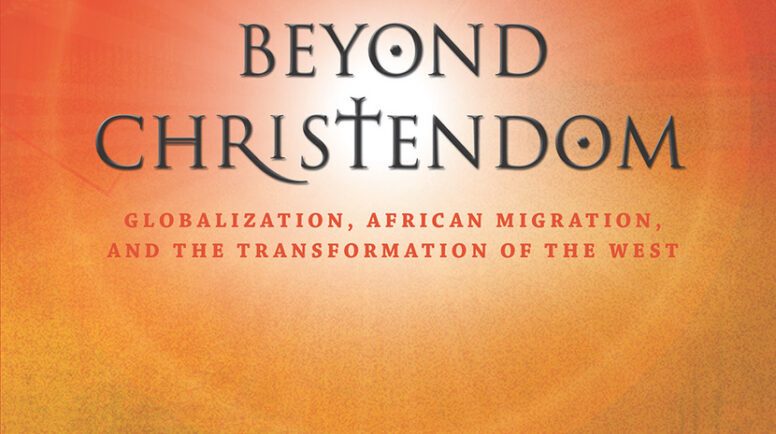
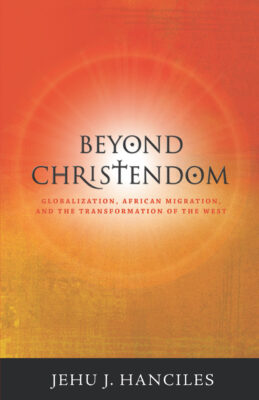
 by Jehu J. Hanciles
Orbis Books, Maryknoll, N.Y. 430 pages
Reviewed by Eunil David Cho
In “Beyond Christendom,” Jehu Hanciles’ primary task is to explore “the extricable connection” between migration and mission in the Christian perspective, which has been significantly overlooked by Western theological standpoint. Drawing on an interdisciplinary approach that utilizes various sources and analytical tools, Hanciles examines the interconnection of the three important themes in this work: globalization, migration and religious expansion.
Hanciles critically evaluates the peculiarly Western notion of globalization for its “one-directional, managed process with a fixed ideal.” He proves how its notion is deeply rooted in religious convictions fostered by the idea of “Christendom” – the experience and understanding of Christianity as a territorial and tribal faith. His analysis of how this particular idea of global culture shaped by Christendom ultimately leads to the main argument of this book: Christendom was “bankrupted as a universal ideal” by expanding colonial interests as well as the missionary encounter with the immutable diversity of non-Western societies. Christendom’s urge to expand through colonialism and missions eventually led to the establishment of emerging non-Western Christian movements. Since then, in the last 50 years, the landscape of global Christianity has been dramatically reshaped as Africa, Latin America and Asia have emerged as the new locations of the growing faith.
Hanciles goes on to explain the biblical understanding of migration by identifying migration as “a theologizing experience” for God’s people. In doing so, he strengthens his argument for the inherent link between the major historical changes in Christianity and human migration. Namely, from the 1960s, the prominence of migration could be seen in the growing migration movement from South to North, which is rapidly changing the religious landscape of the Western societies.
Lastly, this book considers the religious implications and impact of the South-to-North migration on Western societies by looking at specific cases: Muslim migrants in Europe and America, and African Christian migrants in the United States. After exploring these cases, Hanciles returns to his primary task by demonstrating how Christianity is “the most migratory of religions,” and explaining the South-to-North movement has a greater implication for Christianity then any other world religion. From this convincing perspective, “every missionary is a migrant in some sense” and “every Christian migrant is a potential missionary.”
For its new approach in studying global Christianity, “Beyond Christendom” is a valuable guide. This book helps Christian readers understand how Christianity has been transformed into a non-Western religion with the accelerating importance of Africa, Asia and Latin America in shaping the global Christian landscape. In particular, Hanciles’ arguments challenge Christian leaders to reevaluate their Eurocentric or Americanized understandings of Christianity and globalization. Most importantly for today, Hanciles’ examination of the subject through the lenses of migration gives new directions for theologians and pastors to consider the issue of global migration as the distinctive feature of Christianity.

Eunil David Cho is pastor of Bethany Presbyterian Church in Marietta, Georgia.