Guest commentary by Kathy Dale McNair
My sister died of alcoholism at 52.
It broke me.
 Growing up, my siblings and I were told to study hard, work hard, find a career that has meaning, give back, help others, be part of a faith community. I heard the same messages my sister did. I asked myself, how could she destroy her life when she had so much to live for? I blamed her. I was angry. I didn’t know alcoholism is a disease. I blamed myself because I could not save her. I didn’t realize that after a certain point in the disease of alcoholism, the brain chemistry changes. That is when alcoholism becomes a mental illness, a brain disorder. She had crossed over and I couldn’t pull her back.
Two months after we buried my sister, I descended into a deep, intractable depression. After several months of my spiraling down, I accepted how serious this was, and my husband helped me seek treatment. I got an accurate diagnosis: clinical depression. I had the greatest confidence in my doctor as we tried different medications. Nothing seemed to work. I saw a therapist, but my depression did not lift. I was beginning to think my life would be grey and flat for the rest of my days.
But a handful of friends at church became aware of my despair. They saw I wasn’t coming to church, which is one of the greatest joys of my life. When I did come, they could tell something wasn’t right. At coffee hour, one would make eye contact or find some private time to spend with me. Another would call during the week just to let me talk and she listened. Another would come get me and take me for a long walk.
I will forever remember what one friend said to me on one of my most hopeless days. She knew I was suffering. She could tell I had lost my faith in God. And yet she knew me well enough to know that believing in God and aligning myself with God is core to who I am.
When we paused for a moment on our walk, she turned to me. She formed a circle with her arms and said, “Kathy, I am going to hold this space for you until you are ready to come back.”
That was the turning point.
This woman who knew me deeply, and loved me greatly, was going to stay by me. She had confidence that my life would be restored in God’s good time. And until then, she said her faith would carry me.
That’s when my life began to turn toward the light.
Many, many months later, when my health returned, I strongly felt God calling me to find ways to help other people affected by mental health challenges. I personally experienced the power of faith and hope when I was living with what seemed to be a hopeless situation. I now offer a place where others can get spiritual support during their dark days.
I am the founder of Faith, Hope and Recovery (FHR), a ministry for those struggling with mental health challenges, their family and their friends. We develop support groups for individuals. We help educate faith communities and equip congregations to know how to respond to mental health concerns.
You may not know that:
- 1 in 5 people has a diagnosable mental illness. That’s one person in every pew. That’s a silent, invisible epidemic.
- Most people with mental health crises go to their faith leader first.
- The number of older adults (people over 65) with psychological disorders will double in the next 5-10 years.
- Most older adults are not comfortable referring to their situation as a mental illness. They are, however, comfortable talking about loss, depression, loneliness, anxiety, grief and fear.
- Most members of churches don’t know how to approach someone with a mental health concern.
So, what can the church do?
Christians already have the heart to care. We reach out to those who are hurting. We act. We pray. But where do we start?
Think of this mental health epidemic as a new mission field. It is a mental health ministry. Like other mission initiatives, we need to be educated and equipped. We need to learn how to speak the language and to know our limits, to know when to get help.
That we can learn.
We don’t have to be therapists to provide care and compassion. Scripture reminds us to tread softly, to walk with another through dark valleys and be an advocate for those who cannot advocate for themselves.
Here’s how to get started…
Visit to the website of the National Alliance on Mental Illness (NAMI) for excellent resources. The FaithNet section of the website provides wonderful resources: sample sermons, prayers, articles, blogs and guides. The article “How to be an Inclusive and Welcoming Congregation” is very useful.
Know the warning signs.
Know where to get help: Create a card with local mental health resources to keep near you. Check out your free local NAMI or Depression and Bipolar Support Alliance (DBSA) support groups. There are support groups online now, which may be a helpful alternative for those uncomfortable attending a group in person.
Know how to help: What to say, what to do, when to act. Mental Health Ministries, Pathways to Promise and Mental Health First Aid are all national programs offering practical tools to educate and equip congregations.
Everybody can do something.
Just do it.
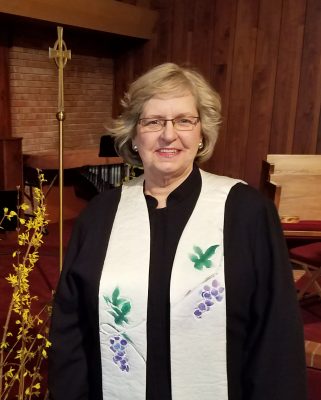 Kathy Dale McNair is the executive director of Faith, Hope and Recovery, a ministry that provides faith-based support groups for all people affected by mental illness, consults with churches to develop mental health team and is creating a curriculum on “Faith, Hope and Wholeness.” She is a specialized PC(USA) pastor affiliated with Winnetka Presbyterian Church in Illinois.