ST. LOUIS – What can congregations do – just regular, ordinary congregations — to talk about race and the painful complexities of racism? What are some ways to get started, or to keep going?

Erin Counihan, pastor of Oak Hill Presbyterian Church, a small urban church in South Saint Louis, has a long list of ideas about that – ideas that her mostly-white congregation has put to work.
On the evening of July 7, participants at the Big Tent conference split up and rode by bus to five congregations in St. Louis, to get a sense of some of the work those congregations are doing on the ground, in a community where the Michael Brown shooting in 2014 in Ferguson and the protests that followed essentially forced people in this area to look at hard realities.
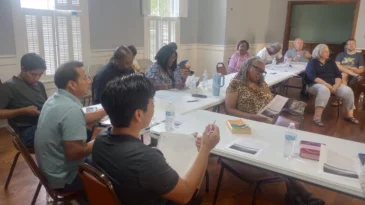
About 50 people rode the bus from Washington University in St. Louis to Oak Hill church, passing through both affluent neighborhoods and those with boarded up houses. At the church, Counihan greeted her Presbyterian guests, then talked about how her congregation has approached what she called “Sacred Conversations about Race.”
Starting in 2016, a group of parishioners began reading books about race – starting with Debby Irving’s “Waking Up White” and Ta-Nehesi Coates’ “Between the World and Me,” both personal accounts of growing racial awareness. From that grew the Touchy Topics Book and Discussion Group – reading fiction and nonfiction, books about privilege and immigration and public policy and privilege.
Congregants did a timeline exercise – stretching out a long landscape of paper, and having people mark on it important dates of racial history in the local community and the nation. Then people added their own memories to the timeline – the stories of people who had personal experience with redlining, with busing for school desegregation, with interracial relationships. “People didn’t feel threatened, because they were able to participate and say, ‘I remember this,’” Counihan said. Another learning: Different generations had very different experiences.
Counihan also led the Big Tent visitors through an exercise she called the Delmar Divide – one Oak Hill uses regularly with mission groups staying at Amen St. Louis, an Oak Hill ministry that houses visiting mission groups coming for an urban ministry experience.
While the Delmar Divide is clearly a St. Louis story – a story of racial and economic separation between two neighborhoods on either side of Delmar Boulevard – nearly all who participate in the exercise say they can point to something similar in their own towns, Counihan said.
Counihan played a video – a clip from a BBC news story detailing the economic, racial and class divisions in the neighborhoods separated by Delmar Boulevard.
In the video, a man walks past beautiful old expensive homes, saying: “This is Delmar. You can just see across the street, where you’re slapped with the reality” – prosperity on the south side of the street, deprivation to the north. In the neighborhood south of Delmar, 70 percent of the population holds bachelor’s degrees; to the north, just 10 percent. South of Delmar is about three-quarters white; north, more than 90 percent black.
“What did you see?” Counihan asked the Big Tent crowd as the video ended.
The answers: Boarded-up houses to the north, gated communities to the south. Green spaces versus asphalt. Disparities in income.
In many cities, “there is a weird line like that,” Counihan said. “And it doesn’t happen by accident.”
Among the reasons: redlining. Gated communities. Racially restrictive covenants.

Melanie Smith, associate pastor for youth and young adults at Ladue Chapel Presbyterian Church, a congregation in the St. Louis suburbs, has for five years brought groups of high school students to spend a week at Amen House, in what she calls an “urban plunge.” In an interview, Smith described that experience as “absolutely wonderful and remarkable.”
Many of the Ladue students live in the suburbs, and conduct nearly all of their life routines within a two-mile radius of home, she said. “They might go downtown for a Cardinals game, but they’ve never actually walked around the streets” of urban neighborhoods, Smith said.
She uses as her theme Galatians 3:28 – “all of you are one in Christ Jesus”– teaching them that “at the core of it, we are all beloved children of God” and that “we are called as Christians to engage issues of social justice.”
Many of the students have encountered diversity even in the suburbs – they have friends who are LGBTQ, biracial or transgender, Smith said. “They’re already asking questions. And they want to know if the church is a safe place to ask.”
She encouraged the Presbyterians to read Richard Rothstein’s book “The Color of Law: A Forgotten History of How our Government Segregated America.”
The Delmar divide is the result of the policies that book details, Smith said. On the south side of Delmar, whites saw that blacks were moving in their direction, so they started using restrictive housing covenants. The deed for a house would say that the house was sold “on the condition that the person who bought it would not sell to a person of color.”
A man in the crowd said he found that same restriction on the deed for a home he once owned. “You will not sell to a person of the Negro race,” it stated. “We sold to a black family.”
 Then the participants were asked to consider this about the Delmar divide. “When you see these images and you know these numbers and you’re visiting town, my question to you is which part of town would you feel less comfortable in? Which part of town would you like to visit? Which part of town would you like to live in?”
A white woman answered: “I would like to live in a house that looks nice. I don’t care who my neighbors are.” But she doesn’t want a drug problem.
“Where do you feel most comfortable?” she was asked.
“I don’t know,” the woman replied.
A black woman said she’d be comfortable living on either side of Delmar Boulevard. “I would prefer to live on the south side,” the nicer, mostly-white neighborhood, she said – but added that she would go to the north side to see the doctor or to shop or buy food.
That’s because the north side is more likely to meet the black woman’s needs, Counihan said – where it’s easier to find a hair salon she likes, a doctor with whom she feels comfortable, a grocery that carries the food she prefers.
Counihan lives near the church, but knows that her teenage daughter, who’s biracial, says that north of Delmar the store employees “don’t follow her around” as they do in the stores closer to home. When they go to the discount store two blocks from their house, “I walk in and they say ‘Good morning.’” Counihan said. “She walks in right behind me and they say, ‘We need your bag,’” wanting the girl to leave her backpack at the counter.
Counihan also carries a backpack, but she is never stopped. How often do the clerks stop her daughter?
“Every time,” she said. “That’s the reality, right? That’s the reality of it.”
Following that conversation, Oak Hill volunteers served dinner to the Big Tent guests. The questions Counihan suggested for table discussion were these:
- Where in your community is there a divide like this? Who can you talk to who might be able to tell you where such a divide exists?
- What organizations or individuals are working on issues raised by divides like this?
- How is your congregation positioned to get involved with this work? What entry points do you have? Perhaps more importantly, what barriers do you face?
- What resources and relationships are available to you to take next steps?