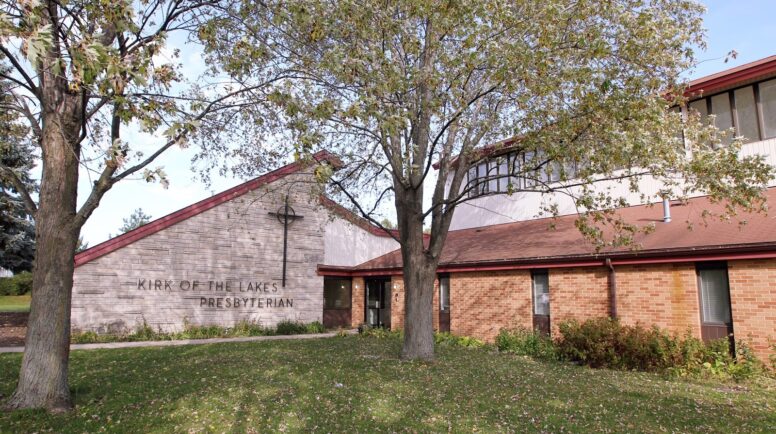
How will you feel if we decide to close? About 45 minutes into the interview for the solo pastor position at Kirk of the Lakes, a small congregation in the far northwest suburbs of Chicago, that was the question posed to me. I paused, half expecting someone to cry out, “Get behind me, Satan!” This ruling elder had voiced the unspeakable; she had named aloud the source of their deepest collective anxiety: the possibility the congregation would have to close its doors.
Looking back, that moment was a breakthrough and a gift. By courageously voicing what was, in their minds, the “worst case scenario,” they had been set free for a chance at new life.
Jesus announced his ministry by declaring he had come to set the captives free (Luke 4:18), but if you have been a part of a congregation hanging on, struggling to keep the lights on and the roof from leaking, you do not feel free. If you have begun to look at visitors as an income source or, “Finally, a new elder candidate!” – you do not feel free. Instead, you might feel a sense of bondage to what once was and to ways of being church that no longer produce fruit. Continuing to hang on and limp along is not life-giving. It is not the freedom we can know in Christ. By bravely naming the possibility that their season of ministry might be coming to an end, this congregation broke their “bondage to decay” (Romans 8:21) and in doing so were now freed to experience God’s re-creation.
It might be difficult to imagine that in closing, a congregation could give its most powerful witness to the saving grace of Jesus Christ. But through their final day of worship on August 28, 2016, that’s exactly what Kirk of the Lakes did. Their story is not about a congregation that hung on until they dwindled down to a handful of members and closed quietly with no one noticing. This congregation, with 50-60 in worship on Sundays and close to 90 on the rolls, went out with dignity, grace and a legacy that will continue to witness to God’s grace for many years to come. A caring and compassionate congregation who worshipped in a well-maintained building in an ideal location, the Kirk had been among the many churches of mainline denominations born in the suburban church booms of the 1960s and peaked in the early 90s when the walls were filled with active youth groups and scores of young children and families. This congregation’s decline began shortly thereafter. They expanded their building with hopes that would help return them to their previous vibrancy, but instead their decline continued leaving cherished memories, a longing for what once was and a burdensome mortgage. Following their recent completion of the New Beginnings study (a tool to help churches or presbyteries assess and discern their future), they acknowledged that they were at an important crossroads and needed to come up with a plan to move forward. Together the leaders agreed that “doing nothing was not an option.”
The decision to consider closing does not come easily, nor should it. But facing the question head-on is in itself a proclamation of faith and a declaration that we believe in a God of new life, who is continually creating and re-creating, in whom death does not have the final word. Facing the question of closing for this congregation freed them from the depleting functions of survival mode to live out their calling as the body of Christ, as defined in our Book of Order (F-1.0301) in the most public of ways.
The church is to be a community of faith, entrusting itself to God alone, even at the risk of losing its life.
The decision to shift from survival mode is indeed a leap of faith. As the Kirk made this decision, they understood that they risked losing their congregational life as they knew it. Their pivotal process of self-reflection before I arrived had enabled them to see that they needed to change and let go of their current, unsustainable ways of doing ministry. Yet, as I joined them, none of us knew what their new life would look like. Demonstrating tremendous faith, this congregation bravely began an intentional process to discern God’s will for them – a period of listening, following, wrestling and stumbling; a time pregnant with prayerful pauses and repeated reflection.
Through ongoing faith formation classes, together we built our spiritual muscles for this time of discernment. After a teaching series on prayer, a team dedicated to igniting the prayer life of the congregation formed, which led to prayer events, resources and prayer partners (some of which continue today). Vibrant worship and regular fellowship further equipped this community of faith for the work of ministry in their season of discernment. With trust in God’s provision, the congregation explored its missional identity, seeking ways of sharing God’s transforming love in their community. With hearts and minds open to what God might reveal, and keeping the option of closing on the table, we put one foot in front of the other on the paths God made straight. Only in letting go of the struggle to maintain depleting ministries were we free to explore the new life God had in store.
The church is to be a community of hope, rejoicing in the sure and certain knowledge that, in Christ, God is making a new creation … . The church lives in the present on the strength of that promised new creation.
Hanging on does not look like hope. Letting go sure does though, because hope is essential to stepping into what may come. The first steps in letting go moved us in the direction of revitalization, and initially energy and enthusiasm were strong. New possibilities sprung up. New ministries revealed themselves. But it wasn’t long before the years of maintaining a building beyond their means, of recycling the same leaders and of aging membership and loss took their toll. It became difficult to elect new elders and deacons. The current leaders with energy were fully absorbed in revitalization efforts while also trying to juggle their other commitments – a recipe for burnout. The work of renewal began to feel depleting, working harder with less and less strength.
After a long period of faithful discernment and experiment, and having lived fully into its identity as a community of hope, the Kirk made the courageous decision that their season of ministry had ended and it was time for them to be salt and yeast in other ways and in other congregations. Drawing strength from the new creation promised in Christ, they decided that it was time to direct their prayers and energies to their legacy, and to building up the body of Christ through other worshipping communities. In the ultimate act of letting go, the Kirk was again free to live into the hope of new life.
The church is to be a community of love, where sin is forgiven, reconciliation is accomplished, and the dividing walls of hostility are torn down.
The Kirk’s story of resurrection runs the risk of conveying the process was without pain. In fact, it was far from it. The cross precedes new life. This process of discerning whether or not to close a beloved church is as trying as ministry can be. The church of Jesus Christ doesn’t die. While closing a congregation may present as death in may ways, it instead lives on in new forms. Certainly, there were times when our emotions got the best of us – grief held us hostage to the building or the past, divisions surfaced and factions formed when decisions didn’t go our way.
But every single Sunday we all showed up to worship and to be reminded of God’s grace and promises in Christ. Attendance hardly dropped, membership was stable and we even acquired a few new regular attendees. This indeed was a community of love, a community that forgave each other, that reconciled for the sake of the body, that didn’t let dividing walls stand for long. Leaders worked to ensure no sheep were lost from the fold so that even if someone didn’t agree with the direction they would still feel a part of the body. Some of that reconciliation realistically could not be completed before closing, but it continues today. By God’s grace, this body of Christ, now without walls, continues to be a community of love.
The church is to be a community of witness, pointing beyond itself through word and work to the good news of God’s transforming grace in Christ Jesus its Lord.
In the midst of deep discernment, the Kirk of the Lakes received an offer from the high school next door to buy all of the church property. The offer stunned the leaders and the congregation. But strengthened by faith, hope and love, and with open hearts and minds for how God was working in this season, the offer was accepted and the congregation was freed for possibilities they had never imagined. The Kirk now had more resources than ever before to proclaim the good news in ways that would have lasting impact near and far, and they committed to do just that.
The entire congregation participated in the process of determining who would receive financial gifts – gifts that would be life-giving for these partners in mission and their beneficiaries. From mission workers around the world to small food pantries and tutoring programs, the Kirk’s ministry of giving spread hope exponentially. The largest portions of the sale proceeds went to building up local congregations and their ministries, but still left considerable funds for significant mission donations. Through the gifts of the church, food, counseling, shelter, healthcare, education and witness to the gospel were made possible.
As the congregation and community gathered to present the local gifts, members of the Kirk had a chance to hear how some of those donations would give new life to others. The director of one mental health agency reminded us that for each client helped, seven generations of that family would benefit, extending the Kirk’s legacy for years to come. The tutoring program explained that their gift would provide 9,000 meals over the summer. A high school scholarship would provide 15 students with a chance for college for the next five years. The county special recreation association reported that their gift will build a sensory room where all kinds of sensory stimulation will help children with autism and other special needs. The list goes on and on with more than 30 organizations whose missions of hope will point beyond the life of the Kirk to the lasting grace of God in Jesus Christ.
The calling of the church
As I’ve shared the story of this congregation over the last several months, I often come across feelings of fear and anxiety. I have visited with churches with less than 20 in worship who have told me that they are not yet ready to have this conversation. I have been invited to tell the Kirk of the Lakes story only to be disinvited because it hits “too close to home.” The small but growing bunch of us who have walked this journey toward closure with congregations tell a story that not everyone wants to hear. We tell a story many try to avoid, like a virus, as if it’s catching. “Could that happen to us?” they wonder silently.
But these stories have to be told. They have to be told because Jesus called us to share the good news of the gospel, and these are gospel stories. These are stories of witness to our foundational beliefs in Christ. If we say we have been set free in Christ’s resurrection and ascension, we need to face head-on what that means in the life and seasons of churches. Everything on earth has a life cycle – a time to be born and time to die, a time to reap and a time to plant. But somehow we have avoided this conversation when it comes to the seasons of our congregations. Not every discussion about the possibility of closure will lead to a decision to close. But every time we put the conversation on the table, we remind ourselves that we are people of the resurrection, and that closing is not the final word.
I sure don’t want churches to close. But more importantly, I want to see the church be faithful to its call to proclaim the good news of God’s love and to participate in God’s mission for the reconciliation and transformation of the world, rather than to find itself paralyzed by the destructive patterns of survival mode.
Are we living and doing church as people of the resurrection, or are we bound in bondage to decay? Freed to new life, the Kirk of the Lakes has not died but has risen, living on through their legacy gifts and salting the earth with people of faith who know most intimately that new life promised in Christ is real. Individual churches may close, but God continues to build up the body of Christ for the transformation of the world. Thanks be to God.
NANCY DOLAN is a teaching elder serving in the Presbytery of Chicago. She enjoys blending the corporate human resource experience of her first career with her passion to help congregations embrace the transitions and challenges of the 21st-century church.