 When Beth Garrod-Logsdon, pastor at Wilmore Presbyterian Church in Wilmore, Kentucky, prepared to broach the subject of a sabbatical with the session, she did so with some trepidation. She’d heard how some churches were resistant to such requests, and she wasn’t at all sure how the Wilmore congregation would respond. Garrod-Logsdon was about to celebrate her tenth anniversary in Wilmore, and she believed it was the right time to take a sabbatical. She wasn’t burned out, but instinctively felt that she needed renewal. Would the session agree?
It’s a common question, and one that pastor, session and congregation should address openly.
Sabbaticals for pastors are now widely accepted, a situation that wasn’t the case even a couple of decades ago. One reason for that acceptance is that sabbatical grants for pastors and congregations have become more available. An even stronger motive results from the stories that congregations and pastors tell after successful sabbatical experiences. A healthy sabbatical period results in deep renewal for both a church and its leader, and it re-energizes both to continue in a long-term pastorate.
Sabbaticals and pastors
Why should a pastor consider a sabbatical?
The rhythms of time are both theological and spiritual. From the earliest chapters of Genesis where God rests after creation to the Gospel stories about Jesus’ own Sabbath observance, our tradition supports and encourages the deeply spiritual cycles involving work and not-work.
Often, church leaders get caught up in an understanding of work that is different, harmful and typically unintentional. This happens when we see everything the pastor does as religious expression and obligation. We blur the definitions of “work” and “call.” We assume that everything the pastor does – from changing light bulbs to preaching – is God’s call on that person, and we fail to take into account his or her personal life and needs. We make “call” all about “work” and nothing about rest and renewal. This leads to tiredness, lackluster spirituality and a loss of creativity.
Stagnation certainly isn’t good for the pastor, but it’s also not good for the church. What happens if the pastor stays put and stagnation continues to develop? Conversely, what happens when a pastor takes a sabbatical and returns with renewed energy, enthusiasm, spirituality and ideas? Just as stagnation can seep into the psyche of the congregation from the pastor, so can rest and renewal.
Sometimes the only way to short-circuit the troubled habits we practice is to interrupt the perpetual cycle of doing and concentrate on being. It’s why many people take vacations to lie on the beach, hike in the mountains, photograph flowers or putter around the house. Vacations, at their best, remind us of the rhythms of life, faith and calling, and also the rhythms of work and rest.
Pastors need rest from the demands of work, just as parishioners do. But when work is confused with call, pastors sometimes expect more work from themselves (and parishioners expect it of them), because our church culture tends to layer the pastor’s work with heavier meaning. Personal life and spiritual life can take a beating.
This way of understanding and living is counterproductive. It leads to decreased effectiveness and lower job satisfaction, and sometimes to burnout. To relieve themselves of exhaustion and burnout in a church, pastors sometimes look for a new call (where the cycle often repeats itself after a time) or leave the pastorate altogether.
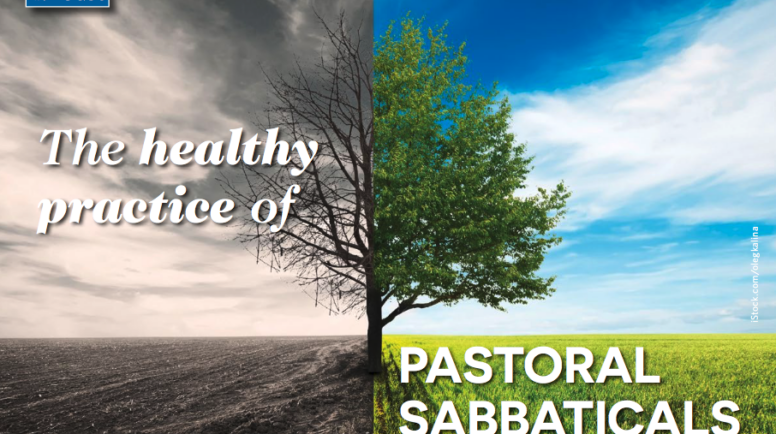
 A sabbatical gives the pastor a way to continue in the same congregation while re-examining the work/life/soul balance. What if she can step away for a few weeks to rediscover the beauty of nature, the quality of personal relationships, the knowledge-expanding experience of travel? What if he can observe his own need for rest, paying attention to physical, mental and spiritual renewal? What if the pastor can rediscover and reclaim what drew her to this particular calling in the first place, just by stepping aside from it for a brief time?
Most pastors who have taken sabbaticals find that they return to their churches physically refreshed and spiritually renewed in ways that a normal vacation cannot provide. Open-ended time to read, study, create, pray and reconnect with others, self and God provide the opportunity for a reawakening of the soul and a rejuvenation of one’s call.
Sabbaticals and congregations
As you can see, there are many reasons why a sabbatical is good for a pastor. But is a sabbatical also good for the congregation? Are there reasons a congregation should consider a sabbatical for its own benefit? Actually, there are quite a few.
There are significant ways a congregation can benefit from the pastor’s sabbatical and experience its own renewal at the same time.
In Beth Garrod-Logsdon’s discussions with the session about the possibility of sabbatical, she made it clear that she hoped they would find ways to join her in the exploration of sabbath rest and the gift of time. The more they heard her talk about her personal need for renewal and also about the types of practices they might pursue in order to experience renewal, their enthusiasm grew.
Planning a sabbatical
Goals for and the structure of a sabbatical will vary for every pastor and every congregation, but they should start with a baseline understanding that this is a time for renewal – rebalancing the spiritual, physical and other aspects of our individual and corporate selves.
If a pastor and session considering a sabbatical begin with the idea of sharing together in renewal, more creative situations will likely result. Certainly the pastor will have already started a list of elements expected to bring personal renewal in this time. That list should probably include:
- Spiritual retreat;
- Attention to physical health (exercise, good nutrition, an annual physical examination);
- Rest;
- Creativity;
- Study;
- New experiences;
- Travel as a way to expand one’s horizons, both literally and metaphorically;
- Concern for rejuvenating significant relationships;
- Renewal of one’s sense of call.
What elements might be a part of a congregation’s sabbatical experience? Here are some possibilities:
- Spiritual renewal;
- Emphasis on physical, emotional and mental health;
- Receptivity to exploring the theological and spiritual aspects of time, renewal and sabbath rest;
- Creativity;
- Study;
- New experiences;
- Interest in mirroring, as far as possible, some of the themes of the pastor’s sabbatical;
- Openness to a temporary leader (or more than one in rotation), who may offer new perspectives in worship and preaching, and who may help the congregation in the pursuit of renewal;
- Encouragement of new vitality in relationships;
- Determination to renew the congregation’s sense of call.
Too often, congregations expect the pastor to focus on a tangible outcome during the sabbatical (and the pastor also often expects this of herself). The measurable results they envision sometimes include things like a set of sermons or book manuscript, a new design for Sunday worship, a reorganization chart of the church’s staff or committees or a plan for a new contemplative worship service. While these are admirable goals (and possibly subjects for ongoing renewal that may begin to ferment during the extra time for study and reflection), a finished product is not an appropriate aim for sabbaticals. This is the time for letting go of having to produce, and for considering how the Spirit leads.
You may wonder, who will pay for all this time off? Not only does the pastor’s salary need to continue, but what about staff to fill in, activities for the congregation and expenses for the pastor’s spiritual retreats and travel?
There are granting organizations whose purpose is to encourage pastoral sabbaticals. Chief among them is the Lilly Endowment at Christian Theological Seminary. This endowment awards grants of up to $50,000 each year for a limited number of congregations (the multipage application is on the website). As much as $15,000 of that amount can be designated for fill-in staff and congregational programming; the rest of the grant is for the pastor’s expenses (along with family, if applicable).
Our own Presbyterian Church (U.S.A.) Board of Pensions has a sabbatical grant program for smaller churches that provides up to $3,000 for a pastor’s expenses.
Another option is the sabbatical-on-a-budget plan. If grant applications are not successful, there are ways to make things happen less expensively. The pastor may use continuing education funds. The congregation may offer an opportunity for donations. A special fund may be set aside by the session.
One excellent way to support the sabbatical concept in your congregation is to adopt a sabbatical policy. A policy sets goals and expectations, and can be seen as a valuable added incentive when a congregation is recruiting a new pastor or wants to retain the current one with an incentive. Sample clergy sabbatical policies are available from many presbyteries or can be found with a simple Google search.
Even if there is no extra money in a congregation, creative cost-free solutions can help the church grant the pastor the gift of time and renewal.
After the successful sabbatical is over, congregants and pastor will have much to share with each other as they renew their call together. “Here is what we did. Here is what we learned. Here is how we were changed.”
Expressing faith through sabbatical
So, where is Beth Garrod-Logsdon on the road to a possible sabbatical, and where is the congregation of Wilmore Presbyterian? Luckily, they are all in the same place. No one in the congregation has expressed a negative opinion about the concept, and the session has enthusiastically supported pursuing a sabbatical that will involve not only the pastor and her family, but also the whole congregation. Together they have chosen a theme: Expressions of faith.
 Garrod-Logsdon is finishing up her application for a grant from the Lilly Endowment at Christian Theological Seminary. If approved, she will spend both the first and last weeks of her 13-week sabbatical in spiritual retreat. This practice, she believes, will bookend all of her experiences with an emphasis on spiritual renewal. The rest of her time she will divide equally between travel and home. During the travel period she plans to spend a week with her sister, and two weeks traveling with her husband and children. The at-home time will involve reading and the creative acts of writing, painting and making stained glass.
The Wilmore session has approved a sabbatical planning team from the congregation that is composed of people diverse in age and congregational tenure. This team is still working on how the congregation will experience sabbatical. One option they are considering is reading one of the books the pastor will be reading and discussing it together when she returns. They expect to hire a part-time supply pastor who will lead them in worship around the chosen sabbatical theme of expressions of faith.
And if they don’t receive the large grant? They are determined a lack of funds won’t stop their overall vision, even though the details of the plan will be altered by financial necessity. They will apply for the Board of Pensions grant. The pastor will travel less and closer to home. They will continue to pursue renewal.
Even though the pastor will be gone for 13 weeks, grant or no grant, she and the entire congregation are already looking forward to the time when all of them expect to experience some time apart, dedicated to self-renewal and profound explorations of the gifts of time and creativity.
This is what sabbatical looks like when pastor, session and congregation are all in tune with its goals and benefits. This is precisely how it can contribute to your congregation’s overall health.
 Melissa Bane Sevier is a writer, photographer, and PC(USA) minister who lives in Versailles, Kentucky. She is the author of the 2017-18 Presbyterian Women Horizons Bible Study, and also authored “Journeying Toward Renewal: A Spiritual Companion for Pastoral Sabbaticals.”