BALTIMORE – What does it mean to be a church that finds life in the wilderness – that follows God into the unknown and discovers, “right here, where desert blooms might be sprouting,” as a worship leader put it.
The NEXT Church national gathering is being held Feb. 26-28 at a hotel in downtown Baltimore, built around the theme “The Desert in Bloom: Living, Dying, and Rising in a Wilderness Church.”

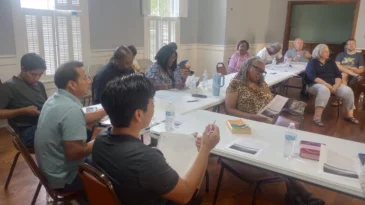
About 675 people are attending – about half of them pastors, about a quarter are serving in other contexts (including in mid council work and chaplaincy, for example) and about another quarter are ruling elders or church leaders. And about 40 percent are attending a NEXT Church conference for the first time, said Jessica Tate, NEXT Church’s director.
What is NEXT?
During an introductory session Feb. 26 for those who had not been to a previous NEXT Church conference, Adam Fronczek, a pastor from Cincinnati who is one of the conference co-chairs, gave a little history, saying NEXT got started some years ago when a small group of pastors got together at a General Assembly and said “we need to be having a real conversation about what the next church looks like – probably it looks a lot different” than things do now.
They talked about declining membership in the Presbyterian Church (U.S.A.), and about how to move past political divisions in the denomination to talk about the challenges and joys of ministry. And “they wanted to talk about creativity,” Fronczek said.
During opening worship, Tate said the presenters are all good at their craft, but not all will be “obviously and immediately relevant for your context.”
Lori Raible, a minister from Charlotte, North Carolina and another conference co-chair, encouraged the first-time attenders to think of the conference presentations as similar to eating at a cafeteria. “You’re not going to like everything you see and hear,” Raible said. “Be prepared for some things not to resonate with you,” and for others to energize and inspire.
Shavon Starling-Louis, a pastor from Rhode Island and the third co-chair, said, “I always leave this space energized” and exhausted, with ideas “to plant seeds I can sprinkle through the year.”
Worship: Prayer in the wilderness
“What does this wilderness text really mean for those who are in this room?” Billy Honor, pastor of Pulse Church in Atlanta, started his sermon with this question after reading Isaiah 35, the text all preachers at this gathering will use.

Honor opened with the story of a beloved toy truck from his childhood that didn’t work – because it didn’t have batteries, it didn’t have the power. “Some things just don’t work like they’re supposed to when they don’t have the power,” he said.
For communities of faith to work like they are supposed to work, “how does the church get the batteries of the Holy Ghost?” he asked.
In Isaiah, the land of desolation – a land that looks like it isn’t working – begins to speak and becomes a prophetic voice, he reminded those gathered. But, “the prophet speaks words of hope.”
“There’s the promise of what the church should be, and then there’s the reality of what we experience everyday,” he said noting that sometimes the church looks so much like Jesus “you can’t believe it’s made of humans,” and sometimes the church looks so much like humans, it’s hard to believe Jesus is in there.
He said that the important question is this: How is the church changing? Not this: How is the church dying? He continued, “The gospel is spread through compelling, not through conquering.” People are not best introduced to the gospel “by you forcing it upon them.”
 But, “we don’t have to do it on our own,” he said, stressing that what makes the church different from a social club or a political action is that the church is accompanied by the Spirit of God. “You need to pray” and ask God to “put some super on my natural,” he said. Because “we can’t do the work” and follow the calling of the church “by ourselves. … We need the Spirit of God in church, in session meetings … to come in such a way that It inspires you to be better than you’d be on your own, to be more courageous than you’d be on your own.”
Jesus said to save your life you have to lose your life, Honor said, and “you save the church by sharing the church.”
Church should be as good as ice cream that tastes so good it has to be shared, Honor said, following by enthusiastically exclaiming: “You get a lick! And you get a lick! And you get a lick!” Honor concluded saying: That’s Scripture – taste and see that the Lord is good.
Reporting by Leslie Scanlon and Jana Blazek; photos by Jodi Craiglow.