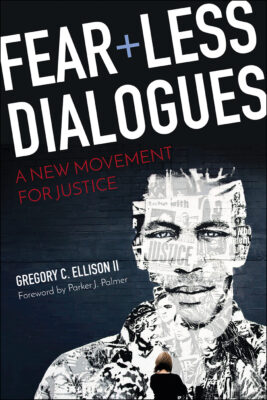
 Gregory C. Ellison II
Westminster John Knox Press, 160 pages
Reviewed by Angela Williams
“Baby, I don’t know how to change the world, but I can change the three feet around me.” These words from Gregory Ellison’s Aunt Dotty inspire the root of a new movement for justice: “Fearless Dialogues.” Weaving poetry, prose and theory, Ellison introduces a powerful new approach to having difficult conversations with people from all walks of life. Such a “fearless dialogue” does not mean a conversation without fear. Instead fear + less is defined as a compound word that names the fears that come with having difficult dialogues in hopes of lessening the impact of those fears. Approaching unlikely partners from this place of humility creates space for radical relational change.
More intriguing than a basic facilitator’s guide, this book invites the reader to join the dialogue and creates a full-body experience with each turn of the page. This blend of art and science seeks to overcome the fears of the unknown, of strangers, of appearing ignorant and of oppressive systems that typically hinder meaningful conversations. It “creates unique spaces for unlikely partners to engage in hard heartfelt conversations that see gifts in others, hear value in stories, and work for change and positive transformation in self and other.”
Ellison draws on the wisdom of spiritual giants like Barbara Brown Taylor, Parker Palmer, Howard Thurman, William James and Henri Nouwen in the same pen stroke as he offers lessons from lesser known teachers like Grandma Ellison, Granma Simpson and an unnamed subway professor. This juxtaposition is a pattern throughout the book as Ellison reflects on his time in Atlanta public schools, as well as in the lecture halls of an ivy-green campus. He models radical hospitality in the theories he shares and in the stories he tells from a place of intense vulnerability. The self-proclaimed scholar, minister and activist shares his journey within to discover vocations of mystic, artist and interrupter. In these pages, he asks the reader to be an active participant in a fearless dialogue with the self, to ask the five hard questions in the style of a Quaker circle of trust:
- Who am I?
- Why am I here?
- What is my gift?
- How does it feel to be a problem?
- What must I do to die a good death?
Reading this book was an eye-opening exploration into a new way of building relationships. In a time when every news story pushes us farther and farther apart from each other, we need a new relational model to re-humanize our unlikely conversation partners. We need practices that help us to transcend our fears and allow us to cross socially-constructed lines to grow ever wider our circles of comfort. Offering radical hospitality to our unlikely dialogue partners brings each of us into the other’s three feet of changeable space. I challenge you to finish this book and not feel compelled to invite Ellison to animate fearless dialogues in your context.
 Angela Williams is a second year dual degree student pursuing a Master of Divinity from Austin Presbyterian Theological Seminary and a Master of Science in Social Work from the University of Texas at Austin.