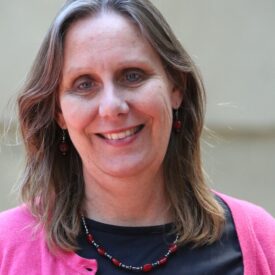
J. Herbert Nelson, stated clerk of the Presbyterian Church (U.S.A.), is hoping to find ways to help Presbyterians better understand the denomination’s per capita funding system — including questions of “what do you buy with your per capita?”
Nelson helped to lead a national webinar June 7 during which mid council leaders and Presbyterians from local congregations could ask questions — including about a proposalcoming to the 2018 General Assembly to raise the General Assembly per capita level by 10 percent in both 2019 and 2020 (from $7.73 per member in 2018 to $8.50 in 2019 and $9.35 in 2020).
During the webinar, Nelson also discussed the public witness that will take place at the assembly in St. Louis — including a march through the streets June 19 to deliver donations (collected during a General Assembly worship service) from Presbyterians that he hopes will allow at least 50 to 60 people accused of nonviolent offenses to be bailed out of jail, released from what he describes as a modern-day “debtors’ prison.” Nelson said the response so far to this plan has been powerful — with some congregations collecting money and asking where they can send it, and Presbyterians planning to travel to St. Louis specifically to take part.
“I am overjoyed at the level of excitement that people are bringing to this,” he said.
People want “some kind of liberation from all of the madness we have spiraled into,” which too often leads to violence. “Because none of us are safe going to a movie theatre. Our children are not safe at school. We have pastors who have never done this before, but say ‘I’m bringing my $30,’ ” and who want to march.
Nelson also said the church does not have a permit for the march, and “this has created some tension.”
But that’s about “not walking in and always being in charge,” he said. The PC(USA) is working with activists from the St. Louis area who’ve been involved in public demonstrations for many months, and who say “they don’t deal with permits because quite frankly they don’t believe they have to,” Nelson said. “The whole struggle is over the streets,” partly in response to police violence. “The streets don’t belong to the police,” he said, so the local activists don’t seek official permits.
The police will be present at the June 19 march, but as long as there is no violence, “I don’t see them creating a problem for the Presbyterian Church (U.S.A.),” Nelson said.
Individual Presbyterians at the assembly can decide whether they want to march, and there will be training and education about this kind of public action, he said. The intent is to “train people to go back home and employ these same type of tactics if necessary, nonviolent peaceful demonstrations” to work for transforming the culture. “It’s a learning lab.”
Here’s more of the webinar conversation about per capita.
The recommendation. The per capita recommendation Nelson now is bringing is a reduction from an earlier proposal that the Committee on the Office of the General Assembly and the Presbyterian Mission Agency Board floated to the church: for a 39 percent increase in 2019, to $10.71 per member, and a 7 percent increase in 2020, to $11.45 per member.
Because of deadlines for submitting recommendations, that initial proposal is still the formal per capita recommendation coming to the assembly; it’s too late to change it now. But Nelson has publicly announced his intention to scale that request back, as the original plan ran into considerable opposition from mid council leaders.
During the webinar, one solo pastor told Nelson that the churches she has served “do not see any benefit of paying per capita every year. They do it,” but question why.
Tricia Dykers Koenig, associate director for Mid Council Relations, said the Office of the General Assembly has “crunched the numbers,” and believes it can operate with a lower per capita increase, although that will mean depleting reserves. For more information, she pointed participants to the revised per capita narrative budget of $15.5 million for 2019.
Costs. Nelson said he wants to help Presbyterians understand more about how capita is used — and that some of the per capita funds that the Office of the General Assembly (OGA) collects get passed through to the Presbyterian Mission Agency (PMA).
OGA, for example, pays rent for the space it uses in the denomination’s national office building in downtown Louisville, Kentucky, Nelson said. The PC(USA), A Corporation, owns the building, and the Presbyterian Mission Agency Board currently controls the A Corporation. The narrative budget lists $1.9 million in per capita fees (amounting to $1.32 of the per capita rate) that OGA would remit to PMA in 2019 for shared services such as human resources and finance and accounting.
Other funds – about $1.7 million – go to PMA for administration of mission. The narrative budget states: “New for 2019–2020:Based upon agreements between OGA and PMA, PMA receives roughly 14% of Per Capita income; as Per Capita income increases, so does PMA’s actual dollar amount.”
Other per capita funds are used for OGA expenses, including $1.5 million for General Assembly operations; $417,000 for permanent and special committees; $1.8 million for the Presbyterian Historical Society; nearly $1.3 million for ecumenical work; more than $1.2 million to support ordered ministry and certification; $300,000 for constitutional interpretation; $435,000 for mid council relations; $123,600 for the Office of the Moderator; and $868,000 for the Office of the Stated Clerk.
Nelson said several measures are coming to this assembly regarding the denomination’s funding system, including an overture from the Presbytery of Newton asking the assembly to create a team to review the current per capita funding system and its financial sustainability.
Vision. Nelson also is trying to articulate his vision for the kind of church he wants the PC(USA) to become: a vision in which congregations become “hubs for organizing” on issues important to their communities, including improving education and making sure people have access to health care. He speaks of generational differences in religious identity, and the need for the PC(USA) to be a “teaching church” educating people about the Reformed tradition.
Nelson said the 2018 assembly will have a focus on racism and systemic injustice – starting with a pre-assembly presentation by Liz Theoharis, one of this year’s Women of Faith award winners and co-chair of the Poor Peoples Campaign: A National Call for Moral Revival. During opening worship, the co-moderators of the 2016 General Assembly, Denise Anderson and Jan Edmiston, will preach on a faithful response to issues of poverty, racism and injustice, he said.
It’s the offering collected at that worship service that will be used to bail out people who are incarcerated for minor offenses but who sit in jail because they don’t have money to pay their fines.
Nelson said of the June 19 public march: “This is about faith. That’s what we’re going to have to learn all over again – how are you going to go out in faith? And we’re going to do it with one book – that book is the Bible. … Do it on faith, and do it because Jesus asked us to.”