 F. Russell Mitman
Eerdmans, 192 pages
Reviewed by Sharon K. Youngs
Russell Mitman poses the question himself: Why another book on preaching? His answer, in short: “to rescue ‘preaching’ from the narrows of ‘sermonizing.’”
In his latest book, Mitman, who has served as a United Church of Christ parish pastor and conference minister, builds on his initial work from 17 years earlier in “Worship in the Shape of Scripture.” There, he asserted that liturgics and homiletics are “married arts.” Here, he maintains that preaching the Word of God happens within and throughout an entire worship service, which leads him to write as much about liturgy as he does preaching. In fact, Mitman argues that lifting a sermon out of the context of corporate worship “begs the question as to whether it really should be called a ‘sermon’ at all.”
Central to Mitman’s approach is the grammatical difference between adjectives and adverbs. Adjectives modify nouns, while adverbs modify verbs, adjectives and other adverbs. That distinction leads Mitman to contend that, for example, “biblical preaching” describes a thing – a style of preaching – while the art of “preaching biblically” focuses on “the action of doing the preaching and what happens in the doing.”
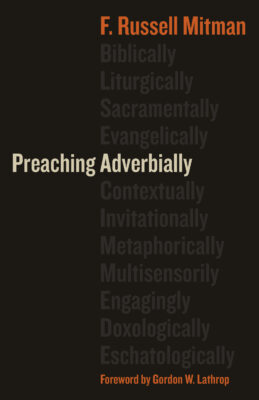
Mitman associates 11 adverbs with preaching, beginning with biblically (letting Scripture shape preaching, rather than vice versa), and moving to liturgically (“the whole liturgy preaches”), sacramentally (Christ is as present in preaching as a means of grace as Christ is present in the sacraments), evangelically (to “gospel” – as a verb – through Scripture what God is doing in the present), contextually (“in the context of an assembly who live and move and have their being in a particular time and place”), invitationally (demonstrating “outrageous gospel hospitality”), metaphorically (“inviting the assembly into experiencing multiple levels of meaning”), multisensorily (worship that incorporates all five senses), engagingly (seeing the sermon within the whole of the liturgy), doxologically (“proclaiming the good news liturgically and homiletically”) and eschatologically (“allowing God to finish the sermon and leaving it up to God to add an ‘amen,’ if and when God so decides”).
Mitman includes a select bibliography of resources that have informed his understanding of integrating homiletics and liturgics in a holistic way. Some of the resources are no longer in print; others are more recent.
Along the way, Mitman describes what he refers to as “by the ways” that he includes in his own sermons — “verbal sidebars” intended to offer “brief educational moments, short humorous or ironic interjections and even some one-sentence personal commentaries.” He goes on to caution that such sidebars not “become sidetracks that lead the assembly off the main trajectory of the homiletical event.”
An argument could be made that Mitman has included several “by the ways” in his book – lengthy excerpts from the works of other theologians and preachers, extensive sections of liturgy, parts of his own sermons and personal anecdotes and opinions – that some readers, at times, might consider as moving beyond sidebars and into sidetracks from the main trajectory of his thesis. In addition, his extensive use of adverbs has the potential to wear on some readers before they reach the end of the book’s 11 chapters.
Be that as it may, Mitman offers excellent reminders of the importance of crafting liturgy, writing and delivering sermons, and leading worship — thoughtfully, prayerfully, holistically and, yes, adverbially.
Sharon K. Youngs is pastor of First Presbyterian Church in Oak Ridge, Tennessee.