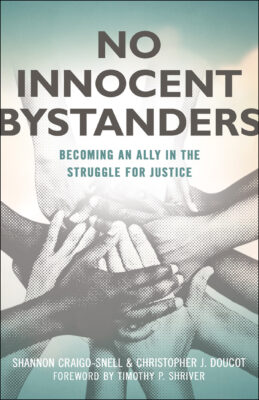
 Shannon Craigo-Snell and Christopher J. Doucot
Westminster John Knox Press, 144 pages
Reviewed by Angela Williams
“No Innocent Bystanders” by Shannon Craigo-Snell and Christopher J. Doucot is a wonderfully practical primer written by, to and for white Christians seeking to become allies in the struggle for racial justice. Tracing the similarities and differences between the struggles for LGBTQ equality and racial justice, the book explores how to be an ally from historical, theological and practical perspectives.
Craigo-Snell and Doucot give an excellent crash course in the history of the LGBTQ equality movement in the U.S. and how the presence of straight allies helped that movement create change so quickly. After laying out some facts in the history of racism, the authors identify issues of welcome, relationship and classism that white would-be allies must address to start antiracism work. This framing adequately addresses the need for the work to be intersectional and for allies to address their feelings of white guilt and white fragility. White guilt is the feeling that overwhelms some white people when they become aware of unearned benefits they receive due to the color of their skin. White fragility occurs when white people feel that it is more emotionally difficult for them to learn about racism than it is for people of color to experience racism. In order to combat the phenomena of white guilt and white fragility, the book offers a theological reframing away from an innocence-guilt paradigm toward one of grace and sin.
Innocence and guilt emphasize individual actions rather than long-term character development and the development of systems of oppression. Meanwhile, doctrines of grace and sin acknowledge the systemic and communal aspects of racism and Christians’ called response to it. Later, Craigo-Snell and Doucot use Christian virtues of faith, hope, love, humility, prudence, fortitude, temperance and patience as guiding principles for allies to act within the struggle.
While the book focuses on anti-black racism from an exclusively Christian perspective, its practical examples show how white Christian allies show up in justice movements with Muslim, LGBTQ, immigrant, Native as well as black communities in the U.S. and the United Kingdom. Its narrow scope could definitely be expanded, but then it may lose the accessibility of a book that is under 150 pages.
The discussion questions in each chapter and an exercise assessing readers’ abilities, assets and access make this an excellent study resource for a small group or book club to work through together. The concrete examples meet people where they are. Readers can travel across the country to stand in the streets with people or make sandwiches for their local Black Lives Matter chapter. Readers who may be recently aware of the structural oppression in the U.S. will benefit from the thorough historical accounts, theological grounding and practical action steps offered to the white Christian community. White Christian allies who are already doing antiracism work and participating in the struggle for racial justice may want to find a more challenging text. However, this concise history is a good reminder of how we got to where we are. Overall, this book is a gift to white Christians today due to its readability, practicality, succinct history and grounded theology.
 Angela Williams is a student at Austin Presbyterian Theological Seminary.