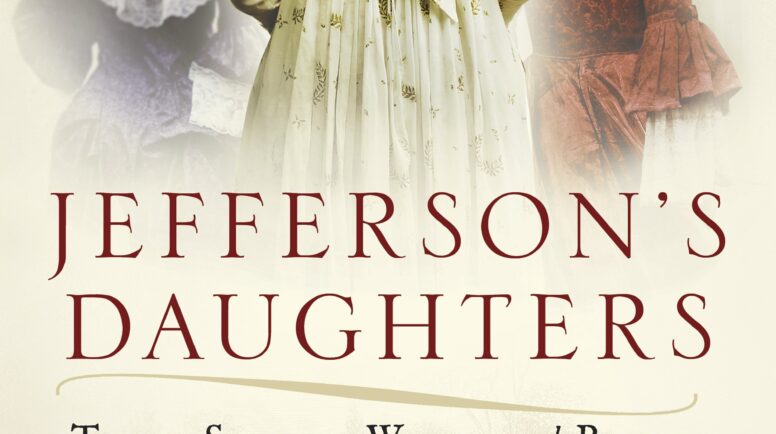
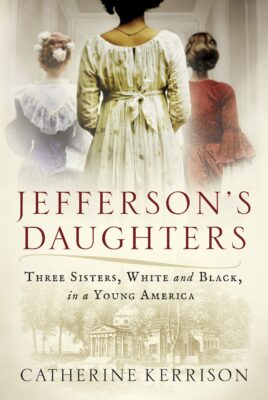
 Catherine Kerrison
Ballantine Books, 448 pages
Reviewed by Melissa Kirkpatrick
The years of the Revolution and the Early Republic, full of tumult and contradictions as they are, provide the setting for another story — one of extended and interwoven families, a society in the midst of change and three sisters. Read this book, get a refresher course in the public events of the period and let your mind experience the sights, sounds and even smells of the streets of Paris and Washington, as well as Virginia. Learn of the difficulties and ironies of life as the daughters of one of the most prominent of the country’s founders.
Jefferson was a brilliant man, but his vision, limited by his times, did not extend to the gifts and potential of women or people of color. Educated in Virginia and in Paris in the style of the elite, his daughters from his marriage to Martha Wayles were bright and capable. This was a period that saw the publication of Mary Wollstonecraft’s “A Vindication of the Rights of Women” and a full conversation on both sides of the Atlantic about women’s economic and educational opportunities. Yet, their father had no expectation that a fine education would fit them for anything but the traditional life of planter’s wives. Their relationships with their often-absent father were very different. Martha Jefferson, as a young girl, had tried to comfort her father in his deep grief after the death of his beloved wife. She remained close to him throughout her life. Maria, determined to make her own way, was less concerned about conforming to Jefferson’s opinions. The story of the daughters’ marriages and families, their experiences of managing plantations and their lives as children of a public figure are well told.
Harriet’s story is of a different order entirely. Her family, enslaved by the Wayles family, had been bequeathed to the Jeffersons. Martha had known them from her infancy. Harriet’s mother, Sally Hemings, in fact, was the youngest child of John Wayles, Martha’s own grandfather. Sally had been in France with Jefferson and his daughters; her choice to return to Virginia and her family, rather than press for her freedom in France, set the course of her life. Sally had extracted a firm promise from Jefferson that their children – Beverley, Harriet, Madison and Eston – would be freed, and they were, though without official papers of manumission. Without those papers, they would have been considered runaway slaves, until the passage of the 13th amendment. At the age of 21, Harriet left Virginia. Equipped with her father’s funds and mother’s training, she successfully passed for white and disappeared into Washington City. Catherine Kerrison’s account of her intense search for some clue about the rest of Harriett’s life shows us how difficult it is to discover what life might have been like for those who were not wealthy, well-connected and white.
Especially considering the complex story of these three sisters, white and black, a remark by Lonnie Bunch, director of the National Museum of African American History and Culture, seems particularly apt: “The African-American experience is the lens through which we understand what it is to be an American.” To write histories, we can learn much from personal papers, diaries, letters, legal documents business and farm records. But these must be tied together into a narrative that offers us something more. This book beautifully reflects the best of the historian’s craft.
Melissa Kirkpatrick is director of education ministries at Manassas Presbyterian Church in Virginia and is a member of the Company of Teachers of the Reformed Institute of Metropolitan Washington.