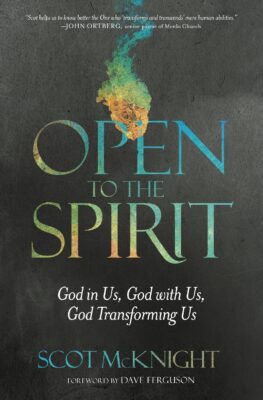
 Scot McKnight
WaterBrook Press, 240 pages
Reviewed by Gordon Lindsey
In his letter to the Galatians, Paul asks the Galatian believers: How did you receive the Spirit? By works of the law or by hearing with faith?
I suspect that if Paul were to address that same question in many congregations today, people would scratch their heads and say, “Paul, whatever in the world are you talking about?”
Unless we attend a Pentecostal church, many Christians today find the Holy Spirit a strange, confusing element of the Christian life. Talk about the Spirit can even make them downright nervous. Doesn’t the Spirit cause all those bizarre things charismatics do? Better to keep the Spirit safely remote as just an article in the creed.
For Scot McKnight, this attitude is to deny Christians the vitality and transforming power of the Holy Spirit. He writes: “If we are given spirit at creation or birth, it is God’s Spirit who animates us with transformed, eternal life.” He sees Jesus as a charismatic or pneumatic person. And so can we be.
The key for McKnight is openness to the Spirit. Drawing upon his work as a professor of New Testament at Northern Seminary and his life experience, his book offers a deep discussion of the many ways we can become open to the Spirit. He writes, for example, chapters on how in opening ourselves to the Spirit, we open ourselves to a new self, new power, a new orientation of life and to the life of love in community.
In so doing, he shows his respect for such typical Pentecostal practices like speaking in tongues and prophecy, but he makes a point that such Spirit phenomena are not for self-aggrandizement, but for building up the church community. Fundamentally, “a Spirit-prompted Christian life is about learning to live in fellowship with other Spirit-prompted people.”
McKnight’s book will be a useful resource to a pastor or a Christian educator who wishes to stimulate some active discussion about the Spirit in a church school class or small study group. The book richly opens up scriptural references to the Spirit, but it does so avoiding a dull, academic tone. Readers with a limited theological background should find it very accessible. Many may also find it motivating to explore further dimensions of life in the Spirit. It did for me.
I have only two criticisms. McKnight is convinced that if we open to the Spirit, we will indeed experience the power of the Spirit in our lives. He recognizes that the Spirit blows where the Spirit blows, but his confidence can easily slide into breeding a sense of guilt if one is not experiencing life in the Spirit just as he describes it. And second, McKnight focuses so exclusively on the work of the Spirit in the Christian life and church that I want to hear him talk as well about how the Spirit may be at work in the wider world, including if and how in other religions. That is a dimension of the scriptural testimony he does not deal with. It seems to me, however, that is an important issue for Christians to be discussing in our interreligious world.
Neither of these cautions, however, should diminish the value of this book in opening up life in the Holy Spirit for believers today.
Gordon Lindsey is a retired Presbyterian minister living in Charlottesville, Virginia, where he is engaged in an active ministry of teaching and supply preaching.