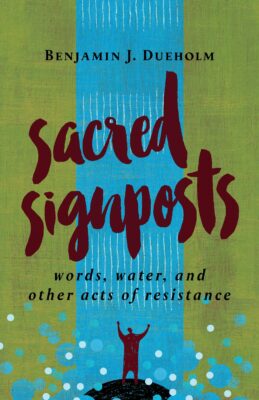
 Benjamin J. Dueholm
Eerdmans, 176 pages
Reviewed by Gordon Lindsey
When we review the ways Christians have expressed their faith, we face a puzzle. Theologies vary. So do ethical systems. Worship styles come and go. So what gives the Christian movement its continuity from generation to generation, from culture to culture? It is the enduring practices of Christianity, contends Benjamin Dueholm in his new book “Spiritual Signposts.”
“If nothing else, a religion is what it does,” says Dueholm, a Lutheran pastor. “We take hold of religious practices, and they take hold of us.” And so he devotes his book to discussing the “central, sacred, vexing practices of Christianity, the ‘holy possessions’ by which Christians receive and enact their faith.” For Dueholm, those seven holy possessions include the Word of God, baptism, Eucharist and the cross. His book reflects on each in a separate chapter.
I found these chapters thought provoking in ways I did not expect. In each case, I came to the chapter with my own settled ideas gained from my own theological training and reading. But I found Dueholm leading me down avenues I had not explored before.
I came to his chapter on baptism with my usual ideas about baptism as washing from sin, as a re-clothing with Christ, as a spiritual experience of death and resurrection. But Dueholm talks about baptism as a way of drawing boundaries. In baptism, Christians define who’s in and who’s out within the Christian circle. Yet that boundary always remains porous. Concludes Dueholm, “Hence the final, irresolvable paradox of baptism: it defines a community whose boundary is its practice of being unbounded. It defines a family, whose limit is its practice of transcending limits.”
Dueholm loves to play upon the paradoxes involved in all of the seven signposts. Those paradoxes resist any attempt on our part to reduce Christianity down to stark simplicity. Yet they do not require that we have a deep theological grasp to participate in them. Ordinary believers do all the time in their congregational gatherings.
His writing style parallels his thought. It is easy to read. It avoids technical, theological jargon. Yet it never sinks into simplistic babble. I found it a joy to read. In many cases he has a memorable way of expressing himself that begs to be quoted in sermons as, for example, when we writes: “God enters world history, in Exodus, as the God of slaves – the people who work by hand – and not the people who give orders.”
The paradoxes he describes and the quotable way he expresses them means working pastors may find the book a fruitful resource as they prepare sermons and reflect upon the paradoxes of their own ministry. Also I can see this book being used as a discussion resource in small study groups or Sunday school classes. Each chapter can stand alone as a discussion topic.
What will make it an especially fruitful discussion resource is exactly that paradoxical way Dueholm approaches these seven practices. Laypeople reading them may find themselves challenged at first. He may take them out of their customary mindsets. But that can provide the opportunity for a more in-depth discussion of practices they may have been practicing all their Christian lives.
GORDON LINDSEY is a retired Presbyterian minister living in Charlottesville, Virginia, where he is engaged in an active ministry of teaching and supply preaching.