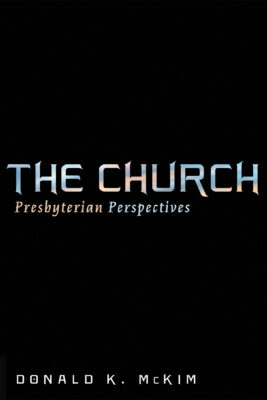
 Donald K. McKim
Cascade Books, 108 pages
For better or worse, part of the experience of Christianity in America has “assumed” church. In the age of Christendom, one could assume the reality of the church with relative ease. If the larger society and culture is assumed to be Christian, then the particular ethos, identity and activity of the Christian community are not all that noteworthy or special or unique. “Assuming” church has led us into some strange forms of self-understanding: thinking one can be a Christian without the church and thinking that the Christian project has more to do with Christianizing our society or our country than it does with the mission of the church.
As Christianity becomes more of an optional way of life in an increasingly secular and post-Christian society, the identity, purpose and significance of what we mean by “church” becomes increasingly necessary and important. In his book, “The Church: Presbyterian Perspectives,” Donald McKim offers a Reformed Presbyterian vision of what it means to be the Christian community and why such a community has an important contribution to make to the Christian witness in our world today. In a format accessible to church pastors, leaders and officers, or as a resource for an adult study group or even an ambitious confirmation class, McKim offers an introduction to a Presbyterian ecclesiology that is first and foremost a call to discipleship heard and acted upon in the particulars of Christian community. Second, he grounds the church’s existence as a creature of the Word, reformed and always reforming, not as the primary agent of reform but as the object and people with and through whom God does God’s reforming work. McKim then grounds his Reformed Presbyterian ecclesiology more broadly through the third articles of the Nicene and Apostles’ Creeds. The church is an appendage of Jesus Christ himself brought about in every age by the person and work of the Holy Spirit. The Spirit does not just enable the church to exist in a static fashion, but empowers the Christian community to exist to serve the particular part of the world in which it is located. McKim describes the church as catholic and as a communion of saints — as it embodies in our broken reality the unity that is ours in Jesus Christ and as the Holy Spirit presses us toward the goal to unite the communion of saints together as one body, warts and all. McKim concludes with a Trinitarian benediction and vision of the church whose faith is sustained by the providence of God, united to the living Christ and enlivened by the Holy Spirit.
This book is a great introductory resource for anyone interested in what it means to live as a disciple in Christian community and what it means to live as a Reformed Presbyterian church today. One wishes for more specifics and engagement in terms of the particular challenges and threats in our culture, nation and time. And additional examples, illustrations and suggestions of how this theological vision takes form daily in various ways and at various levels of the church’s existence would also be helpful. We can no longer assume the church. Again and again, we must be told whose we are, why we are here, and why it matters for the sake of the world. Donald McKim’s “Presbyterian Perspectives” helps to do just that.
 Chris Currie is pastor/head of staff at First Presbyterian Church in Shreveport, Louisiana.