 CHICAGO – On the final day of the Mid Council Leaders Gathering, top leaders of the Presbyterian Church (U.S.A.) offered a sense of vision; data on race and gender in the denomination; and, on World Communion Sunday, a sense of what God seeks in a divided time.
Presbyterian Mission Agency. Diane Givens Moffett, president and executive director of the Presbyterian Mission Agency, spoke first Oct. 7, thanking these presbytery and synod leaders for “being agents of healing. Thank you for your hands and feet that respond to disasters and floods and rain,” helping people in need all over the world. “Thank you for speaking up and speaking out” against racism and violence.
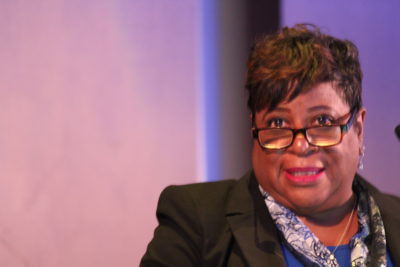
Moffett described mission as the way people of faith present Christ to the world, “love with skin on it.”
She called on Presbyterians to “put flesh and blood” on the 25thchapter of Matthew’s Gospel. “We want to be a church of action.”
That’s a challenge. “The political climate right now is at an all-time low,” Moffett said. “We’ve got to learn to deal with racism. … It’s a problem and it’s a sin.”
Frank Spencer, president of the Board of Pensions, presented new data on demographics, showing the PC(USA) was 90.6 percent white in 2017. About 100,000 Presbyterians identify as other than white, and 442 congregations self-identify as African American.
Presbyterians need to “look at the demographics of this denomination in a world that is filled with diversity,” Moffett said. “It says something about the water we’re swimming in.”
She also challenged the church to “tangible action” involving racism and white supremacy, poverty and making congregations vital. Responding to poverty is “not just giving food to people who are hungry. That’s the first step. It’s also asking why they are hungry,” and dismantling systems “that take away the hope of people.”
Board of Pensions. Spencer presented the most recent “Living by the Gospel” report — showing that the number of ordinations was up in 2017 and that more ministers and other church workers are receiving benefits from the Board of Pensions. Another finding: gender disparities persist in the church. Male ministers are paid more than women ministers across the board — as solo pastors, as senior pastors, at all levels and ages.
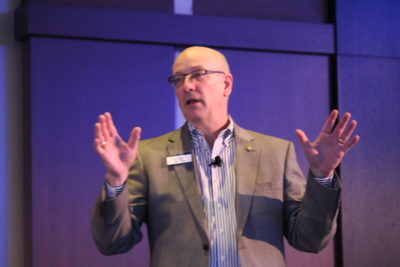
“This is a critical conversation for the church,” and a theological one, Spencer said. “Are we going to address the gender gap?”
He also challenged mid council leaders to understand the importance of making sure church workers have health and pension benefits. “Anyone heard of 19 and a half hours?” – he asked, of calls structured just under the level where benefits would be provided. In approving that, “you are robbing them. We are shamefully doing that collectively.”
Spencer said the 2018 General Assembly instructed the Board of Pensions to analyze and report on the viability of African-American Presbyterian churches and the challenges of supporting installed pastoral leadership for those congregations.
To not pay attention to black congregations “and the struggles they’re having is simply wrong,” Spencer said. “I’ll tell you straight up this is a hard one for the board to wrestle with. We have not ever collected data by race,” having a commitment that “we explicitly do not, cannot and will not underwrite health care by race, because there are indeed disparities.”
Spencer said the board is seeking partners in doing the work the assembly instructed it to do – trying to think creatively.
One initiative already in the works: offering a CREDO session specifically for African American clergy, in partnership with Johnson C. Smith Theological Seminary. Invitations will go out in late November or early December, with the event scheduled for late 2019.
“This is not intended to be a permanent separation” of blacks at CREDO, Spencer said. “But it is intentionally a gathering led by people from within the community so that we can learn and hear and address the issues with which your sisters and brothers are struggling with in this particular context, in this strange place of being an African-American pastoral leader in a predominantly white denomination.”
Office of the General Assembly. J. Herbert Nelson, stated clerk of the PC(USA), called on Presbyterians to do “real transformative work” with people in struggle.
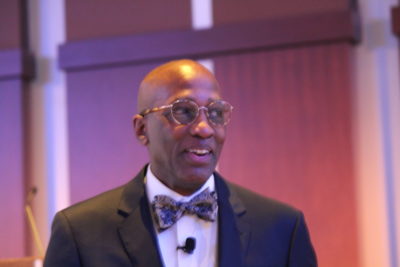
“We are not the big kahuna in the room anymore,” Nelson said. “We are not the ones who walk into the room and say ‘We’re going to do it this way.’ ” He called for engagement, for working for justice in relationship – as the assembly did in St. Louis in June, marching in the streets without a permit, because that’s the way local organizers had been doing it for months, raising the question “who owns the streets of St. Louis? Do the police own it or do the people own it?”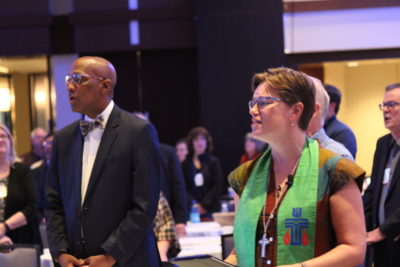
Without change, “we will die a slow death,” Nelson said. Many children and grandchildren of people in the church reject the faith. “They are asking questions and we are failing to give them answers that correlate with their current realities. We are still talking about the good old days.”
One area that needs attention, he said: relationships with immigrant fellowships, often given “a second-class citizenship” in the PC(USA).
“Segregation by any other name is segregation,” Nelson said. “Many of them are people of color. We can do better than that.”
Nelson said he believes the PC(USA) is capable of transformative work. “We can do it,” he said. “I know we can. I believe we can. But we have to always remind ourselves that the work we do is not for us. It is not for us. It belongs to the Lord,” who gives us “everything we need by grace.”
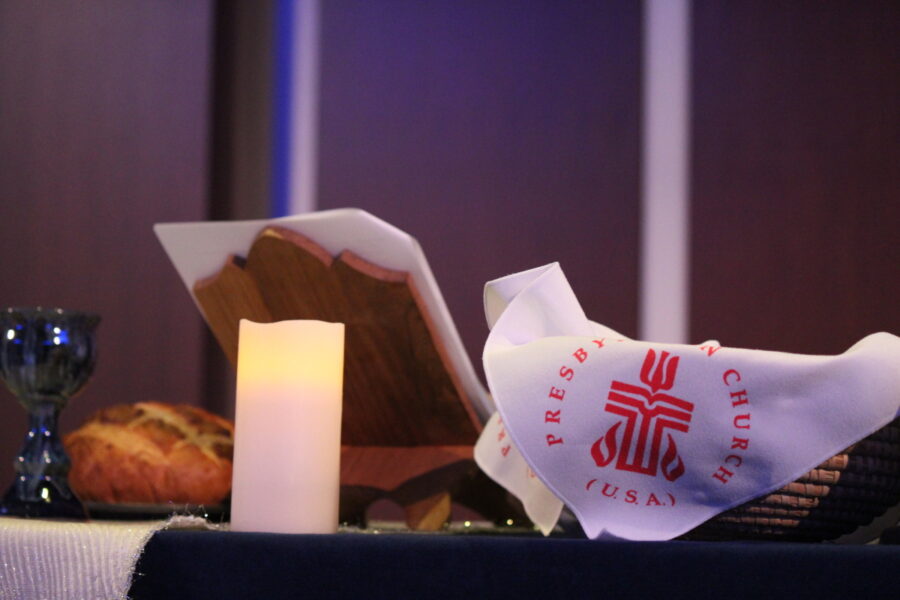
Worship with the co-moderator. Cindy Kohlmann, a presbytery executive who serves as co-moderator of the 2018 General Assembly, along with Vilmarie Cintrón-Olivieri, preached during closing worship, from the 58th chapter of Isaiah.
In this passage, “the nation is crumbling,” Kohlmann said. “Families are divided. There is a sense of exile. Those in power seek more power. Those with wealth seek more wealth. And the oppressed are crushed into the earth.”
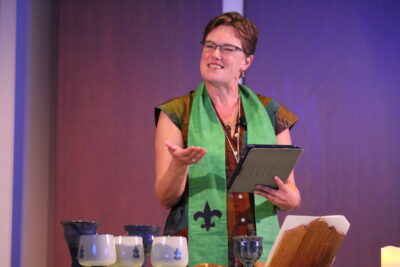
God sends the prophet Isaiah to speak about the fast that God chooses.
When God sends prophets, “they do not speak the comforting word,” she said. “They do not speak the easy word. They do not come up and say, ‘ All is well. Be at peace.’ ”
Prophets come in hard times prepared to speak truth to power, “to remind us whose we are, who has claimed us, and who we should be following. The prophets are called to disrupt what is happening, to call us to account and redirect us back to God.”
God is still calling prophets and prophetesses, because long after the Bible was written we are still human, we still fall short of the glory of God, she said. In today’s difficulties, “we, the religious leaders, we are complicit,” Kohlmann said. “The words of Isaiah are for us, as well as the powers that be.”
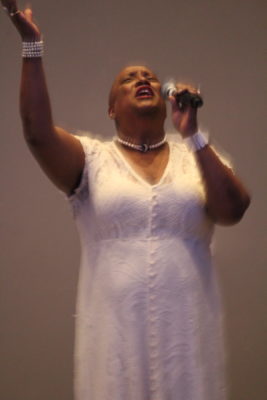
Fasting has a connotation of setting something aside in order to focus one’s faith – and doing so in recognition that fasting comes with “the privilege of being able to set something aside in solidarity with those who have no choice,” she said.
People of faith need to decide “what fast are you being invited to choose in the name of the Lord?”
Is it to bow down, collapse in grief and mourning, Kohlmann asked?
“The fast that turns inward? The fast that is mine alone? That fast that I have the privilege to choose? Let me tell you: what I choose is the Lord,” a Lord who says “I am already at work. I am already doing a new thing. … The fast that I choose is to loose those bonds of injustice,” to let the captives go free, to stand in solidary with neighbors, to listen to voices that have been silenced for years.
In that fast, “we believe women and we trust black women,” she said. That fast releases those long held captive because of sexual preference and gender identity and “we see you, we finally see you. It is good to finally see you as beloved children of God the way you are. Is that not the fast you choose?”
That fast will take Presbyterians away from “the fast of always knowing what’s right, of always being in control and in charge, of always being the ones in power,” Kohlmann said. It calls them to go beyond offering food pantries to figure out the systemic reasons why people don’t have access to food. It takes them to new places, following Jesus.
“It is time for us to join God in that work,” she said. “Jesus is already doing it. We’ve been too busy choosing the wrong fast. It’s time. … What fast is God calling you to choose?”